a Department of Kinesiology and Rehabilitation Science , University of Hawai'i at Mānoa , Honolulu , HI , USA.
b Department of Educational Psychology , University of Hawai'i at Mānoa , Honolulu , HI , USA.
Ethn Health. 2019 Aug;24(6):724-735. doi: 10.1080/13557858.2017.1346177. Epub 2017 Jul 5.
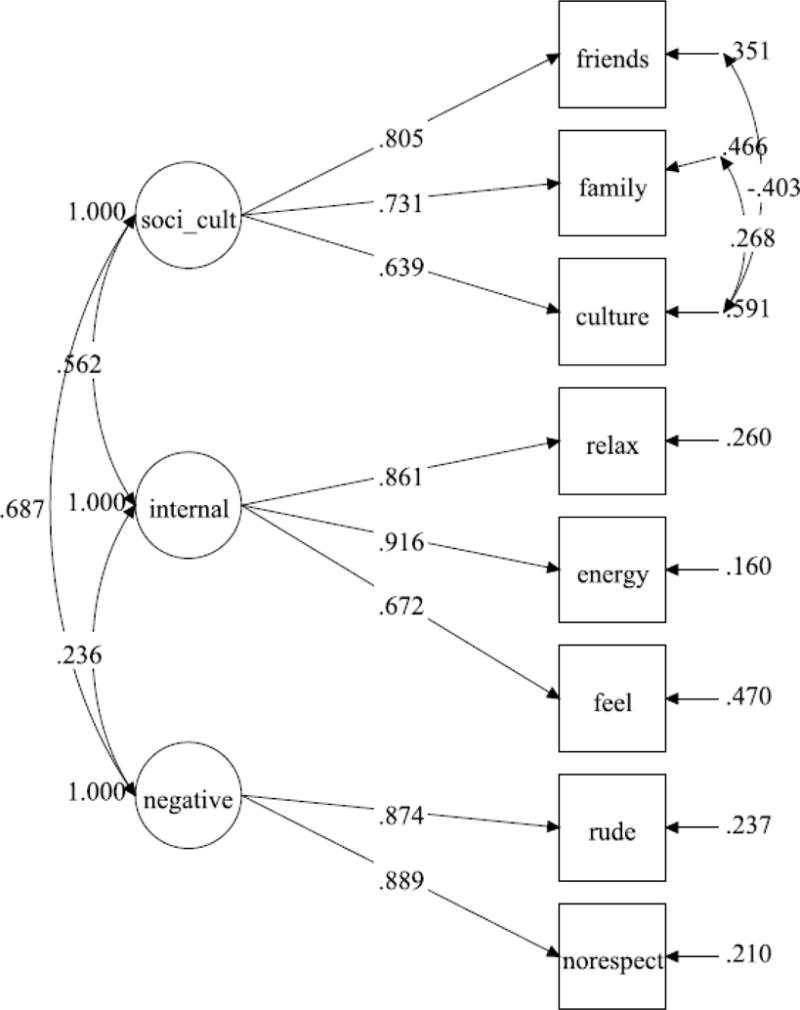
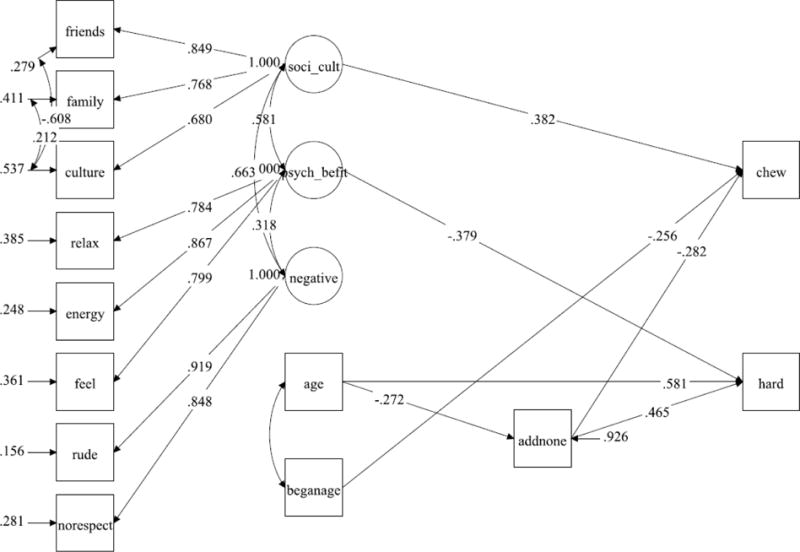
Betel nut chewing is embedded within the cultures of South Asia, and Southeast Asia, and the Western Pacific. The determinants of betel nut consumption are complex. Ongoing consumption of betel nut is affected by cultural, social, and drug-specific effects (i.e. dependence). This study's first objective was to assess the psychometric properties (i.e. reliability and validity) of the socio-cultural constructs in a survey developed for betel nut chewers. The study's second objective was to investigate the influence of socio-cultural variables on betel nut chewing behaviors among Chamorro and non-Chamorro Micronesians in Guam. The current study was a secondary analysis of a larger study ( = 600; = 375 chewers and = 225 former chewers) that examined socio-cultural factors that influence why chewers chew betel nut, along with assessing chewing behaviors, perceptions of risks, probability of changing behaviors, and methods that could be used to reduce use or quit. The socio-cultural constructs of the survey were analyzed using confirmatory factor analysis and structural equation modeling. The socio-cultural factors were a sufficient fit with data and the instrument is reliable and valid, as indicated by various model fit indices ( (13) = 18.49 with = .14, TLI = .99, CFI = 1.00, SRMR = .02, RMSEA = .03 with 90% CIs [.00,.07]). Cronbach's alpha, the sign and magnitude of the factor loadings, the inter-factor correlations, and the large proportion of variance extracted for each factor, all indicate that the instrument is reliable and valid. Additionally, multivariate analyses showed that socio-cultural reasons were important contributing or chewing betel nut. Participants cited chewing because their friends and family members chewed, the behavior is embedded within their culture, and it would be considered rude and disrespectful to not chew. Based on the findings, this study provides important implications pertaining to creating culturally appropriate cessation programs.
嚼槟榔的习惯存在于南亚、东南亚和西太平洋地区的文化中。嚼槟榔的决定因素是复杂的。持续嚼槟榔受到文化、社会和药物特定影响(即依赖)的影响。本研究的第一个目标是评估为嚼槟榔者开发的调查中社会文化结构的心理测量特性(即可靠性和有效性)。本研究的第二个目标是调查在关岛的查莫罗人和非查莫罗密克罗尼西亚人中,社会文化变量对嚼槟榔行为的影响。本研究是对一项更大研究的二次分析( = 600; = 375 名嚼槟榔者和 = 225 名前嚼槟榔者),该研究考察了影响嚼槟榔者嚼槟榔的社会文化因素,以及评估咀嚼行为、对风险的看法、改变行为的可能性以及可用于减少使用或戒烟的方法。使用验证性因子分析和结构方程模型对调查的社会文化结构进行了分析。社会文化因素与数据具有足够的拟合度,该工具可靠且有效,各种模型拟合指数( = 18.49, = 0.14,TLI = 0.99,CFI = 1.00,SRMR = 0.02,RMSEA = 0.03,90%CI [0.00, 0.07])表明了这一点。克朗巴赫的阿尔法、因子负荷的符号和大小、因子之间的相关性以及每个因子的大量方差提取都表明该工具是可靠和有效的。此外,多元分析表明,社会文化原因是咀嚼槟榔的重要原因。参与者表示咀嚼是因为他们的朋友和家人咀嚼,这种行为是他们文化的一部分,不咀嚼会被认为是粗鲁和不尊重的。根据研究结果,本研究提供了与创建文化上适当的戒烟计划有关的重要意义。