Supportive Care Center, Samsung Comprehensive Cancer Center, Seoul, Korea.
Department of Family Medicine, Samsung Medical Center, Sungkyunkwan University School of Medicine, Seoul, Korea.
Cancer Res Treat. 2018 Jul;50(3):681-690. doi: 10.4143/crt.2017.201. Epub 2017 Jul 4.
Older patient populations commonly have cognitive impairment, which might impact decisional capacity. We examined patients and family caregivers preferences for family involvement in treatment decision making assuming different level of cognitive impairment, and sought to explore the factors associated with the preferences and the degree to which patients and family members agree on preferences.
A total of 358 elderly cancer patient and caregiver dyads were recruited from the 11 cancer centers in Korea andwere asked to express their preferences forfamily involvement in treatment decision making using hypothetical scenarios with three different levels of cognitive status (intact, mild impairment, and severe impairment).
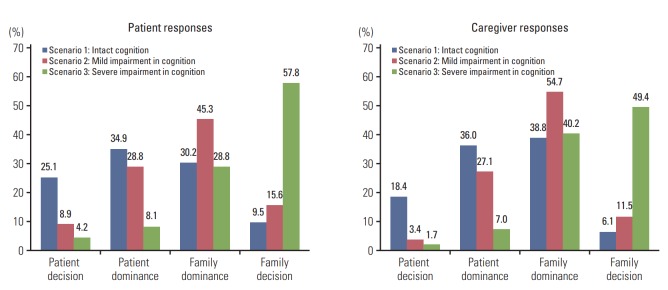
Both patients and family caregivers preferred greater family dominance in treatment decision makingwith the increasing the level of cognitive impairment (39.7%, 60.9%, and 86.6% for patients and 45.0%, 66.2%, and 89.7% for caregivers in each scenarios). Patient and family caregiver concordance in decisional control preference was small for all three scenarios (weighted κ=0.32, κ=0.26, and κ=0.36, respectively). Higher patient education was associated with preference for patient dominance in treatment decision in conditions of both mild and severe cognitive impairment. The association of higher patient education and patient-caregiver preference concordance was positive with intact cognition, while it was negative with severe cognitive impairment.
Decision control preferences were affected by hypothesized cognitive status of the patients. Findings from our study would be helpful to develop effective strategy for optimizing family involvement in cancer treatment decision in the context of deteriorating cognitive function of the patients.
老年患者群体通常存在认知障碍,这可能会影响其决策能力。我们考察了患者和家属在不同认知损伤程度下对家属参与治疗决策的偏好,并试图探讨与偏好相关的因素,以及患者和家属对偏好的认同程度。
总共招募了来自韩国 11 家癌症中心的 358 名老年癌症患者和护理人员,他们被要求使用三种不同认知状态(完整、轻度损伤和重度损伤)的假设情景来表达对家属参与治疗决策的偏好。
随着认知损伤程度的增加(在每种情景中,患者的比例分别为 39.7%、60.9%和 86.6%,护理人员的比例分别为 45.0%、66.2%和 89.7%),患者和家属都更倾向于让家属在治疗决策中占据主导地位。对于所有三种情景,患者和家属在决策控制偏好上的一致性都很小(加权 κ 值分别为 0.32、0.26 和 0.36)。较高的患者教育程度与轻度和重度认知损伤情况下患者主导治疗决策的偏好相关。较高的患者教育程度与患者-护理人员偏好一致性的关联在认知完好的情况下呈正相关,而在认知严重损伤的情况下呈负相关。
决策控制偏好受到患者假设认知状态的影响。我们的研究结果有助于制定有效的策略,以优化患者认知功能恶化情况下家属参与癌症治疗决策的程度。