Nejdl Lukas, Kudr Jiri, Moulick Amitava, Hegerova Dagmar, Ruttkay-Nedecky Branislav, Gumulec Jaromir, Cihalova Kristyna, Smerkova Kristyna, Dostalova Simona, Krizkova Sona, Novotna Marie, Kopel Pavel, Adam Vojtech
Department of Chemistry and Biochemistry, Mendel University in Brno, Brno, Czech Republic.
Central European Institute of Technology, Brno University of Technology, Brno, Czech Republic.
PLoS One. 2017 Jul 12;12(7):e0180798. doi: 10.1371/journal.pone.0180798. eCollection 2017.
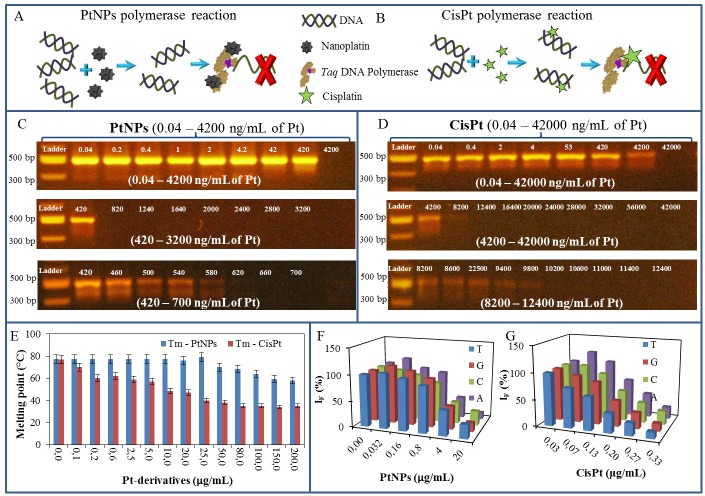
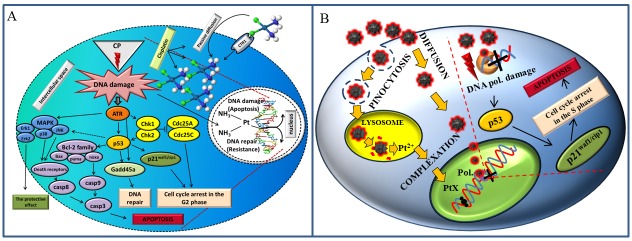
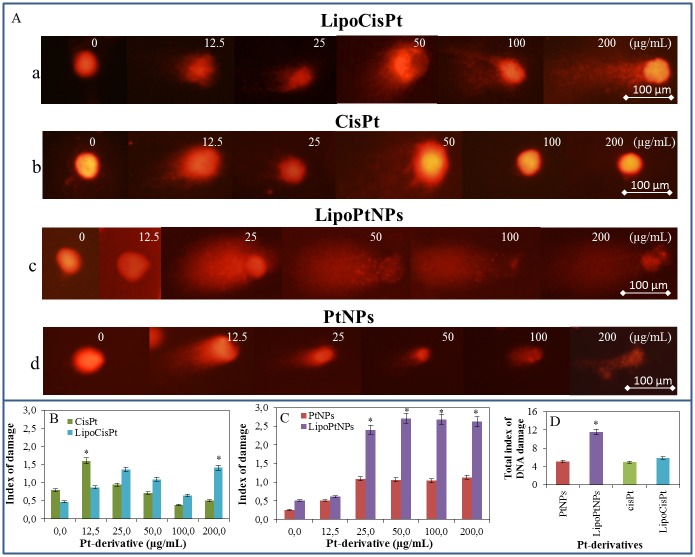
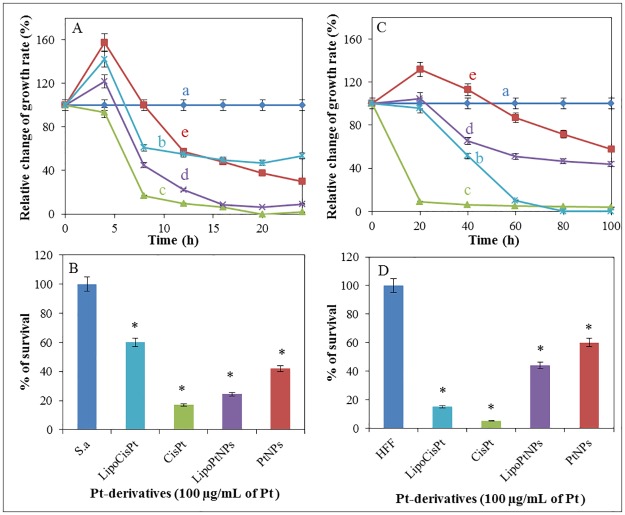
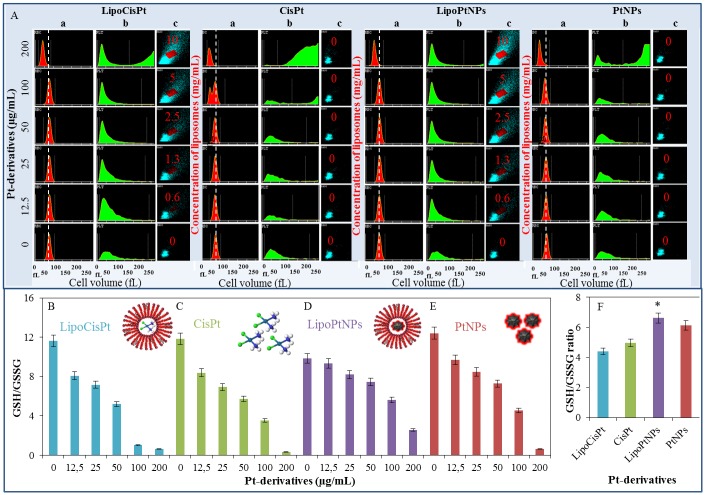
Sparsely tested group of platinum nanoparticles (PtNPs) may have a comparable effect as complex platinum compounds. The aim of this study was to observe the effect of PtNPs in in vitro amplification of DNA fragment of phage λ, on the bacterial cultures (Staphylococcus aureus), human foreskin fibroblasts and erythrocytes. In vitro synthesized PtNPs were characterized by dynamic light scattering (PtNPs size range 4.8-11.7 nm), zeta potential measurements (-15 mV at pH 7.4), X-ray fluorescence, UV/vis spectrophotometry and atomic absorption spectrometry. The PtNPs inhibited the DNA replication and affected the secondary structure of DNA at higher concentrations, which was confirmed by polymerase chain reaction, DNA sequencing and DNA denaturation experiments. Further, cisplatin (CisPt), as traditional chemotherapy agent, was used in all parallel experiments. Moreover, the encapsulation of PtNPs in liposomes (LipoPtNPs) caused an approximately 2.4x higher of DNA damage in comparison with CisPt, LipoCisPt and PtNPs. The encapsulation of PtNPs in liposomes also increased their antibacterial, cytostatic and cytotoxic effect, which was determined by the method of growth curves on S. aureus and HFF cells. In addition, both the bare and encapsulated PtNPs caused lower oxidative stress (determined by GSH/GSSG ratio) in the human erythrocytes compared to the bare and encapsulated CisPt. CisPt was used in all parallel experiments as traditional chemotherapy agent.
稀疏测试的铂纳米颗粒(PtNPs)组可能具有与复杂铂化合物相当的效果。本研究的目的是观察PtNPs对噬菌体λ DNA片段体外扩增、对细菌培养物(金黄色葡萄球菌)、人包皮成纤维细胞和红细胞的影响。体外合成的PtNPs通过动态光散射(PtNPs尺寸范围为4.8 - 11.7 nm)、zeta电位测量(pH 7.4时为-15 mV)、X射线荧光、紫外/可见分光光度法和原子吸收光谱法进行表征。PtNPs在较高浓度下抑制DNA复制并影响DNA的二级结构,这通过聚合酶链反应、DNA测序和DNA变性实验得到证实。此外,顺铂(CisPt)作为传统化疗药物,用于所有平行实验。而且,与CisPt、脂质体包裹顺铂(LipoCisPt)和PtNPs相比,脂质体包裹的PtNPs(LipoPtNPs)导致的DNA损伤高出约2.4倍。脂质体包裹PtNPs还增强了它们的抗菌、细胞抑制和细胞毒性作用,这通过金黄色葡萄球菌和人包皮成纤维细胞(HFF)的生长曲线法测定。此外,与裸露和包裹的CisPt相比,裸露和包裹的PtNPs在人红细胞中引起的氧化应激更低(通过谷胱甘肽/氧化型谷胱甘肽比率测定)。顺铂作为传统化疗药物用于所有平行实验。