Alampay Liane Peña, Godwin Jennifer, Lansford Jennifer E, Bombi Anna Silvia, Bornstein Marc H, Chang Lei, Deater-Deckard Kirby, Di Giunta Laura, Dodge Kenneth A, Malone Patrick S, Oburu Paul, Pastorelli Concetta, Skinner Ann T, Sorbring Emma, Tapanya Sombat, Uribe Tirado Liliana M, Zelli Arnaldo, Al-Hassan Suha, Bacchini Dario
Ateneo de Manila University, Philippines.
Center for Child and Family Policy, Duke University, USA.
Int J Behav Dev. 2017 Jul;41(4):491-502. doi: 10.1177/0165025417697852. Epub 2017 Jun 9.
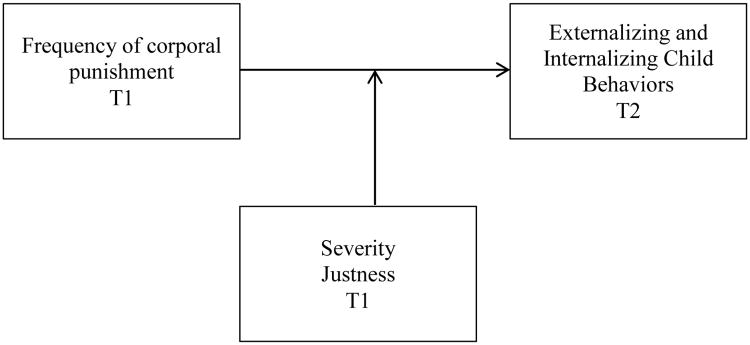
There is strong evidence of a positive association between corporal punishment and negative child outcomes, but previous studies have suggested that the manner in which parents implement corporal punishment moderates the effects of its use. This study investigated whether severity and justness in the use of corporal punishment moderate the associations between frequency of corporal punishment and child externalizing and internalizing behaviors. This question was examined using a multicultural sample from eight countries and two waves of data collected one year apart. Interviews were conducted with 998 children aged 7-10 years, and their mothers and fathers, from China, Colombia, Italy, Jordan, Kenya, Philippines, Thailand, and the United States. Mothers and fathers responded to questions on the frequency, severity, and justness of their use of corporal punishment; they also reported on the externalizing and internalizing behavior of their child. Children reported on their aggression. Multigroup path models revealed that across cultural groups, and as reported by mothers and fathers, there is a positive relation between the frequency of corporal punishment and externalizing child behaviors. Mother-reported severity and father-reported justness were associated with child-reported aggression. Neither severity nor justness moderated the relation between frequency of corporal punishment and child problem behavior. The null result suggests that more use of corporal punishment is harmful to children regardless of how it is implemented, but requires further substantiation as the study is unable to definitively conclude that there is no true interaction effect.
有充分证据表明体罚与儿童负面结果之间存在正相关,但先前的研究表明,父母实施体罚的方式会缓和其使用效果。本研究调查了体罚使用中的严厉程度和公正性是否会缓和体罚频率与儿童外化和内化行为之间的关联。使用来自八个国家的多元文化样本以及相隔一年收集的两波数据对这一问题进行了研究。对来自中国、哥伦比亚、意大利、约旦、肯尼亚、菲律宾、泰国和美国的998名7至10岁儿童及其父母进行了访谈。父母回答了关于他们使用体罚的频率、严厉程度和公正性的问题;他们还报告了孩子的外化和内化行为。孩子们报告了自己的攻击性。多组路径模型显示,在不同文化群体中,正如父母所报告的,体罚频率与儿童外化行为之间存在正相关。母亲报告的严厉程度和父亲报告的公正性与孩子报告的攻击性有关。严厉程度和公正性均未缓和体罚频率与儿童问题行为之间的关系。这一零结果表明,更多地使用体罚对儿童有害,无论其实施方式如何,但由于该研究无法明确得出不存在真正交互效应的结论,因此需要进一步证实。