Chromy David, Schwabl Philipp, Bucsics Theresa, Scheiner Bernhard, Strassl Robert, Mayer Florian, Aichelburg Maximilian C, Grabmeier-Pfistershammer Katharina, Trauner Michael, Peck-Radosavljevic Markus, Reiberger Thomas, Mandorfer Mattias
Division of Gastroenterology and Hepatology, Department of Internal Medicine III, Medical University of Vienna, Währinger Gürtel 18-20, 1090, Vienna, Austria.
Vienna HIV & Liver Study Group, Medical University of Vienna, Vienna, Austria.
Wien Klin Wochenschr. 2018 Feb;130(3-4):105-114. doi: 10.1007/s00508-017-1231-x. Epub 2017 Jul 25.
Hepatitis C virus (HCV) therapy should be considered without delay in all patients with significant (SIGFIB) or advanced liver fibrosis (ADVFIB). We aimed to investigate the rates of treatment initiation with interferon-free regimens within a screening program for SIGFIB/ADVFIB in human immunodeficiency virus/HCV coinfected patients (HIV/HCV).
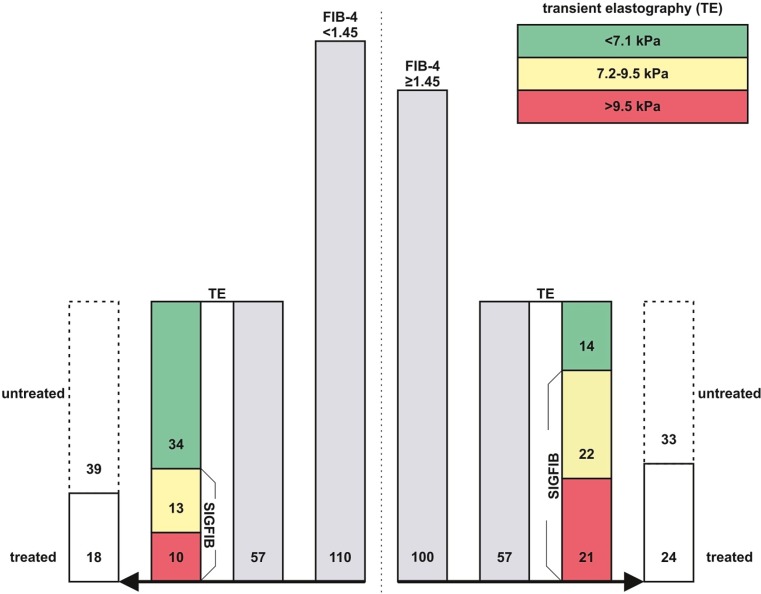
The FIB-4 was calculated in all HIV/HCV from 2014-2016. HIV/HCV were counselled by the HIV clinic and referred to the Division of Gastroenterology and Hepatology for transient elastography (TE) and evaluation for HCV therapy. Patients were stratified by FIB-4 of </≥1.45 (established cut-off for ruling out ADVFIB) and SIGFIB/ADVFIB were defined by liver stiffness >7.1 kPa/>9.5 kPa, respectively.
Among 1348 HIV+ patients, 16% (210/1348) had detectable HCV-RNA. One hundred HIV/HCV had a FIB-4 ≥1.45. Among these, 57% (57/100) underwent TE. The majority of these patients had SIGFIB (75%; 43/57) or ADVFIB (37%; 21/57), however, interferon-free treatment was initiated in only 56% (24/43). In addition, fifty-two percent (57/110) of HIV/HCV with FIB-4 <1.45 underwent TE. Interestingly, 40% (23/57) and 18% (10/57) of these patients showed SIGFIB or even ADVFIB, respectively, and 78% (18/23) finally received interferon-free treatment. Overall, only 20% (42/210) of HIV/HCV received interferon-free treatment.
FIB-4 was not useful for ruling out SIGFIB/ADVFIB in our cohort of HIV/HCV. Treatment was initiated only in a small proportion (20%) of HIV/HCV during the first 2 years of interferon-free treatment availability, although the observed proportion of patients with SIGFIB (assessed by TE) was considerably higher (58%). Thus, it requires the ongoing combined efforts of both HIV and HCV specialists to increase treatment uptake rates in this special population.
对于所有患有显著肝纤维化(SIGFIB)或晚期肝纤维化(ADVFIB)的患者,应立即考虑进行丙型肝炎病毒(HCV)治疗。我们旨在调查在一项针对人类免疫缺陷病毒/HCV合并感染患者(HIV/HCV)的SIGFIB/ADVFIB筛查项目中,采用无干扰素方案开始治疗的比例。
计算了2014年至2016年所有HIV/HCV患者的FIB-4指数。HIV/HCV患者由HIV门诊提供咨询,并被转介至胃肠病学和肝病科进行瞬时弹性成像(TE)检查以及HCV治疗评估。患者根据FIB-4指数是否小于/大于等于1.45(排除ADVFIB的既定临界值)进行分层,SIGFIB/ADVFIB分别定义为肝脏硬度>7.1kPa/>9.5kPa。
在1348例HIV阳性患者中,16%(210/1348)可检测到HCV-RNA。100例HIV/HCV患者的FIB-4指数≥1.45。其中,57%(57/100)接受了TE检查。这些患者中大多数患有SIGFIB(75%;43/57)或ADVFIB(37%;21/57),然而,仅56%(24/43)的患者开始接受无干扰素治疗。此外,FIB-4指数<1.45的HIV/HCV患者中有52%(57/110)接受了TE检查。有趣的是,这些患者中分别有40%(23/57)和18%(10/57)表现为SIGFIB甚至ADVFIB,最终78%(18/23)的患者接受了无干扰素治疗。总体而言,仅20%(42/210)的HIV/HCV患者接受了无干扰素治疗。
在我们的HIV/HCV队列中,FIB-4指数对于排除SIGFIB/ADVFIB并无用处。在无干扰素治疗可用的头两年中,仅一小部分(20%)的HIV/HCV患者开始接受治疗,尽管观察到的SIGFIB患者比例(通过TE评估)要高得多(58%)。因此,需要HIV和HCV专家持续共同努力,以提高这一特殊人群的治疗接受率。