Qin Jian, Yu Guoqi, Xia Tianlong, Li You, Liang Xue, Wei Peng, Long Bingshuang, Lei Mingzhi, Wei Xiao, Tang Xianyan, Zhang Zhiyong
Department of Environmental and Occupational Health, Guangxi Medical University, Nanning 530021, China.
Department of Epidemiology and Health Statistics, Guangxi Medical University, Nanning 530021, China.
Int J Environ Res Public Health. 2017 Jul 19;14(7):812. doi: 10.3390/ijerph14070812.
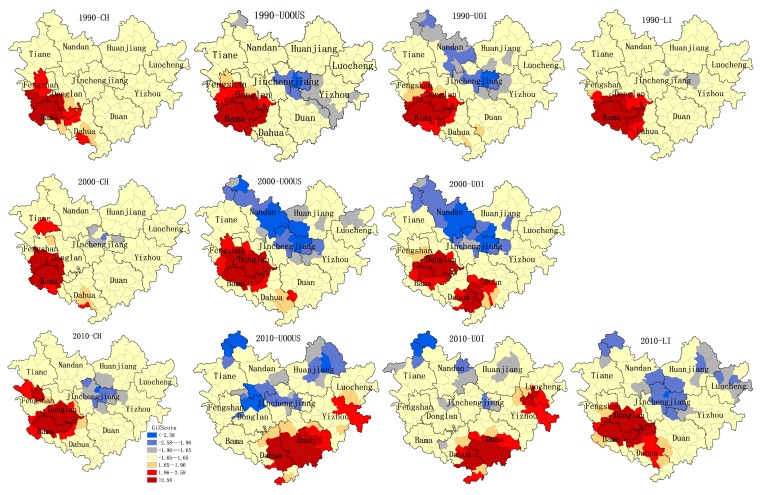
The study aims to determine the spatial and temporal variation of a longevous region and explore the correlation between longevity and socioeconomic development. Population data at the township level were obtained from the last four population censuses (1982-2010). Five main lifespan indicators and the Human Development Index (HDI) were calculated. Getis-Ord G*, Gravity modeling, and Pearson's between lifespan indicators and HDI were applied. In this study, a stable longevous gathering area was discovered in Hechi during different periods. Under the influence of social and economic development, more longevous areas appeared. However, the effects of genetic and natural environmental factors on longevity were always dominant in this remote and mountainous city. Furthermore, longevity indicators lacked any significant correlation with life expectancy. No significant positive correlation was detected between lifespan indicators and HDI. Thus, we conclude that lifespan indicators can determine the spatial distribution and variation pattern of longevity from multiple dimensions. The geographical scope of longevity in Hechi City is gradually expanding, and significant spatial clustering was detected in southwestern, southern, and eastern parts of Hechi. This study also found that social economic development is likely to have a certain impact on new longevous areas, but their role on extreme longevity is not significant.
该研究旨在确定一个长寿地区的时空变化,并探索长寿与社会经济发展之间的相关性。乡镇级人口数据取自最近四次人口普查(1982 - 2010年)。计算了五个主要寿命指标和人类发展指数(HDI)。应用了Getis - Ord G*、引力模型以及寿命指标与HDI之间的皮尔逊相关性分析。在本研究中,不同时期在河池发现了一个稳定的长寿聚集区。在社会经济发展的影响下,出现了更多的长寿地区。然而,在这个偏远山区城市,遗传和自然环境因素对长寿的影响始终占主导地位。此外,长寿指标与预期寿命之间缺乏显著相关性。寿命指标与HDI之间未检测到显著正相关。因此,我们得出结论,寿命指标可以从多个维度确定长寿的空间分布和变化模式。河池市长寿的地理范围正在逐渐扩大,在河池西南部、南部和东部检测到显著的空间聚集。本研究还发现,社会经济发展可能对新的长寿地区有一定影响,但其对极端长寿的作用并不显著。