Yang Zaijun, Chen Zhenyong, Peng Zhengsong, Yu Yan, Liao Mingli, Wei Shuhong
Key Laboratory of Southwest China Wildlife Resources Conservation (Ministry of Education), College of Life Science, China West Normal University, Nanchong, Sichuan, 637009, China.
BMC Genomics. 2017 Jul 31;18(1):567. doi: 10.1186/s12864-017-3960-7.
The wheat mutant line three-pistil (TP) exhibits three pistils per floret. As TP normally has two or three seeds in each of the florets on the same spike, there is the possibility of increasing the number of grains per spike. Therefore, TP is a highly valuable mutant for breeding and for the study of floral development in wheat. To map the three-pistil gene (Pis1), genotyping-by-sequencing single-nucleotide polymorphism (GBS-SNP) data from an F mapping population (CM28 × CM28TP) was used to construct a genetic map that is of significant value.
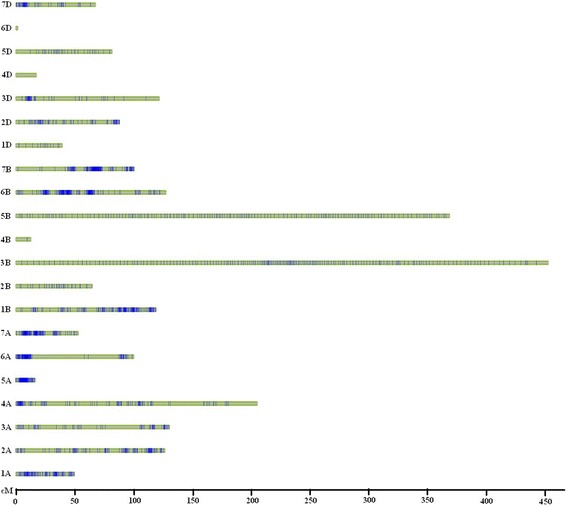
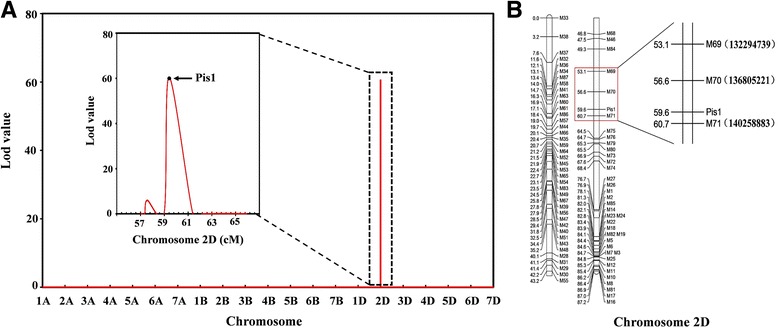
In the present study, a high-density genetic map of wheat containing 2917 GBS-SNP markers was constructed. Twenty-one linkage groups were resolved, with a total length of 2371.40 cM. The individual chromosomes range from 2.64 cM to 454.55 cM with an average marker density of 0.81 cM. The Pis1 gene was mapped using this high-resolution map, and two flanking SNP markers tightly linked to the gene, M70 and M71, were identified. The Pis1 is 3.00 cM from M70 and 1.10 cM from M71. In bread wheat genome, M70 and M71 were found to delimit a physical distance of 3.40 Mb, which encompasses 127 protein-coding genes. To validate the GBS-generated genotypic data and to eliminate missing marker data in the Pis1 region, five Kompetitive Allele-Specific PCR (KASP) assays were designed from corresponding GBS sequences, which harbor SNPs that surround Pis1. Three KASP-SNP markers, KM70, KM71, and KM75, were remapped to the Pis1 gene region.
This work not only lays the foundation for the map-based cloning of Pis1 but can also serve as a valuable tool for studying marker-trait association of important traits and marker-assisted breeding in wheat.
小麦突变体三雌蕊(TP)每朵小花有三个雌蕊。由于TP在同一穗上的每朵小花中通常有两粒或三粒种子,因此存在增加每穗粒数的可能性。因此,TP是用于小麦育种和花发育研究的极有价值的突变体。为了定位三雌蕊基因(Pis1),利用来自F作图群体(CM28×CM28TP)的简化基因组测序单核苷酸多态性(GBS-SNP)数据构建了具有重要价值的遗传图谱。
在本研究中,构建了一张包含2917个GBS-SNP标记的小麦高密度遗传图谱。解析出21个连锁群,总长度为2371.40厘摩。各条染色体长度从2.64厘摩到454.55厘摩不等,平均标记密度为0.81厘摩。利用这张高分辨率图谱对Pis1基因进行了定位,并鉴定出两个与该基因紧密连锁的侧翼SNP标记M70和M71。Pis1基因与M70相距3.00厘摩,与M71相距1.10厘摩。在普通小麦基因组中,发现M70和M71界定了一个3.40兆碱基的物理距离,其中包含127个蛋白质编码基因。为了验证GBS生成的基因型数据并消除Pis1区域的缺失标记数据,根据相应的GBS序列设计了5个竞争性等位基因特异性PCR(KASP)分析,这些序列含有围绕Pis1的SNP。三个KASP-SNP标记KM70、KM71和KM75被重新定位到Pis1基因区域。
本研究不仅为Pis1基因的图位克隆奠定了基础,还可作为研究小麦重要性状的标记-性状关联及标记辅助育种的宝贵工具。