Park Jung Hun, Kim Sang Jin, Hyun Jong Hee, Han Kyung Su, Kim Byung Chang, Hong Chang Won, Lee Sang-Jeon, Sohn Dae Kyung
Center for Colorectal Cancer, Research Institute and Hospital, National Cancer Center, Goyang, Korea.
Department of Surgery, Chungbuk National University College of Medicine, Chungbuk National University Hospital, Cheongju, Korea.
Ann Coloproctol. 2017 Jun;33(3):93-98. doi: 10.3393/ac.2017.33.3.93. Epub 2017 Jun 30.
The adenoma detection rate is commonly used as a measure of the quality of colonoscopy. This study assessed both the association between the adenoma detection rate and the quality of bowel preparation and the risk factors associated with the adenoma detection rate in screening colonoscopy.
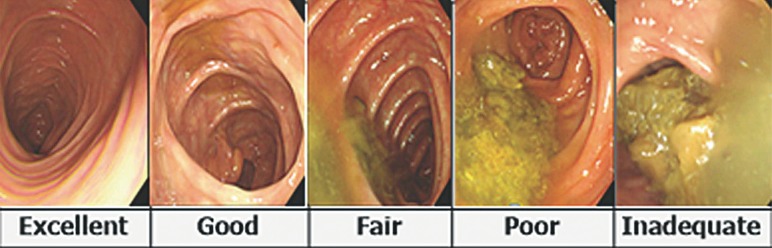
This retrospective analysis involved 1,079 individuals who underwent screening colonoscopy at the National Cancer Center between December 2012 and April 2014. Bowel preparation was classified by using the Aronchick scale. Individuals with inadequate bowel preparations (n = 47, 4.4%) were excluded because additional bowel preparation was needed. The results of 1,032 colonoscopies were included in the analysis.
The subjects' mean age was 53.1 years, and 657 subjects (63.7%) were men. The mean cecal intubation time was 6.7 minutes, and the mean withdrawal time was 8.7 minutes. The adenoma and polyp detection rates were 28.1% and 41.8%, respectively. The polyp, adenoma, and advanced adenoma detection rates did not correlate with the quality of bowel preparation. The multivariate analysis showed age ≥ 60 years (hazard ratio [HR], 1.42; 95% confidence interval [CI], 1.02-1.97; P = 0.040), body mass index ≥ 25 kg/m (HR, 1.56; 95% CI, 1.17-2.08; P = 0.002) and current smoking (HR, 1.44; 95% CI, 1.01-2.06; P = 0.014) to be independent risk factors for adenoma detection.
The adenoma detection rate was unrelated to the quality of bowel preparation for screening colonoscopy. Older age, obesity, and smoking were independent risk factors for adenoma detection.
腺瘤检出率通常被用作衡量结肠镜检查质量的指标。本研究评估了腺瘤检出率与肠道准备质量之间的关联以及筛查结肠镜检查中与腺瘤检出率相关的危险因素。
这项回顾性分析纳入了2012年12月至2014年4月期间在国家癌症中心接受筛查结肠镜检查的1079例患者。采用Aronchick量表对肠道准备情况进行分类。因需要额外的肠道准备而排除肠道准备不充分的患者(n = 47,4.4%)。1032例结肠镜检查结果纳入分析。
受试者的平均年龄为53.1岁,657例受试者(63.7%)为男性。平均盲肠插管时间为6.7分钟,平均退镜时间为8.7分钟。腺瘤和息肉检出率分别为28.1%和41.8%。息肉、腺瘤和高级别腺瘤检出率与肠道准备质量无关。多因素分析显示年龄≥60岁(风险比[HR],1.42;95%置信区间[CI],1.02 - 1.97;P = 0.040)、体重指数≥25 kg/m²(HR,1.56;95% CI,1.17 - 2.08;P = 0.002)和当前吸烟(HR,1.44;95% CI,1.01 - 2.06;P = 0.014)是腺瘤检出的独立危险因素。
筛查结肠镜检查的腺瘤检出率与肠道准备质量无关。年龄较大、肥胖和吸烟是腺瘤检出的独立危险因素。