Zhang Ning, Ma Yansong, Weir Michael D, Xu Hockin H K, Bai Yuxing, Melo Mary Anne S
Department of Orthodontics, School of Stomatology, Capital Medical University, Beijing 100050, China.
Biomaterials & Tissue Engineering Division, Department of Endodontics, Prosthodontics and Operative Dentistry, University of Maryland School of Dentistry, Baltimore, MD 21201, USA.
Materials (Basel). 2017 May 6;10(5):507. doi: 10.3390/ma10050507.
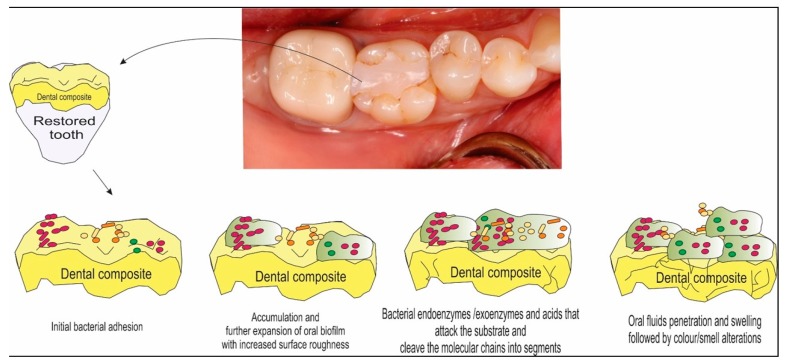
Dental polymeric composites have become the first choice for cavity restorations due to their esthetics and capacity to be bonded to the tooth. However, the oral cavity is considered to be harsh environment for a polymeric material. Oral biofilms can degrade the polymeric components, thus compromising the marginal integrity and leading to the recurrence of caries. Recurrent caries around restorations has been reported as the main reason for restoration failure. The degradation of materials greatly compromises the clinical longevity. This review focuses on the degradation process of resin composites by oral biofilms, the mechanisms of degradation and its consequences. In addition, potential future developments in the area of resin-based dental biomaterials with an emphasis on anti-biofilm strategies are also reviewed.
牙科聚合物复合材料因其美观性以及与牙齿的粘结能力,已成为窝洞修复的首选材料。然而,口腔被认为是聚合物材料的恶劣环境。口腔生物膜会降解聚合物成分,从而损害边缘完整性并导致龋齿复发。修复体周围的复发性龋齿已被报道为修复失败的主要原因。材料的降解极大地影响了临床使用寿命。本综述重点关注口腔生物膜对树脂复合材料的降解过程、降解机制及其后果。此外,还综述了树脂基牙科生物材料领域未来可能的发展,重点是抗生物膜策略。