Zhang Ning, Melo Mary A S, Weir Michael D, Reynolds Mark A, Bai Yuxing, Xu Hockin H K
Department of Orthodontics, School of Stomatology, Capital Medical University, Beijing 100050, China.
Department of Endodontics, Periodontics and Prosthodontics, School of Dentistry, University of Maryland, Baltimore, MD 21201, USA.
Materials (Basel). 2016 Nov 1;9(11):888. doi: 10.3390/ma9110888.
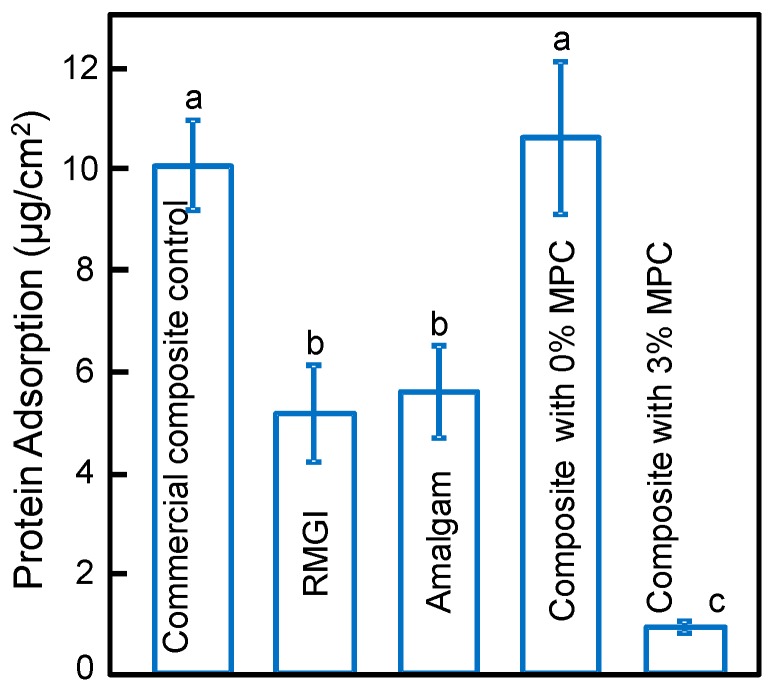
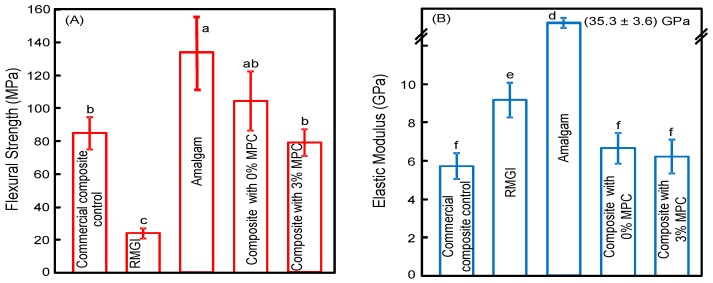
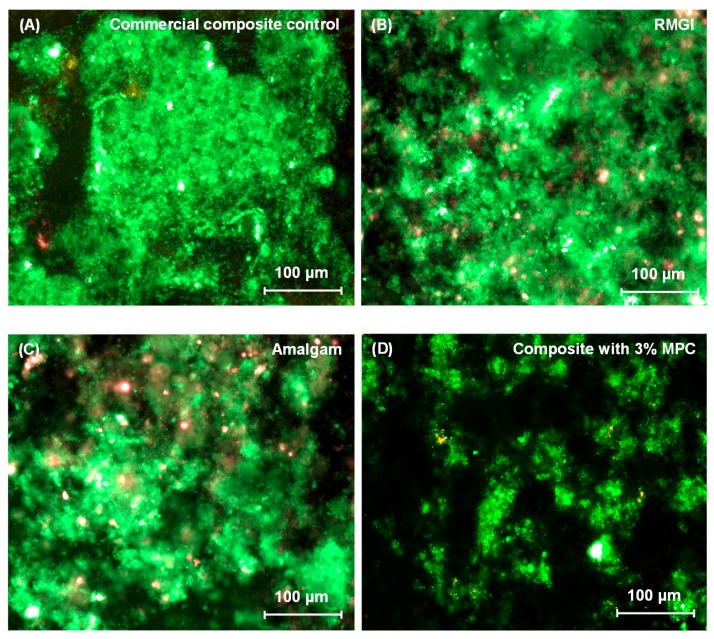
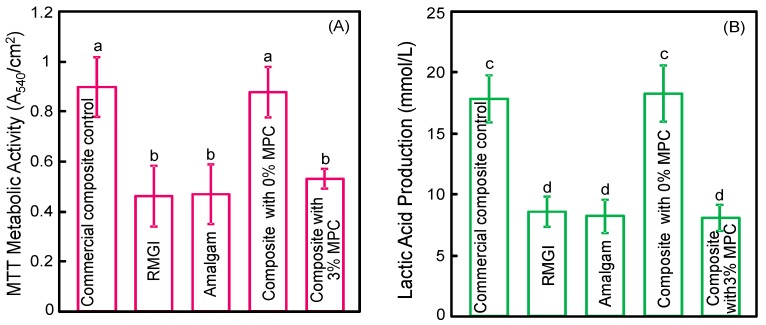
A long-time drawback of dental composites is that they accumulate more biofilms and plaques than amalgam and glass ionomer restorative materials. It would be highly desirable to develop a new composite with reduced biofilm growth, while avoiding the non-esthetics of amalgam and low strength of glass ionomer. The objectives of this study were to: (1) develop a protein-repellent composite with reduced biofilms matching amalgam and glass ionomer for the first time; and (2) investigate their protein adsorption, biofilms, and mechanical properties. Five materials were tested: A new composite containing 3% of protein-repellent 2-methacryloyloxyethyl phosphorylcholine (MPC); the composite with 0% MPC as control; commercial composite control; dental amalgam; resin-modified glass ionomer (RMGI). A dental plaque microcosm biofilm model with human saliva as inoculum was used to investigate metabolic activity, colony-forming units (CFU), and lactic acid production. Composite with 3% MPC had flexural strength similar to those with 0% MPC and commercial composite control ( > 0.1), and much greater than RMGI ( < 0.05). Composite with 3% MPC had protein adsorption that was only 1/10 that of control composites ( < 0.05). Composite with 3% MPC had biofilm CFU and lactic acid much lower than control composites ( < 0.05). Biofilm growth, metabolic activity and lactic acid on the new composite with 3% MPC were reduced to the low level of amalgam and RMGI ( > 0.1). In conclusion, a new protein-repellent dental resin composite reduced oral biofilm growth and acid production to the low levels of non-esthetic amalgam and RMGI for the first time. The long-held conclusion that dental composites accumulate more biofilms than amalgam and glass ionomer is no longer true. The novel composite is promising to finally overcome the major biofilm-accumulation drawback of dental composites in order to reduce biofilm acids and secondary caries.
牙科复合材料长期存在的一个缺点是,与汞合金和玻璃离子修复材料相比,它们会积聚更多的生物膜和牙菌斑。开发一种生物膜生长减少的新型复合材料,同时避免汞合金的不美观和玻璃离子的低强度,将是非常理想的。本研究的目的是:(1)首次开发一种生物膜减少的蛋白质排斥复合材料,使其与汞合金和玻璃离子相匹配;(2)研究它们的蛋白质吸附、生物膜和机械性能。测试了五种材料:一种含有3%蛋白质排斥剂2-甲基丙烯酰氧乙基磷酰胆碱(MPC)的新型复合材料;0%MPC的复合材料作为对照;商业复合材料对照;牙科汞合金;树脂改性玻璃离子(RMGI)。以人唾液为接种物的牙菌斑微观生物膜模型用于研究代谢活性、菌落形成单位(CFU)和乳酸产生。含3%MPC的复合材料的弯曲强度与含0%MPC的复合材料和商业复合材料对照相似(>0.1),远高于RMGI(<0.05)。含3%MPC的复合材料的蛋白质吸附量仅为对照复合材料的1/10(<0.05)。含3%MPC的复合材料的生物膜CFU和乳酸含量远低于对照复合材料(<0.05)。含3%MPC的新型复合材料上的生物膜生长、代谢活性和乳酸降至汞合金和RMGI的低水平(>0.1)。总之,一种新型的蛋白质排斥牙科树脂复合材料首次将口腔生物膜生长和酸产生降低到不美观的汞合金和RMGI的低水平。长期以来认为牙科复合材料比汞合金和玻璃离子积聚更多生物膜的结论不再成立。这种新型复合材料有望最终克服牙科复合材料主要的生物膜积聚缺点,以减少生物膜酸和继发龋。