Renzi Chiara, Fioretti Chiara, Oliveri Serena, Mazzocco Ketti, Zerini Dario, Alessandro Ombretta, Rojas Damaris P, Jereczek-Fossa Barbara A, Pravettoni Gabriella
Applied Research Division for Cognitive and Psychological Science, European Institute of OncologyMilan, Italy.
Interdisciplinary Research and Intervention on Decision, Department of Oncology and Hemato-Oncology, University of MilanMilan, Italy.
Front Psychol. 2017 Jul 26;8:1215. doi: 10.3389/fpsyg.2017.01215. eCollection 2017.
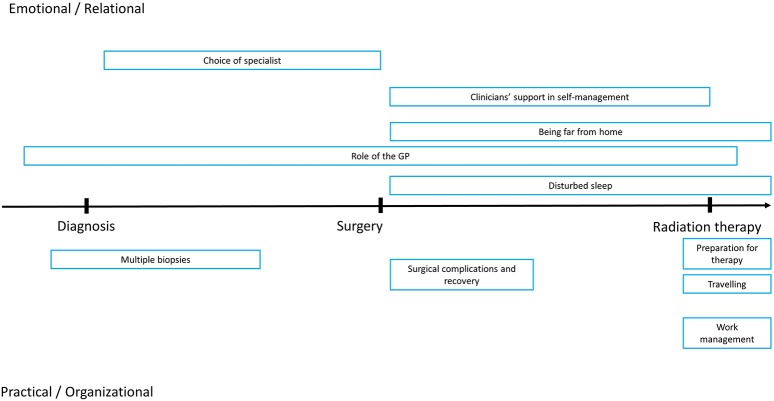
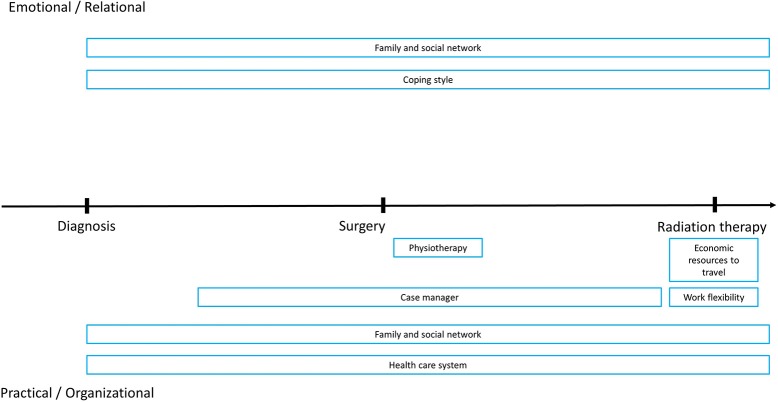
Men with prostate cancer often describe low levels of empowerment. eHealth interventions may represent useful tools to deliver care and education and to meet patients' needs within an empowerment framework. In order to design a platform for cancer patients' empowerment within the H2020 iManageCancer project, the perspective of the target population for the platform was assessed. The present study aims to assess the qualitative experience of prostate cancer patients during treatment in order to provide insights for clinical practice with a particular focus on the design of a web platform to promote cancer patients' empowerment. Ten patients undergoing radiation therapy treatment took part in a semi-structured interview to explore different aspects of patient empowerment. Four main thematic areas were addressed: patient-healthcare providers' communication, decision-making, needs, and resources. A qualitative approach using thematic analysis was followed. Half of the patients reported little to no possibility to share information and questions with healthcare providers. With regards to decision-making, the role of healthcare providers was perceived as directive/informative, but half of the patients perceived to assume an active role in at least one interaction. Difficulties and needs included the choice of the specialist or of the structure after diagnosis, clinicians' support in self-management, surgical consequences, and side effects, preparation for radiation therapy. Resources included family and social support both from a practical and from an emotional perspective, coping style, and work schedule management. These results suggest that relations with healthcare providers should be supported, especially immediately after diagnosis and after surgery. Support to self-management after surgery and at the beginning of radiation therapy treatment also constitutes a priority. The adoption of a personalized approach from the beginning of prostate cancer care flow may promote patient empowerment, overcoming the aforementioned needs and mobilizing resources. The social network represents an important resource that could be integrated in interventions. These considerations will be taken into account in the design of a cancer self-management platform aiming to increase patients' empowerment.
前列腺癌患者常常表示自身的赋权水平较低。电子健康干预措施可能是在赋权框架内提供护理和教育以及满足患者需求的有用工具。为了在“地平线2020 - iManageCancer”项目中设计一个促进癌症患者赋权的平台,对该平台目标人群的观点进行了评估。本研究旨在评估前列腺癌患者在治疗期间的定性体验,以便为临床实践提供见解,特别关注促进癌症患者赋权的网络平台设计。十名接受放射治疗的患者参与了半结构化访谈,以探讨患者赋权的不同方面。访谈涉及四个主要主题领域:患者与医疗服务提供者的沟通、决策、需求和资源。采用了主题分析的定性方法。一半的患者表示几乎没有或根本没有机会与医疗服务提供者分享信息和问题。关于决策,医疗服务提供者的角色被认为是指导性/提供信息性的,但一半的患者认为自己在至少一次互动中发挥了积极作用。困难和需求包括诊断后专科医生或机构的选择、临床医生在自我管理方面的支持、手术后果和副作用、放射治疗准备。资源包括来自家庭和社会在实际和情感方面的支持、应对方式以及工作时间管理。这些结果表明,应加强与医疗服务提供者的关系,尤其是在诊断后和手术后立即加强。术后和放射治疗开始时对自我管理的支持也至关重要。从前列腺癌护理流程开始就采用个性化方法可能会促进患者赋权,克服上述需求并调动资源。社交网络是可以纳入干预措施的重要资源。在设计旨在增强患者赋权的癌症自我管理平台时将考虑这些因素。