Kong Deok-Hoon, Kim Mi Ra, Jang Ji Hye, Na Hee-Jun, Lee Sukmook
Research Center, Scripps Korea Antibody Institute, Chuncheon 200-701, Korea.
Int J Mol Sci. 2017 Aug 17;18(8):1786. doi: 10.3390/ijms18081786.
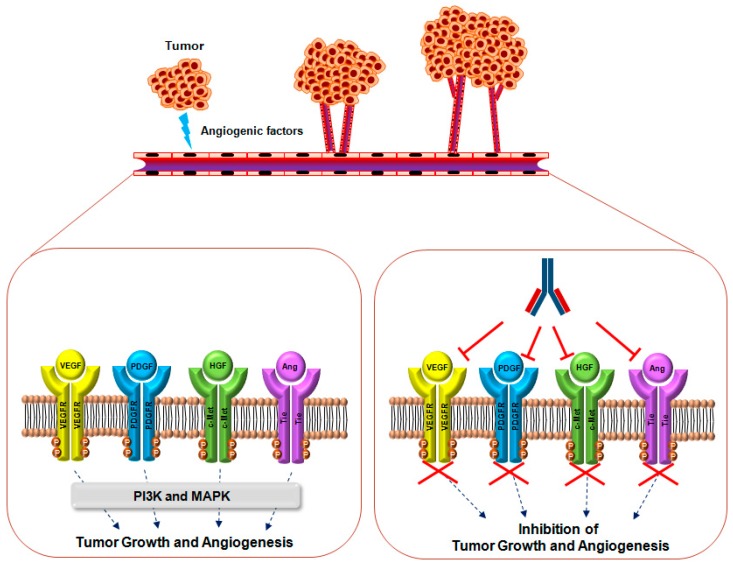
Tumor angiogenesis is a key event that governs tumor progression and metastasis. It is controlled by the complicated and coordinated actions of pro-angiogenic factors and their receptors that become upregulated during tumorigenesis. Over the past several decades, vascular endothelial growth factor (VEGF) signaling has been identified as a central axis in tumor angiogenesis. The remarkable advent of recombinant antibody technology has led to the development of bevacizumab, a humanized antibody that targets VEGF and is a leading clinical therapy to suppress tumor angiogenesis. However, despite the clinical efficacy of bevacizumab, its significant side effects and drug resistance have raised concerns necessitating the identification of novel drug targets and development of novel therapeutics to combat tumor angiogenesis. This review will highlight the role and relevance of VEGF and other potential therapeutic targets and their receptors in angiogenesis. Simultaneously, we will also cover the current status of monoclonal antibodies being developed to target these candidates for cancer therapy.
肿瘤血管生成是控制肿瘤进展和转移的关键事件。它受促血管生成因子及其受体复杂而协调的作用控制,这些因子和受体在肿瘤发生过程中上调。在过去几十年中,血管内皮生长因子(VEGF)信号通路已被确定为肿瘤血管生成的核心轴。重组抗体技术的显著进展导致了贝伐单抗的开发,这是一种靶向VEGF的人源化抗体,是抑制肿瘤血管生成的主要临床疗法。然而,尽管贝伐单抗具有临床疗效,但其显著的副作用和耐药性引发了人们的担忧,这就需要确定新的药物靶点并开发新的治疗方法来对抗肿瘤血管生成。本综述将重点介绍VEGF和其他潜在治疗靶点及其受体在血管生成中的作用和相关性。同时,我们还将涵盖正在开发的针对这些候选靶点用于癌症治疗的单克隆抗体的现状。