Pinazo Maria-Jesus, Pinto Jimy, Ortiz Lourdes, Sánchez Jareth, García Wilson, Saravia Ruth, Cortez Mirko-R, Moriana Silvia, Grau Enric, Lozano Daniel, Gascon Joaquim, Torrico Faustino
International Health Department, ISGlobal, Barcelona Center for International Health Research, (CRESIB), Hospital Clínic-Universitat de Barcelona, Spain.
Fundación CEADES, Cochabamba, Bolivia.
PLoS Negl Trop Dis. 2017 Aug 18;11(8):e0005770. doi: 10.1371/journal.pntd.0005770. eCollection 2017 Aug.
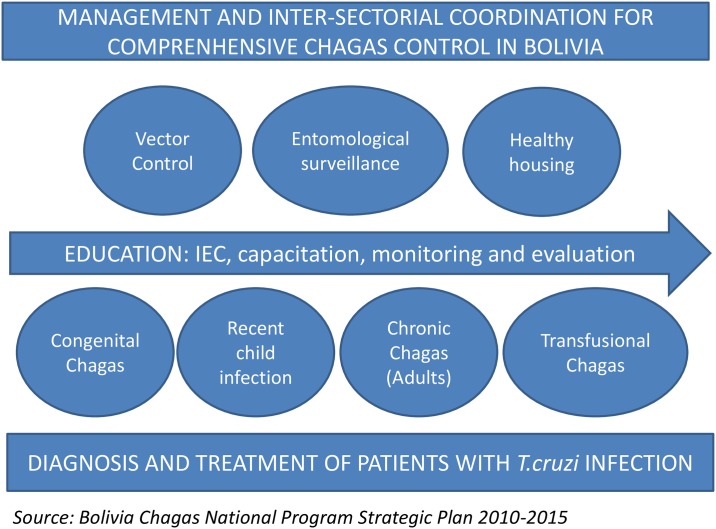
Bolivia has the highest prevalence of Chagas disease (CD) in the world (6.1%), with more than 607,186 people with Trypanosoma cruzi infection, most of them adults. In Bolivia CD has been declared a national priority. In 2009, the Chagas National Program (ChNP) had neither a protocol nor a clear directive for diagnosis and treatment of adults. Although programs had been implemented for congenital transmission and for acute cases, adults remained uncovered. Moreover, health professionals were not aware of treatment recommendations aimed at this population, and research on CD was limited; it was difficult to increase awareness of the disease, understand the challenges it presented, and adapt strategies to cope with it. Simultaneously, migratory flows that led Bolivian patients with CD to Spain and other European countries forced medical staff to look for solutions to an emerging problem.
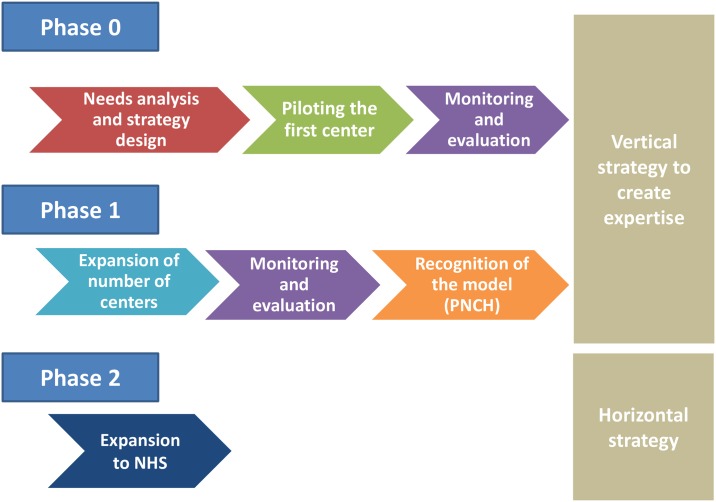
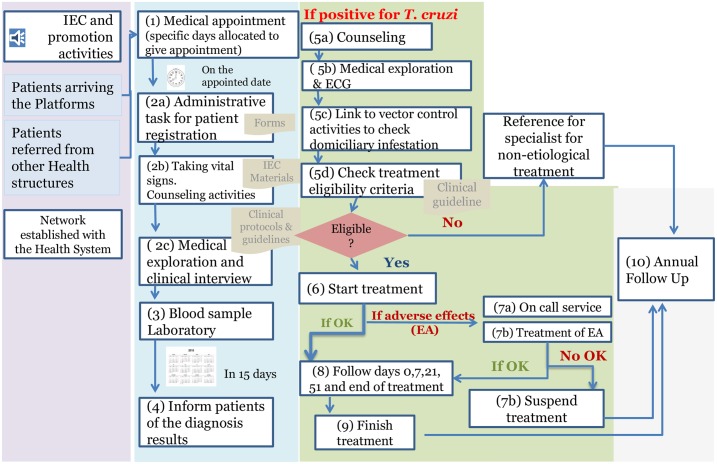
In this context, thanks to a Spanish international cooperation collaboration, the Bolivian platform for the comprehensive care of adults with CD was created in 2009. Based on the establishment of a vertical care system under the umbrella of ChNP general guidelines, six centres specialized in CD management were established in different epidemiological contexts. A common database, standardized clinical forms, a and a protocolized attention to adults patients, together with training activities for health professionals were essential for the model success. With the collaboration and knowledge transfer activities between endemic and non-endemic countries, the platform aims to provide care, train health professionals, and create the basis for a future expansion to the National Health System of a proven model of care for adults with CD.
From 2010 to 2015, a total of 26,227 patients were attended by the Platform, 69% (18,316) were diagnosed with T. cruzi, 8,567 initiated anti-parasitic treatment, more than 1,616 health professionals were trained, and more than ten research projects developed. The project helped to increase the number of adults with CD diagnosed and treated, produce evidence-based clinical practice guidelines, and bring about changes in policy that will increase access to comprehensive care among adults with CD. The ChNP is now studying the Platform's health care model to adapt and implement it nationwide.
This strategy provides a solution to unmet demands in the care of patients with CD, improving access to diagnosis and treatment. Further scaling up of diagnosis and treatment will be based on the expansion of the model of care to the NHS structures. Its sustainability will be ensured as it will build on existing local resources in Bolivia. Still human trained resources are scarce and the high staff turnover in Bolivia is a limitation of the model. Nevertheless, in a preliminary two-years-experience of scaling up this model, this limitations have been locally solved together with the health local authorities.
玻利维亚是世界上恰加斯病(CD)患病率最高的国家(6.1%),有超过607,186人感染克氏锥虫,其中大多数为成年人。在玻利维亚,恰加斯病已被宣布为国家重点疾病。2009年,恰加斯病国家项目(ChNP)既没有针对成年人诊断和治疗的方案,也没有明确的指导方针。尽管已经实施了针对先天性传播和急性病例的项目,但成年人仍然未得到覆盖。此外,卫生专业人员并不了解针对这一人群的治疗建议,而且关于恰加斯病的研究有限;难以提高对该疾病的认识、理解其所带来的挑战以及调整应对策略。与此同时,导致玻利维亚恰加斯病患者前往西班牙和其他欧洲国家的移民潮迫使医务人员寻求解决这一新兴问题的办法。
在这种背景下,得益于西班牙的国际合作,2009年创建了玻利维亚成年人恰加斯病综合护理平台。基于在ChNP总体指导方针框架下建立的垂直护理系统,在不同的流行病学背景下设立了六个专门管理恰加斯病的中心。一个通用数据库、标准化临床表格、针对成年患者的规范化护理,以及针对卫生专业人员的培训活动对于该模式的成功至关重要。通过地方病流行国家和非流行国家之间的合作及知识转移活动,该平台旨在提供护理、培训卫生专业人员,并为未来将经过验证的成年恰加斯病护理模式扩展到国家卫生系统奠定基础。
2010年至2015年期间,该平台共接待了26,227名患者,69%(18,316名)被诊断为感染克氏锥虫,8,567人开始接受抗寄生虫治疗,培训了1,616多名卫生专业人员,并开展了十多个研究项目。该项目有助于增加被诊断和治疗的成年恰加斯病患者数量,制定基于证据的临床实践指南,并带来政策变化,从而增加成年恰加斯病患者获得综合护理的机会。ChNP目前正在研究该平台的医疗保健模式,以便在全国范围内进行调整和实施。
这一策略为满足恰加斯病患者未得到满足的护理需求提供了解决方案,改善了诊断和治疗的可及性。进一步扩大诊断和治疗将基于把护理模式扩展到国家卫生系统结构。其可持续性将得到保障,因为它将依托玻利维亚现有的当地资源。不过,人力培训资源稀缺,玻利维亚的人员流动率高是该模式的一个局限。尽管如此,在初步扩大该模式的两年经验中,这些局限已与当地卫生当局共同在当地得到解决。