Nogueira Dias Genta Maria Luiza, Martins Toni Ricardo, Mendoza Lopez Rossana V, Sadalla José Carlos, de Carvalho João Paulo Mancusi, Baracat Edmund Chada, Levi José Eduardo, Carvalho Jesus Paula
Gynecological Oncology Department, Instituto do Câncer do Estado de São Paulo (ICESP), Faculdade de Medicina, Universidade de São Paulo, São Paulo, Brazil.
Virology Laboratory, Instituto de Medicina Tropical, Universidade de São Paulo, São Paulo, São Paulo, Brazil.
PLoS One. 2017 Aug 22;12(8):e0182854. doi: 10.1371/journal.pone.0182854. eCollection 2017.
Invasive cervical cancer (ICC) is the third most common malignant neoplasm affecting Brazilian women. Little is known about the impact of specific HPV genotypes in the prognosis of ICC. We hypothesized that HPV genotype would impact ICC clinical presentation and survival.
Women diagnosed with ICC at the Instituto do Câncer do Estado de São Paulo (ICESP) between May 2008 and June 2012 were included in the study and were followed until December 2015. HPV genotype was detected from formalin-fixed paraffin-embedded (FFPE) tumor tissue samples using Onclarity™ system (BD Viper™ LT automated system).
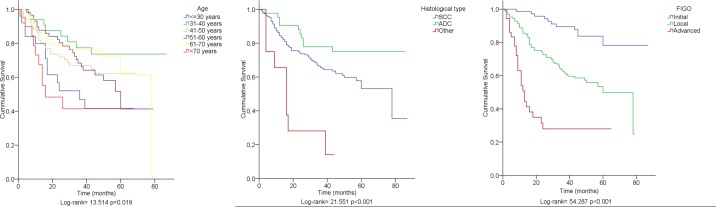
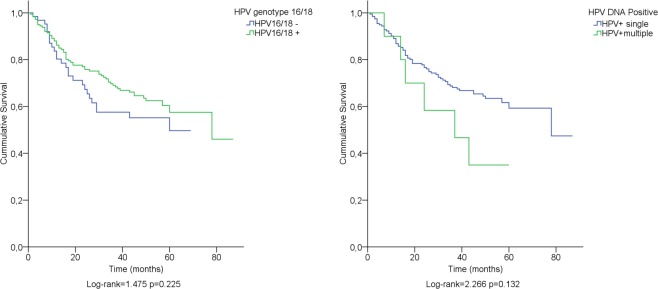
292 patients aged 50±14 years were analyzed. HPVDNA was detected in 84% of patients. The HPV genotypes studied were: HPV16 (64%), HPV18 (10%), HPV33-58 (7%), HPV45 (5%), HPV31 (4%) and other high-risk HPV genotypes (11%). HPV genotypes showed different distributions regarding histological type and clinical stage. Patients were followed for 35±21 months. The overall survival at 5 years after diagnosis of cervical cancer was 54%. Age, clinical staging, histological type and multiple HPV genotypes infection detected in the same tumor specimen were associated with poorer overall survival on multivariate Cox proportional hazard analysis (p<0.05). No specific HPV genotype affected survival.
Multiple HPV genotype infection was associated with poorer ICC survival in our study, compared with single genotype infection. HPV genotyping from FFPE tumor tissue using an automated assay such as the Onclarity BD™ assay provides a simpler alternative for routine clinical use.
This is the largest study employing an automated HPV genotyping assay using FFPE of ICC. Multiple HPV genotype infection adversely influenced survival.
浸润性宫颈癌(ICC)是影响巴西女性的第三大常见恶性肿瘤。关于特定人乳头瘤病毒(HPV)基因型对ICC预后的影响,人们了解甚少。我们推测HPV基因型会影响ICC的临床表现和生存率。
2008年5月至2012年6月期间在圣保罗州癌症研究所(ICESP)被诊断为ICC的女性被纳入本研究,并随访至2015年12月。使用Onclarity™系统(BD Viper™ LT自动化系统)从福尔马林固定石蜡包埋(FFPE)肿瘤组织样本中检测HPV基因型。
分析了292例年龄为50±14岁的患者。84%的患者检测到HPV DNA。所研究的HPV基因型为:HPV16(64%)、HPV18(10%)、HPV33 - 58(7%)、HPV45(5%)、HPV31(4%)和其他高危HPV基因型(11%)。HPV基因型在组织学类型和临床分期方面表现出不同的分布。患者随访了35±21个月。宫颈癌诊断后5年的总生存率为54%。在多变量Cox比例风险分析中,年龄、临床分期、组织学类型以及在同一肿瘤标本中检测到的多种HPV基因型感染与较差的总生存率相关(p<0.05)。没有特定的HPV基因型影响生存率。
在我们的研究中,与单一基因型感染相比,多种HPV基因型感染与较差的ICC生存率相关。使用如Onclarity BD™检测这样的自动化检测方法从FFPE肿瘤组织中进行HPV基因分型为常规临床应用提供了一种更简单的选择。
这是采用基于ICC的FFPE进行自动化HPV基因分型检测的最大规模研究。多种HPV基因型感染对生存率有不利影响。