El-Hendawy Salah, Al-Suhaibani Nasser, Hassan Wael, Tahir Mohammad, Schmidhalter Urs
Department of Plant Production, College of Food and Agriculture Sciences, King Saud University, Riyadh, Saudi Arabia.
Department of Agronomy, Faculty of Agriculture, Suez Canal University, Ismailia, Egypt.
PLoS One. 2017 Aug 22;12(8):e0183262. doi: 10.1371/journal.pone.0183262. eCollection 2017.
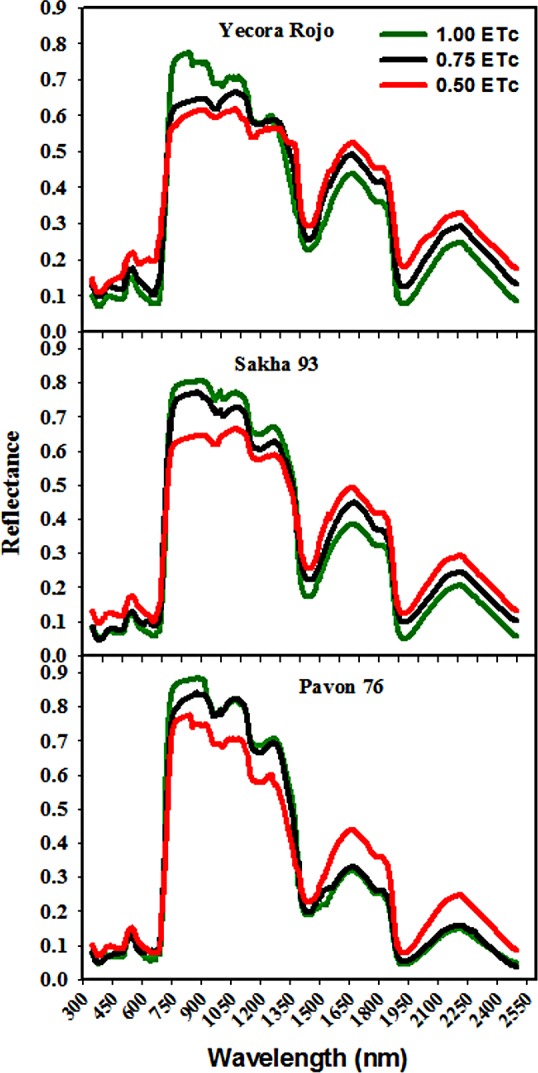
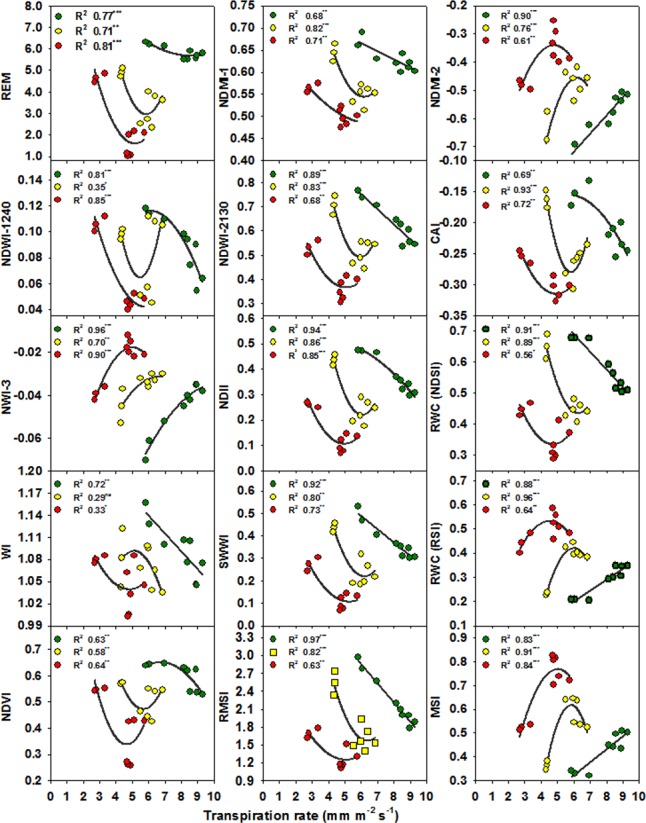
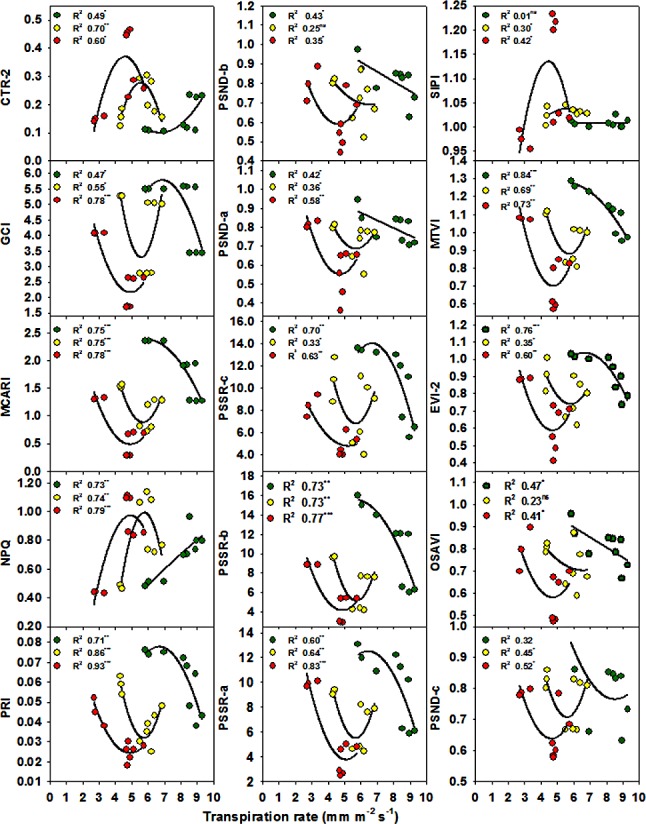
Simultaneous indirect assessment of multiple and diverse plant parameters in an exact and expeditious manner is becoming imperative in irrigated arid regions, with a view toward creating drought-tolerant genotypes or for the management of precision irrigation. This study aimed to evaluate whether spectral reflectance indices (SRIs) in three parts of the electromagnetic spectrum ((visible-infrared (VIS), near-infrared (NIR)), and shortwave-infrared (SWIR)) could be used to track changes in morphophysiological parameters of wheat cultivars exposed to 1.00, 0.75, and 0.50 of the estimated evapotranspiration (ETc). Significant differences were found in the parameters of growth and photosynthetic efficiency, and canopy spectral reflectance among the three cultivars subjected to different irrigation rates. All parameters were highly and significantly correlated with each other particularly under the 0.50 ETc treatment. The VIS/VIS- and NIR/VIS-based indices were sufficient and suitable for assessing the growth and photosynthetic properties of wheat cultivars similar to those indices based on NIR/NIR, SWIR/NIR, or SWIR/SWIR. Almost all tested SRIs proved to assess growth and photosynthetic parameters, including transpiration rate, more efficiently when regressions were analyzed for each water irrigation rate individually. This study, the type of which has rarely been conducted in irrigated arid regions, indicates that spectral reflectance data can be used as a rapid and non-destructive alternative method for assessment of the growth and photosynthetic efficiency of wheat under a range of water irrigation rates.
在干旱灌溉地区,为了培育耐旱基因型或进行精准灌溉管理,以准确、快速的方式同时间接评估多种不同的植物参数变得至关重要。本研究旨在评估电磁光谱三个部分(可见光 - 红外(VIS)、近红外(NIR)和短波红外(SWIR))的光谱反射指数(SRI)是否可用于跟踪暴露于估计蒸发散(ETc)的1.00、0.75和0.50水平下的小麦品种形态生理参数的变化。在不同灌溉率处理的三个品种间,生长和光合效率参数以及冠层光谱反射率存在显著差异。所有参数之间都高度显著相关,特别是在0.50 ETc处理下。基于VIS/VIS和NIR/VIS的指数足以且适合评估小麦品种的生长和光合特性,类似于基于NIR/NIR、SWIR/NIR或SWIR/SWIR的指数。当针对每种灌溉率单独分析回归时,几乎所有测试的SRI都被证明能更有效地评估包括蒸腾速率在内的生长和光合参数。在干旱灌溉地区很少开展此类研究,本研究表明光谱反射数据可作为一种快速、无损的替代方法,用于评估不同灌溉率条件下小麦的生长和光合效率。