Sewdas Ranu, de Wind Astrid, van der Zwaan Lennart G L, van der Borg Wieke E, Steenbeek Romy, van der Beek Allard J, Boot Cécile R L
Department of Public and Occupational Health, Amsterdam Public Health research institute, VU University Medical Center Amsterdam, Van der Boechorststraat 7, 1081 BT, Amsterdam, The Netherlands.
Body@Work, Research Center on Physical Activity, Work and Health, TNO-VU/VUmc, Amsterdam, The Netherlands.
BMC Public Health. 2017 Aug 22;17(1):672. doi: 10.1186/s12889-017-4675-z.
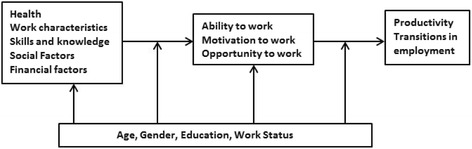
The aims of the present study were to: 1) gain insight into reasons for working beyond the statutory retirement age from older workers' perspectives, and 2) explore how the domains of the research framework Study on Transitions in Employment, Ability and Motivation (STREAM) can be applied to working beyond retirement age.
A qualitative research design included individual interviews (n = 15) and three focus groups (n = 18 participants) conducted with older workers aged 65 years and older continuing in a paid job or self-employment. Interview participants were recruited from an existing STREAM cohort study. Focus group participants were recruited from companies and employment agencies. The data were subjected to thematic analysis.
The most important motives for working beyond retirement age were maintaining daily routines and financial benefit. Good health and flexible work arrangements were mentioned as important preconditions. The themes emerging from the categorization of the motives and preconditions corresponded to the domains of health, work characteristics, skills and knowledge, and social and financial factors from the STREAM research framework. However, our analysis revealed one additional theme-purpose in life.
This study offers important new insights into the various preconditions and motives that influence working beyond retirement age. In addition, the five domains of the STREAM research framework, including the additional domain of 'purpose in life', seem to be applicable to working beyond retirement age. This knowledge contributes to the development of work-related interventions that enhance older workers' motivation to prolong their working lives.
本研究的目的是:1)从老年工作者的角度深入了解法定退休年龄后仍继续工作的原因,以及2)探讨就业、能力和动机转变研究(STREAM)框架的各个领域如何应用于退休后工作。
采用定性研究设计,对65岁及以上仍从事有偿工作或自主创业的老年工作者进行了个人访谈(n = 15)和三个焦点小组访谈(n = 18名参与者)。访谈参与者从现有的STREAM队列研究中招募。焦点小组参与者从公司和就业机构招募。对数据进行了主题分析。
退休后仍继续工作的最重要动机是维持日常生活和经济收益。良好的健康状况和灵活的工作安排被认为是重要的前提条件。动机和前提条件分类中出现的主题与STREAM研究框架中的健康、工作特征、技能和知识以及社会和经济因素领域相对应。然而,我们的分析揭示了一个额外的主题——生活目的。
本研究为影响退休后工作的各种前提条件和动机提供了重要的新见解。此外,STREAM研究框架的五个领域,包括新增的“生活目的”领域,似乎适用于退休后工作。这些知识有助于制定与工作相关的干预措施,增强老年工作者延长工作寿命的动机。