Lee Su Hwan, Kim Soo Jung, Han Yeji, Ryu Yon Ju, Lee Jin Hwa, Chang Jung Hyun
Division of Pulmonary and Critical Care Medicine, Department of Internal Medicine, Ewha Medical Research Institute, Ewha Womans University School of Medicine, Seoul, Korea.
Int J Chron Obstruct Pulmon Dis. 2017 Aug 4;12:2313-2321. doi: 10.2147/COPD.S142621. eCollection 2017.
Muscle mass is known to be associated with mortality in elderly adults. Because hand grip strength (HGS) is known as a simple assessment tool for muscular strength, many researchers have studied the association between HGS and disease. However, empirical evidence for the relationship between chronic obstructive pulmonary disease (COPD) and HGS is still controversial. The aim of this study was to evaluate the association between COPD and HGS, using Korean population data.
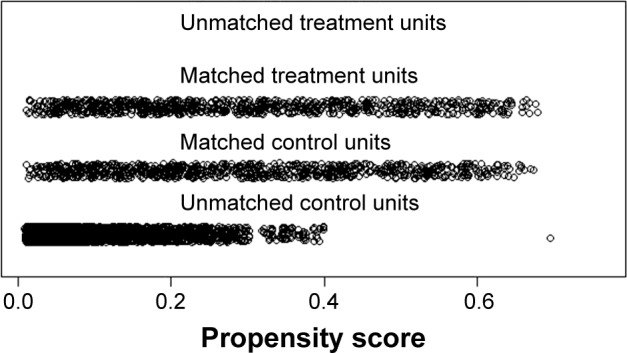
This was a population-based cross-sectional study. Data were obtained from the sixth Korean National Health and Nutrition Examination Survey, which was conducted from 2013 to 2015. To reduce the effects of HGS-related factors and potential confounding factors, propensity score matching was used to match subjects with and without COPD.
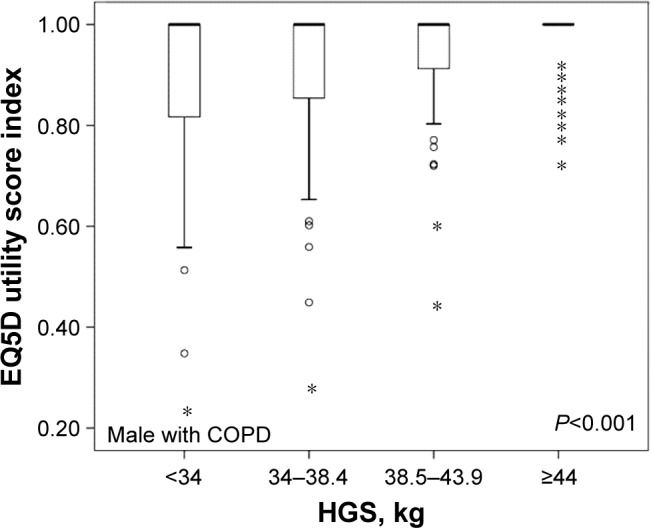
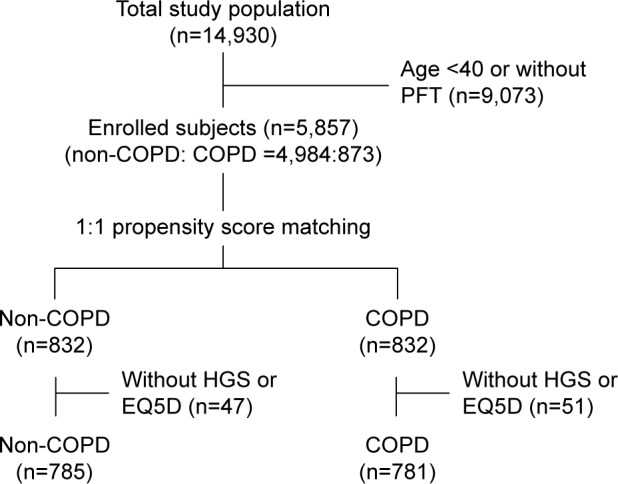
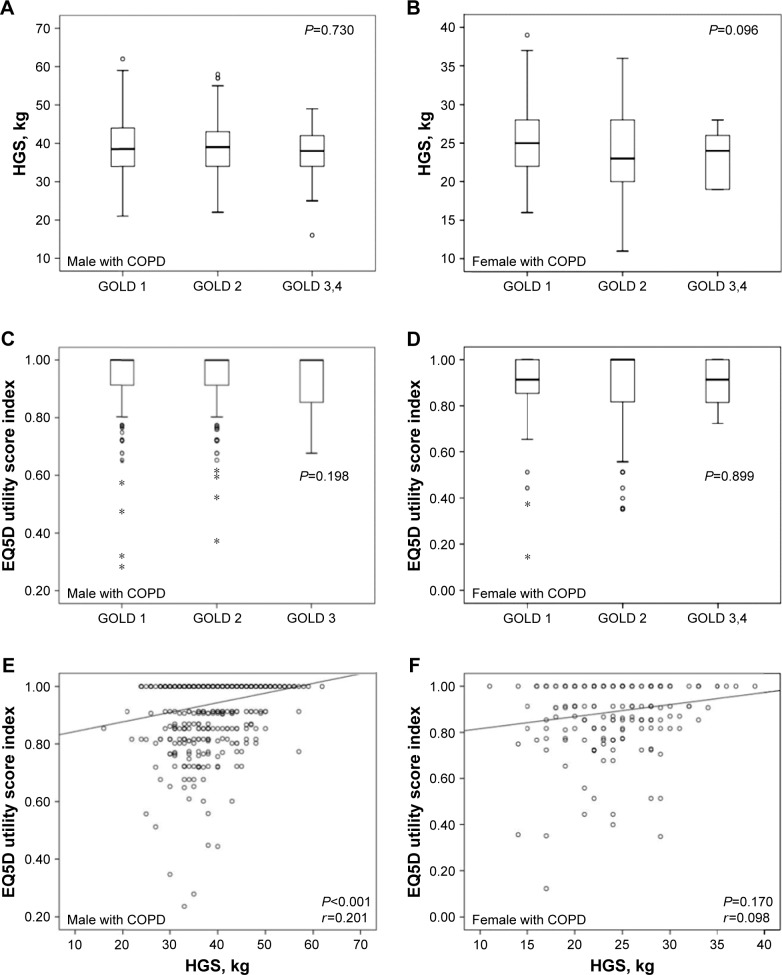
Among 14,930 subjects, 832 were enrolled in each group (non-COPD and COPD) after propensity score matching. COPD subjects did not have lower HGS than non-COPD subjects (non-COPD vs COPD, male, 38.0±7.0 vs 38.9±7.0 kg, =0.044, female, 23.8±4.6 vs 24.2±4.9 kg, =0.342). Lung function was classified by Global Initiative for Chronic Obstructive Lung Disease stages and was not significantly associated with HGS. For male COPD subjects, there was a significant correlation between HGS and the EuroQol Five-Dimension Questionnaire (EQ5D) utility score index, which is an indicator of quality of life that adjusts for age and body mass index (=0.201, <0.001). The correlation was absent for female subjects (=0.098, =0.170).
COPD subjects did not have lower HGS than non-COPD subjects. HGS did not associate with lung function. However, the HGS of male COPD subjects was positively associated with EQ5D utility score index, an indicator of quality of life. HGS may be helpful as an additional method to the evaluation of quality of life in male COPD patients.
已知肌肉量与老年人的死亡率相关。由于握力(HGS)是一种已知的肌肉力量简单评估工具,许多研究人员研究了握力与疾病之间的关联。然而,慢性阻塞性肺疾病(COPD)与握力之间关系的实证证据仍存在争议。本研究的目的是利用韩国人群数据评估慢性阻塞性肺疾病与握力之间的关联。
这是一项基于人群的横断面研究。数据来自2013年至2015年进行的第六次韩国国家健康与营养检查调查。为了减少与握力相关因素和潜在混杂因素的影响,采用倾向得分匹配法对慢性阻塞性肺疾病患者和非慢性阻塞性肺疾病患者进行匹配。
在14930名受试者中,倾向得分匹配后每组纳入832名(非慢性阻塞性肺疾病组和慢性阻塞性肺疾病组)。慢性阻塞性肺疾病患者的握力并不低于非慢性阻塞性肺疾病患者(非慢性阻塞性肺疾病组与慢性阻塞性肺疾病组,男性,38.0±7.0 vs 38.9±7.0千克,P = 0.044;女性,23.8±4.6 vs 24.2±4.9千克,P = 0.342)。肺功能根据慢性阻塞性肺疾病全球倡议阶段进行分类,与握力无显著关联。对于男性慢性阻塞性肺疾病患者,握力与欧洲五维健康量表(EQ5D)效用评分指数之间存在显著相关性,该指数是一种根据年龄和体重指数调整的生活质量指标(r = 0.201,P < 0.001)。女性受试者不存在这种相关性(r = 0.098,P = 0.170)。
慢性阻塞性肺疾病患者的握力并不低于非慢性阻塞性肺疾病患者。握力与肺功能无关。然而,男性慢性阻塞性肺疾病患者的握力与EQ5D效用评分指数呈正相关,该指数是生活质量的一个指标。握力可能作为评估男性慢性阻塞性肺疾病患者生活质量的一种附加方法。