Wellman Center for Photomedicine, Massachusetts General Hospital, Harvard Medical School, Boston, USA.
Department of Precision Engineering, University of Tokyo, Tokyo, Japan.
Sci Rep. 2017 Aug 23;7(1):9169. doi: 10.1038/s41598-017-08693-5.
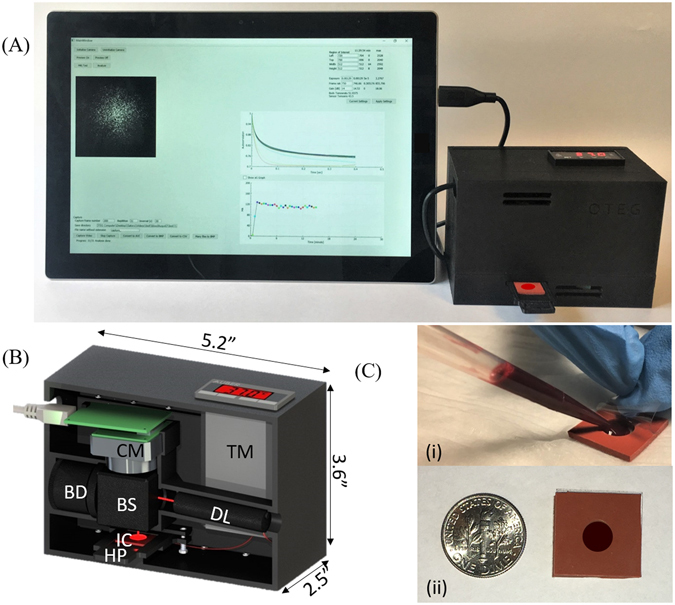
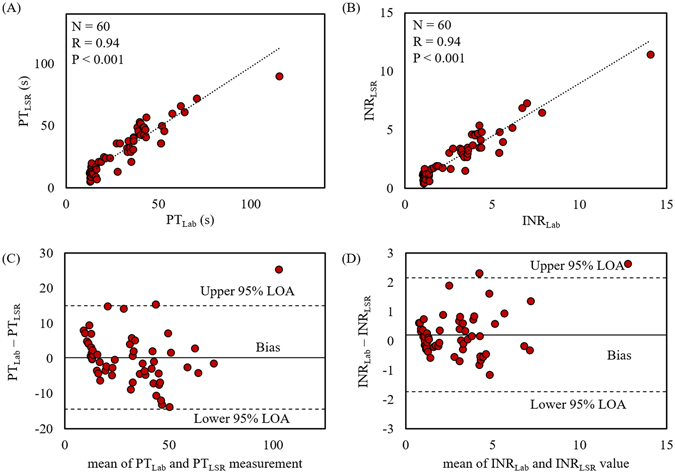
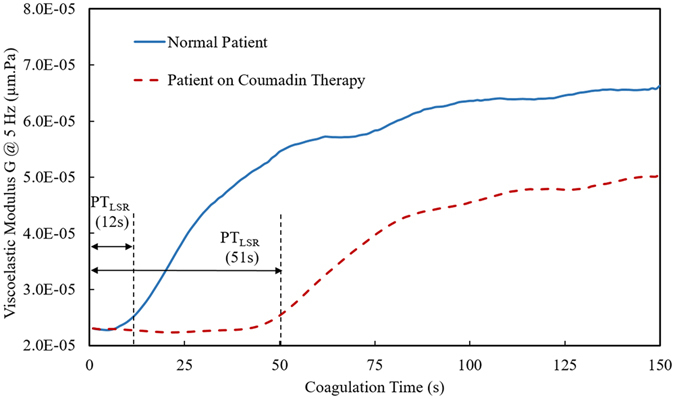
Prothrombin time (PT) and the associated international normalized ratio (INR) are routinely tested to assess the risk of bleeding or thrombosis and to monitor response to anticoagulant therapy in patients. To measure PT/INR, conventional coagulation testing (CCT) is performed, which is time-consuming and requires the separation of cellular components from whole blood. Here, we report on a portable and battery-operated optical sensor that can rapidly quantify PT/INR within seconds by measuring alterations in the viscoelastic properties of a drop of whole blood following activation of coagulation with thromboplastin. In this study, PT/INR values were measured in 60 patients using the optical sensor and compared with the corresponding CCT values. Our results report a close correlation and high concordance between PT/INR measured using the two approaches. These findings confirm the accuracy of our optical sensing approach for rapid PT/INR testing in whole blood and highlight the potential for use at the point-of-care or for patient self-testing.
凝血酶原时间(PT)和相关的国际标准化比值(INR)通常用于评估出血或血栓形成的风险,并监测抗凝治疗的反应。为了测量 PT/INR,通常进行常规凝血检测(CCT),该检测耗时且需要从全血中分离细胞成分。在这里,我们报告了一种便携式和电池供电的光学传感器,它可以通过测量凝血酶原激活后全血的粘弹性变化,在几秒钟内快速定量 PT/INR。在这项研究中,使用光学传感器测量了 60 名患者的 PT/INR 值,并与相应的 CCT 值进行了比较。我们的结果报告了两种方法测量的 PT/INR 之间具有密切的相关性和高度的一致性。这些发现证实了我们的光学传感方法在全血中快速 PT/INR 检测的准确性,并强调了在即时护理或患者自我检测中的应用潜力。