Bioagricultural Science and Pest Management, Colorado State University, Fort Collins, CO, 80523, USA.
School of Agriculture and Food Sciences, The University of Queensland, Brisbane, QLD, 4072, Australia.
Microb Biotechnol. 2017 Sep;10(5):999-1003. doi: 10.1111/1751-7915.12804. Epub 2017 Aug 25.
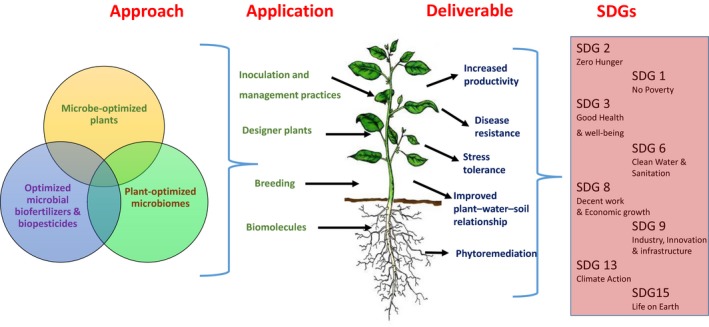
Plant-associated microbiomes have tremendous potential to improve plant resilience and yields in farming systems. There is increasing evidence that biological technologies that use microbes or their metabolites can enhance nutrient uptake and yield, control pests and mitigate plant stress responses. However, to fully realize the potential of microbial technology, their efficacy and consistency under the broad range of real-world conditions need to be improved. While the optimization of microbial biofertilizers and biopesticides is advancing rapidly to enable use in various soils, crop varieties and environments, crop breeding programmes have yet to incorporate the selection of beneficial plant-microbe interactions to breed 'microbe-optimized plants'. Emerging efforts exploring microbiome engineering could lead to microbial consortia that are better suited to support plants. The combination of all three approaches could be integrated to achieve maximum benefits and significantly improved crop yields to address food security.
植物相关微生物组具有巨大的潜力,可以提高农业系统中植物的抗逆性和产量。越来越多的证据表明,利用微生物或其代谢物的生物技术可以提高养分吸收和产量,控制害虫并减轻植物的应激反应。然而,要充分发挥微生物技术的潜力,需要提高其在广泛的实际条件下的功效和一致性。虽然微生物生物肥料和生物农药的优化正在迅速推进,以使其能够在各种土壤、作物品种和环境中使用,但作物育种计划尚未将有益的植物-微生物相互作用的选择纳入其中,以培育“微生物优化植物”。新兴的微生物组工程探索努力可能会导致更适合支持植物的微生物共生体。这三种方法的结合可以整合起来,以获得最大的效益和显著提高作物产量,从而解决粮食安全问题。