Nai Jianwei, Guan Bu Yuan, Yu Le, Lou Xiong Wen David
School of Chemical and Biomedical Engineering, Nanyang Technological University, 62 Nanyang Drive, Singapore 637459, Singapore.
Sci Adv. 2017 Aug 23;3(8):e1700732. doi: 10.1126/sciadv.1700732. eCollection 2017 Aug.
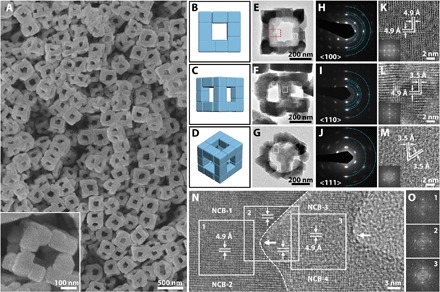
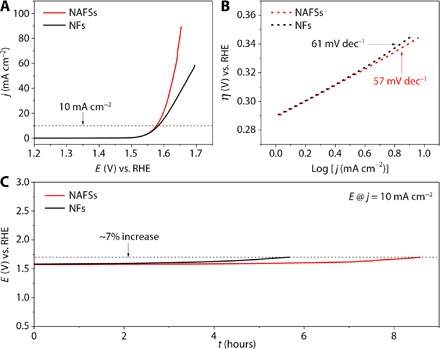
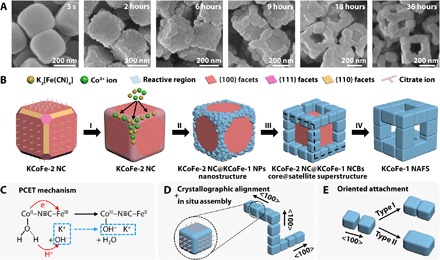
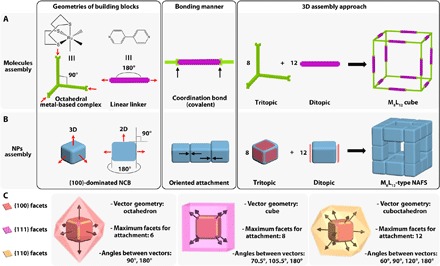
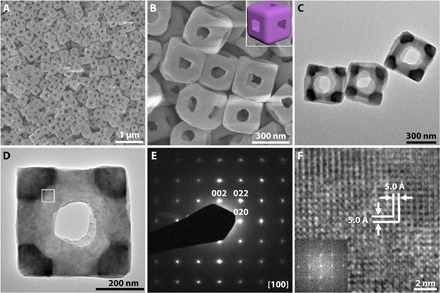
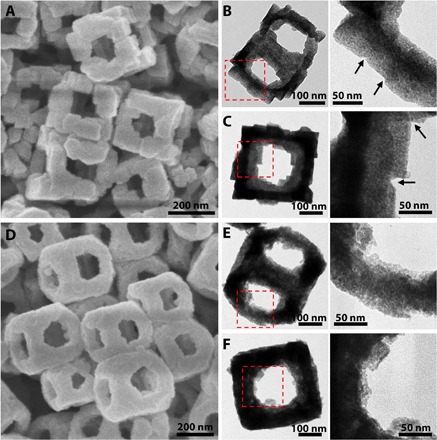
It is fascinating but challenging for nanoscientists to organize nanoparticles (NPs) into ordered architectures just as it is for chemists to manipulate atoms and molecules to form functional molecules and supramolecules. We explore a strategy to assemble anisotropic NPs into open frame-like superstructures via oriented attachment (OA), experimentally realizing a nanoscale analog to the bonding behavior in ML-type supramolecular cubes. We highlight the role of NP shape in the OA-involved assembly for constructing predictable superstructures. In addition, the frame-like superstructures can retain their basic structure when undergoing postcrystallization of the building blocks as well as annealing for conversion toward functional electrocatalytic materials. Our work enables fundamental insights into directional "bonding" among NPs and adds to the growing body of knowledge for bottom-up assembly of anisotropic NPs into sophisticated functional materials.
对于纳米科学家而言,将纳米粒子(NPs)组装成有序结构既迷人又具有挑战性,这就如同化学家操纵原子和分子以形成功能分子和超分子一样。我们探索了一种通过定向附着(OA)将各向异性纳米粒子组装成开放框架状超结构的策略,通过实验实现了与ML型超分子立方体中键合行为的纳米级类似物。我们强调了纳米粒子形状在涉及OA的组装中对构建可预测超结构的作用。此外,当构建块进行后结晶以及退火以转化为功能电催化材料时,框架状超结构可以保留其基本结构。我们的工作为纳米粒子之间的定向“键合”提供了基本见解,并为将各向异性纳米粒子自下而上组装成复杂功能材料的知识体系增添了内容。