Hansen Thomas A, Bartels Mette D, Høgh Silje V, Dons Lone E, Pedersen Michael, Jensen Thøger G, Kemp Michael, Skov Marianne N, Gumpert Heidi, Worning Peder, Westh Henrik
Department of Clinical Microbiology, Hvidovre University HospitalHvidovre, Denmark.
Department of Clinical Microbiology, Odense University HospitalOdense, Denmark.
Front Microbiol. 2017 Aug 9;8:1512. doi: 10.3389/fmicb.2017.01512. eCollection 2017.
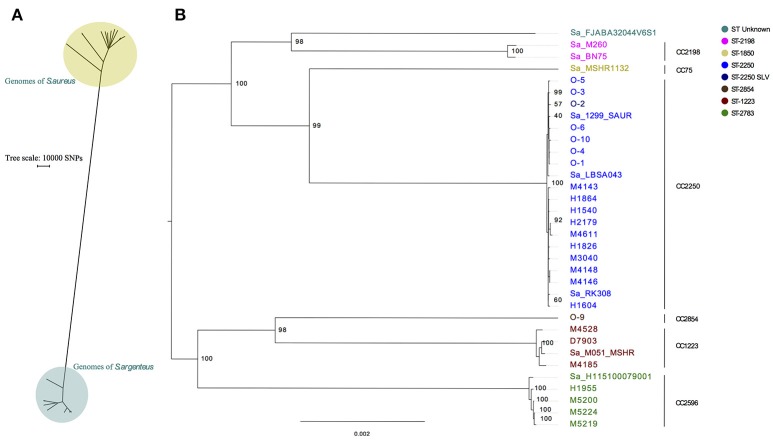
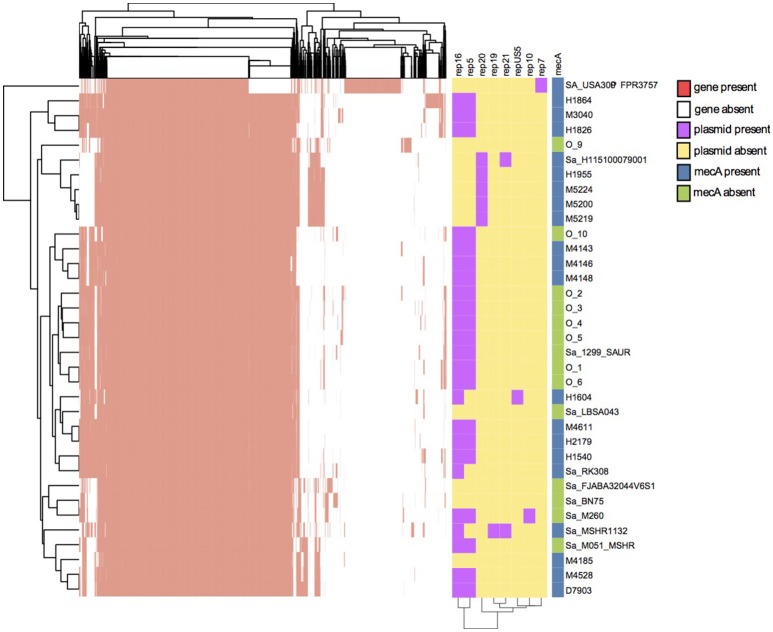
() is a newly identified species that has been misidentified as () and is clinically relevant. We identified 25 genomes in our collection of whole genome sequenced . These genomes were compared to publicly available genomes and a phylogeny revealed seven clusters corresponding to seven clonal complexes. The genome of was found to be different from the genome of and a core genome analysis showed that ~33% of the total gene pool was shared between the two species, at 90% homology level. An assessment of mobile elements shows flow of SCC cassettes, plasmids, phages, and pathogenicity islands, between and . This dataset emphasizes that and are two separate species that share genetic material.
()是一个新鉴定出的物种,曾被误鉴定为(),且具有临床相关性。我们在全基因组测序集合中鉴定出25个基因组。将这些基因组与公开可用的基因组进行比较,系统发育分析揭示了对应于七个克隆复合体的七个簇。发现()的基因组与()的基因组不同,核心基因组分析表明,在90%同源性水平下,两个物种之间共享约33%的总基因库。对移动元件的评估显示了SCC盒、质粒、噬菌体和致病岛在()和()之间的流动。该数据集强调()和()是共享遗传物质的两个不同物种。