Berkan-Kawińska Aleksandra, Koślińska-Berkan Ewa, Piekarska Anna
Department of Infectious Diseases and Hepatology, Medical University of Lodz, Lodz, Poland.
Clin Exp Hepatol. 2015 May;1(1):5-11. doi: 10.5114/ceh.2015.51373. Epub 2015 Apr 30.
To assess the prevalence and severity of vitamin D insufficiency in patients with hepatitis C virus (HCV) infection and in patients with hepatitis B virus (HBV) infection.
This prospective study included 90 patients with chronic hepatitis C and 35 patients with chronic hepatitis B admitted to the Infectious Diseases Department between March 2013 and May 2014. Patients with chronic liver disease other than viral hepatitis, HIV co-infection, advanced liver disease and a history of diseases influencing vitamin D status were excluded. Serum vitamin D measurement as well as liver function, viral load, HCV genotype, interleukin 28 and liver fibrosis assessments were performed.
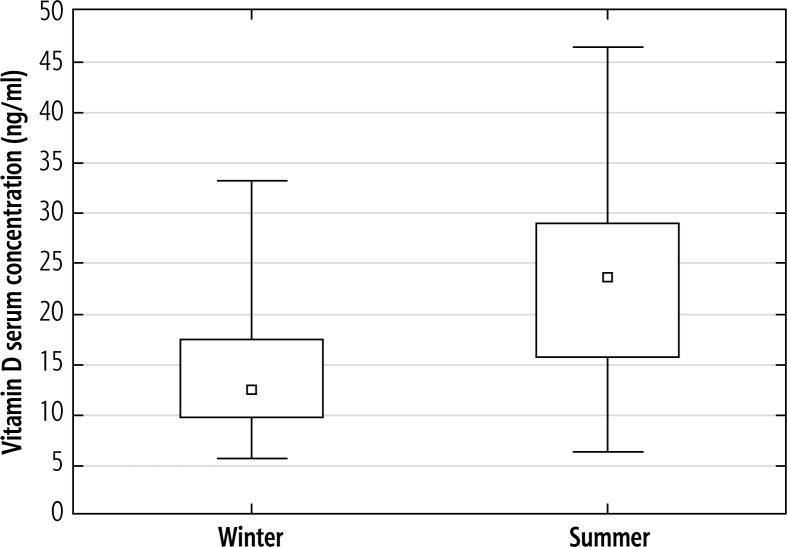
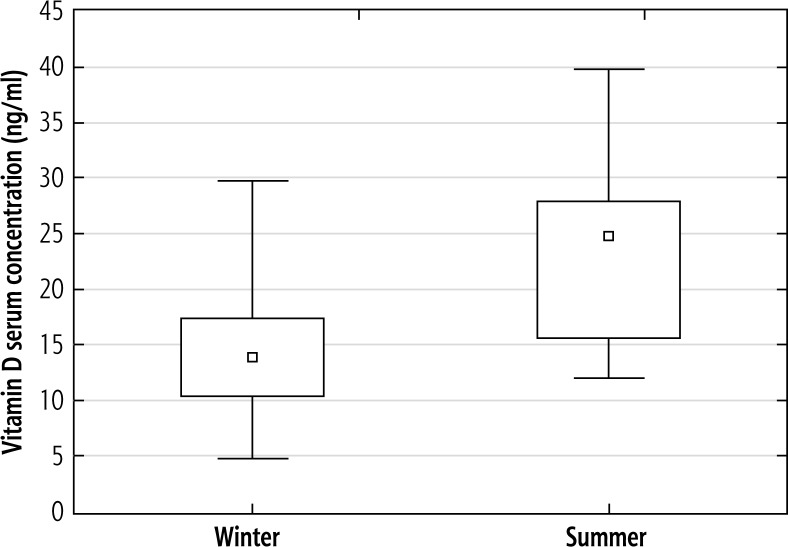
In all patients, the mean vitamin D serum concentration was 18.8 (± 8.9) ng/ml. The mean vitamin D level in HBV infected patients was lower than in HCV infected patients (17.6 ng/ml vs. 19.3 ng/ml; = 0.43). Vitamin D status was assessed in relation to viral load, HCV genotype, interleukin 28 and sex, but the differences were not significant. In both groups, serum vitamin D levels were significantly lower in winter compared to summer (14.2 ng/ml vs. 23.9 ng/ml in patients infected with HCV [ < 0.000001] and 14.7 ng/ml vs. 23.8 ng/ml in patients infected with HBV [ < 0.001]).
Our study showed that in patients with chronic hepatitis C or chronic hepatitis B, insufficient 25(OH)D concentrations occur very often, but are not associated with poor virological characteristics. The only factor influencing the vitamin D level was the season.
评估丙型肝炎病毒(HCV)感染患者和乙型肝炎病毒(HBV)感染患者维生素D不足的患病率和严重程度。
这项前瞻性研究纳入了2013年3月至2014年5月间收治于传染病科的90例慢性丙型肝炎患者和35例慢性乙型肝炎患者。排除了除病毒性肝炎以外的慢性肝病患者、合并HIV感染患者、晚期肝病患者以及有影响维生素D状态疾病史的患者。进行了血清维生素D测定以及肝功能、病毒载量、HCV基因型、白细胞介素28和肝纤维化评估。
所有患者的维生素D血清平均浓度为18.8(±8.9)ng/ml。HBV感染患者的维生素D平均水平低于HCV感染患者(17.6 ng/ml对19.3 ng/ml;P = 0.43)。根据病毒载量、HCV基因型、白细胞介素28和性别评估维生素D状态,但差异无统计学意义。两组患者中,冬季的血清维生素D水平均显著低于夏季(HCV感染患者中为14.2 ng/ml对23.9 ng/ml[P<0.000001],HBV感染患者中为14.7 ng/ml对23.8 ng/ml[P<0.001])。
我们的研究表明,慢性丙型肝炎或慢性乙型肝炎患者中,25(OH)D浓度不足的情况很常见,但与不良病毒学特征无关。影响维生素D水平的唯一因素是季节。