Ahn Jong Ho, Choi Yoon-Hyeong, Paik Hae Jung, Kim Mee Kum, Wee Won Ryang, Kim Dong Hyun
Department of Ophthalmology, Gachon University Gil Medical Center.
Department of Preventive Medicine, Gachon University College of Medicine, Incheon.
Clin Interv Aging. 2017 Aug 22;12:1331-1338. doi: 10.2147/CIA.S140912. eCollection 2017.
Aging is a major risk factor in dry eye disease (DED), and understanding sexual differences is very important in biomedical research. However, there is little information about sex differences in the effect of aging on DED. We investigated sex differences in the effect of aging and other risk factors for DED.
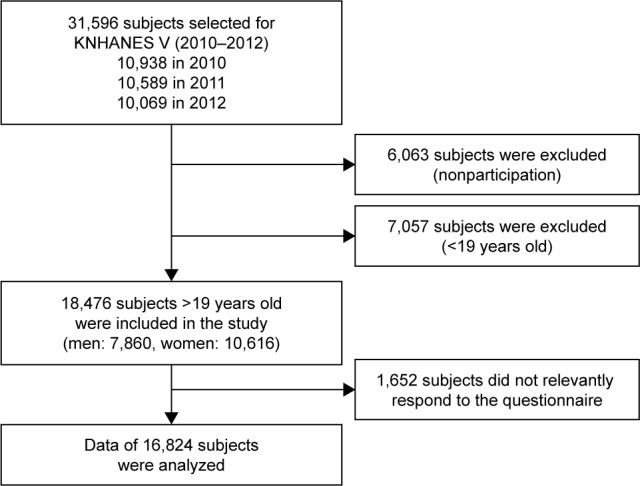
This study included data of 16,824 adults from the Korea National Health and Nutrition Examination Survey (2010-2012), which is a population-based cross-sectional survey. DED was defined as the presence of frequent ocular dryness or a previous diagnosis by an ophthalmologist. Basic sociodemographic factors and previously known risk factors for DED were included in the analyses. Linear regression modeling and multivariate logistic regression modeling were used to compare the sex differences in the effect of risk factors for DED; we additionally performed tests for interactions between sex and other risk factors for DED in logistic regression models.
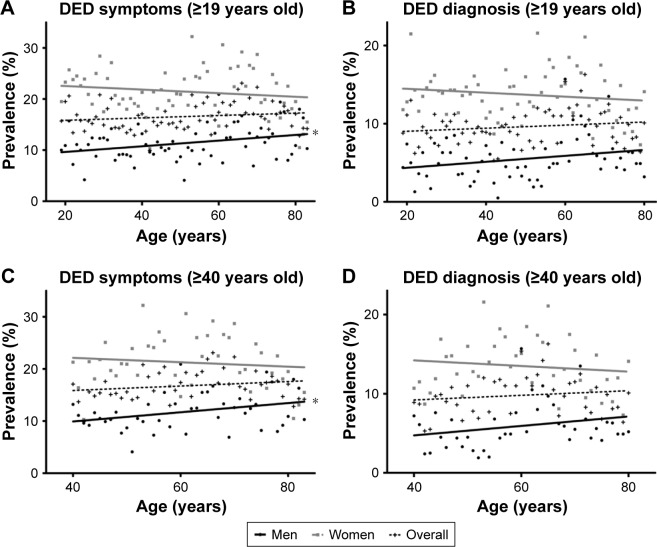
In our linear regression models, the prevalence of DED symptoms in men increased with age (=0.311, =0.012); however, there was no association between aging and DED in women (>0.05). Multivariate logistic regression analyses showed that aging in men was not associated with DED (DED symptoms/diagnosis: odds ratio [OR] =1.01/1.04, each >0.05), while aging in women was protectively associated with DED (DED symptoms/diagnosis: OR =0.94/0.91, =0.011/0.003). Previous ocular surgery was significantly associated with DED in both men and women (men/women: OR =2.45/1.77 [DED symptoms] and 3.17/2.05 [DED diagnosis], each <0.001). Tests for interactions of sex revealed significantly different aging × sex and previous ocular surgery × sex interactions ( for interaction of sex: DED symptoms/diagnosis - 0.044/0.011 [age] and 0.012/0.006 [previous ocular surgery]).
There were distinct sex differences in the effect of aging on DED in the Korean population. DED following ocular surgery also showed sexually different patterns. Age matching and sex matching are strongly recommended in further studies about DED, especially DED following ocular surgery.
衰老为干眼病(DED)的主要风险因素,了解性别差异在生物医学研究中非常重要。然而,关于衰老对DED影响的性别差异信息较少。我们调查了衰老及DED其他风险因素影响方面的性别差异。
本研究纳入了韩国国民健康与营养检查调查(2010 - 2012年)中16824名成年人的数据,这是一项基于人群的横断面调查。DED定义为频繁出现眼部干涩或曾被眼科医生诊断为此病。分析中纳入了基本社会人口统计学因素及DED已知的风险因素。采用线性回归模型和多因素逻辑回归模型比较DED风险因素影响方面的性别差异;我们还在逻辑回归模型中对性别与DED其他风险因素之间的相互作用进行了检验。
在我们的线性回归模型中,男性DED症状的患病率随年龄增加而升高(=0.311,=0.012);然而,衰老与女性DED之间无关联(>0.05)。多因素逻辑回归分析显示,男性衰老与DED无关联(DED症状/诊断:比值比[OR]=1.01/1.04,均>0.05),而女性衰老与DED呈保护性关联(DED症状/诊断:OR =0.94/0.91,=0.011/0.003)。既往眼部手术在男性和女性中均与DED显著相关(男性/女性:OR =2.45/1.77[DED症状]和3.17/2.05[DED诊断],均<0.001)。性别相互作用检验显示,衰老×性别和既往眼部手术×性别存在显著不同的相互作用(性别相互作用:DED症状/诊断 - 0.044/0.011[年龄]和0.012/0.006[既往眼部手术])。
在韩国人群中,衰老对DED的影响存在明显的性别差异。眼部手术后的DED也呈现出性别差异模式。在关于DED,尤其是眼部手术后DED的进一步研究中,强烈建议进行年龄匹配和性别匹配。