Loh Edwin Hong-Teck, Ong Yi-Ting, Venketasubramanian Narayanaswamy, Hilal Saima, Thet Naing, Wong Tien Yin, Chen Christopher P L, Cheung Carol Yim-Lui
Singapore Eye Research Institute, Singapore National Eye Centre, Singapore, Singapore.
Duke-NUS Medical School, National University of Singapore, Singapore, Singapore.
Front Neurol. 2017 Aug 15;8:359. doi: 10.3389/fneur.2017.00359. eCollection 2017.
With increasing interest in determining if measurement of retinal neuronal structure with spectral-domain optical coherence tomography (SD-OCT) is useful in accessing neurodegenerative process in cognitive decline and development of dementia, it is important to evaluate whether the SD-OCT measurements are repeatable and reproducible in these patients.
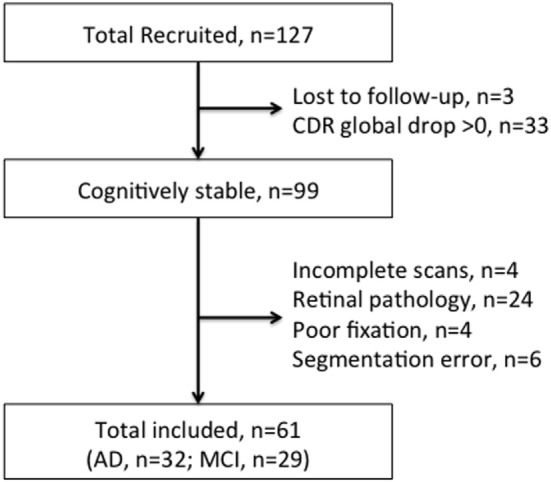
This is a retrospective cohort study. Patients with Alzheimer's disease (AD) or mild cognitive impairment (MCI) with no change in global clinical dementia rating (CDR) score at 1-year follow-up were eligible to be included. Ganglion cell-inner plexiform layer (GC-IPL) and retinal nerve fiber layer (RNFL) parameters were measured with SD-OCT at baseline, 6-month, and 1-year follow-up visits. At baseline, SD-OCT scans were repeated to access intra-visit repeatability of the SD-OCT measurement. SD-OCT measurement over three visits was used to access inter-visit reproducibility. We calculated intraclass correlation coefficients (ICC) and coefficients of variation (CoVs).
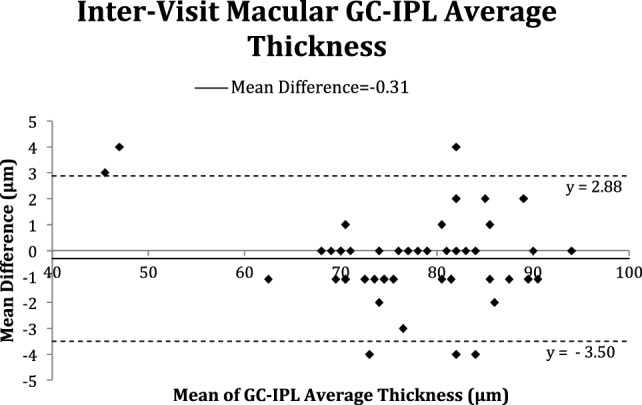
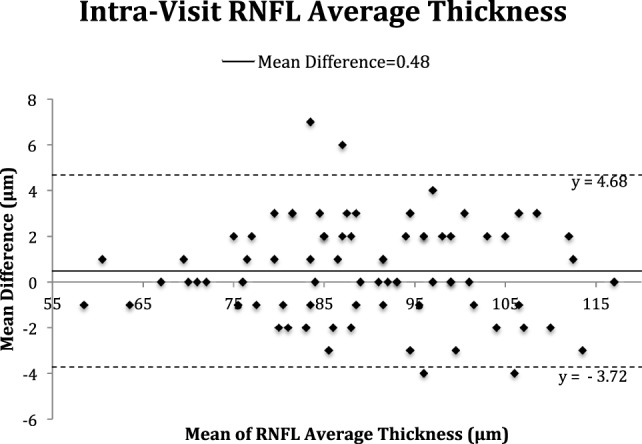
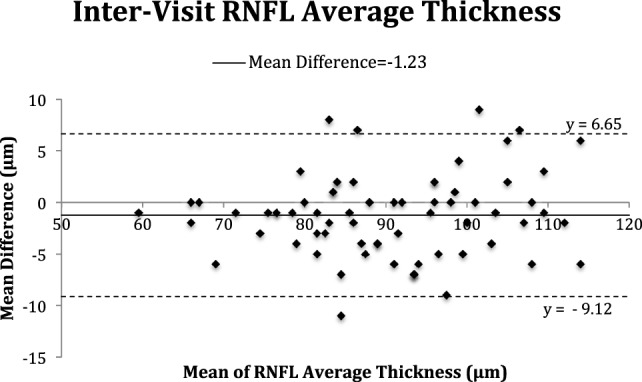
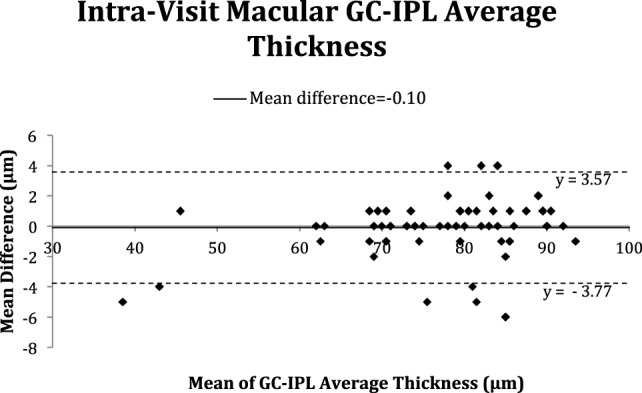
We included 32 patients with stable AD and 29 patients with stable MCI in the final analysis. For GC-IPL measures, the average intra-visit ICC was 0.969 (range: 0.948-0.985), and CoV was 1.81% (range: 1.14-2.40); while the average inter-visit ICC was 0.968 (0.941-0.985), and CoV was 1.91% (range: 1.24-2.32). The average ICC and CoV of intra-visit RNFL measured were 0.965 (range: 0.937-0.986) and 2.32% (range: 1.34-2.90%), respectively. The average ICC and CoV of inter-visit RNFL measures were 0.927 (range: 0.845-0.961) and 3.83% (range: 2.71-5.25%), respectively.
Both GC-IPL and RNFL measurements had good intra-visit repeatability and inter-visit reproducibility over 1 year in elderly patients with no decline in cognitive function, suggesting that SD-OCT is a reliable tool to assess neurodegenerative process over time.
随着人们越来越关注利用光谱域光学相干断层扫描(SD - OCT)测量视网膜神经元结构是否有助于评估认知功能下降和痴呆症发展过程中的神经退行性变,评估SD - OCT测量在这些患者中是否具有可重复性和再现性非常重要。
这是一项回顾性队列研究。纳入在1年随访中全球临床痴呆评定量表(CDR)评分无变化的阿尔茨海默病(AD)或轻度认知障碍(MCI)患者。在基线、6个月和1年随访时用SD - OCT测量神经节细胞 - 内丛状层(GC - IPL)和视网膜神经纤维层(RNFL)参数。在基线时,重复进行SD - OCT扫描以评估SD - OCT测量的访内重复性。三次访视的SD - OCT测量用于评估访间再现性。我们计算了组内相关系数(ICC)和变异系数(CoV)。
最终分析纳入了32例病情稳定的AD患者和29例病情稳定的MCI患者。对于GC - IPL测量,平均访内ICC为0.969(范围:0.948 - 0.985),CoV为1.81%(范围:1.14 - 2.40);而平均访间ICC为0.968(0.941 - 0.985),CoV为1.91%(范围:1.24 - 2.32)。访内RNFL测量的平均ICC和CoV分别为0.965(范围:0.937 - 0.986)和2.32%(范围:1.34 - 2.90%)。访间RNFL测量的平均ICC和CoV分别为0.927(范围:0.845 - 0.961)和3.83%(范围:2.71 - 5.25%)。
在认知功能无下降的老年患者中,GC - IPL和RNFL测量在1年中均具有良好的访内重复性和访间再现性,这表明SD - OCT是评估随时间变化的神经退行性变过程的可靠工具。