Cheng Hui-Man, Wu Yang-Chang, Wang Qingmin, Song Michael, Wu Jackson, Chen Dion, Li Katherine, Wadman Eric, Kao Shung-Te, Li Tsai-Chung, Leon Francisco, Hayden Karen, Brodmerkel Carrie, Chris Huang C
Department of Integration of Traditional Chinese and Western Medicine, China Medical University Hospital, Taichung, Taiwan.
School of Chinese Medicine, College of Chinese Medicine, China Medical University, Taichung, Taiwan.
BMC Complement Altern Med. 2017 Sep 2;17(1):439. doi: 10.1186/s12906-017-1947-1.
Indigo naturalis is a Traditional Chinese Medicine (TCM) ingredient long-recognized as a therapy for several inflammatory conditions, including psoriasis. However, its mechanism is unknown due to lack of knowledge about the responsible chemical entity. We took a different approach to this challenge by investigating the molecular profile of Indigo naturalis treatment and impacted pathways.
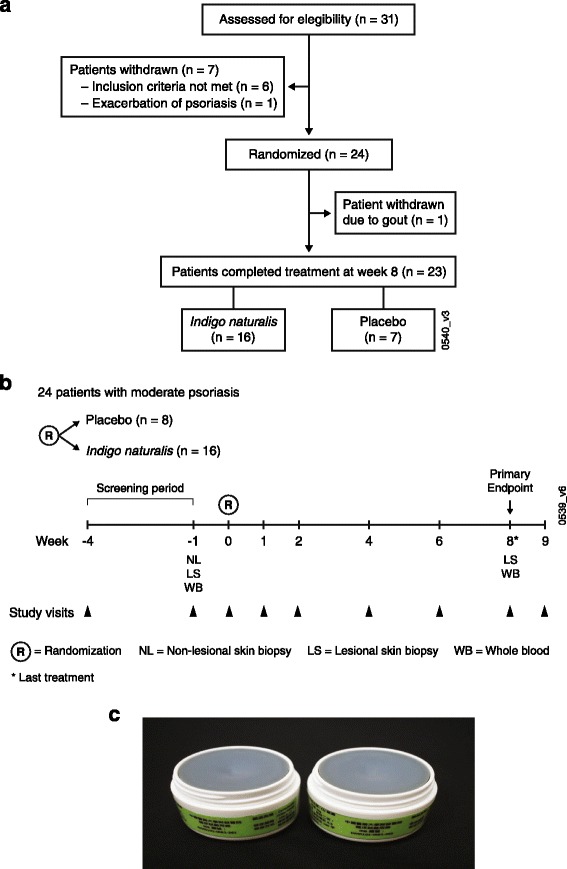
A randomized, double-blind, placebo-controlled clinical study was conducted using Indigo naturalis as topical monotherapy to treat moderate plaque psoriasis in a Chinese cohort (n = 24). Patients were treated with Indigo naturalis ointment (n = 16) or matched placebo (n = 8) twice daily for 8 weeks, with 1 week of follow-up.
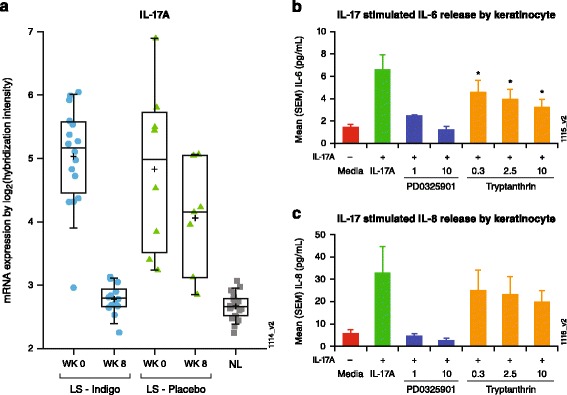
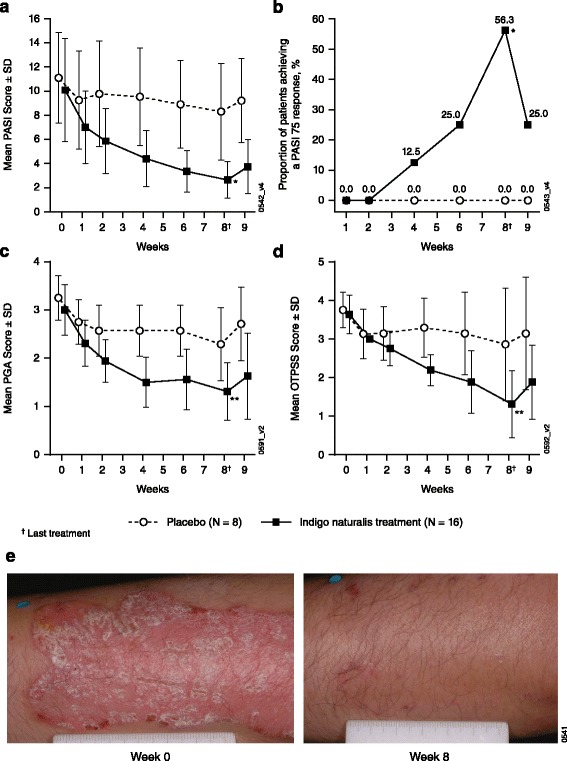
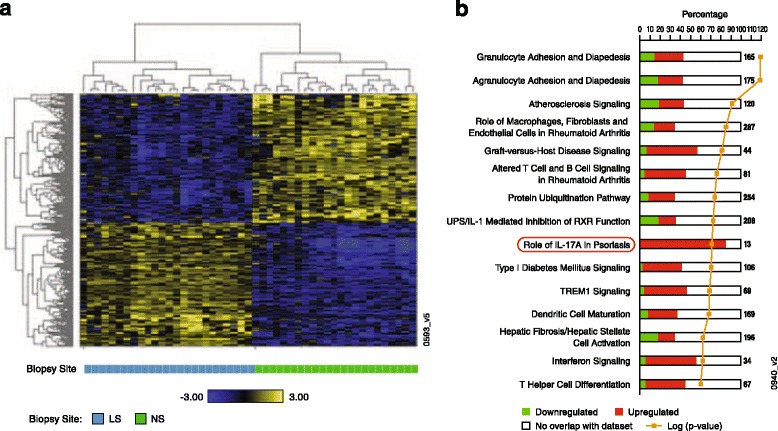
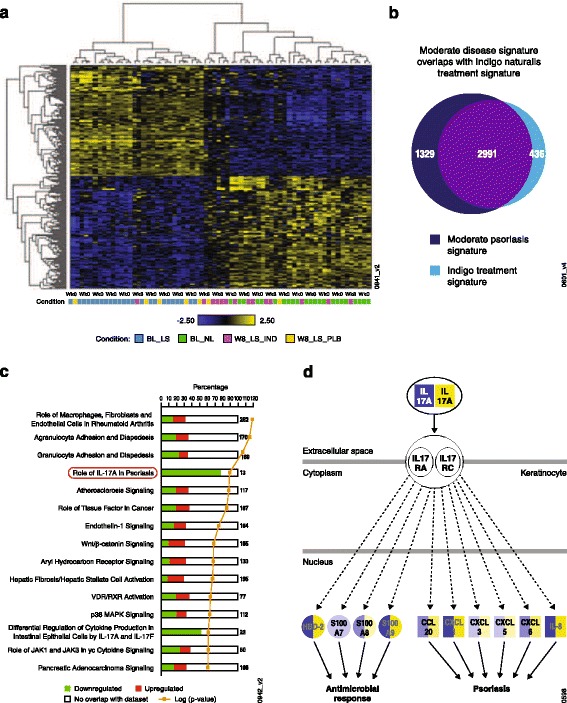
At week 8, significant improvements in Psoriasis Area and Severity Index (PASI) scores from baseline were observed in Indigo naturalis-treated patients (56.3% had 75% improvement [PASI 75] response) compared with placebo (0.0%). A gene expression signature of moderate psoriasis was established from baseline skin biopsies, which included the up-regulation of the interleukin (IL)-17 pathway as a key component; Indigo naturalis treatment resulted in most of these signature genes returning toward normal, including down-regulation of the IL-17 pathway. Using an in vitro keratinocyte assay, an IL-17-inhibitory effect was observed for tryptanthrin, a component of Indigo naturalis.
This study demonstrated the clinical efficacy of Indigo naturalis in moderate psoriasis, and exemplified a novel experimental medicine approach to understand TCM targeting mechanisms.
NCT01901705 .
青黛是一种传统中药成分,长期以来被认为可用于治疗多种炎症性疾病,包括银屑病。然而,由于对其有效化学实体缺乏了解,其作用机制尚不清楚。我们采用了一种不同的方法来应对这一挑战,即研究青黛治疗的分子图谱和受影响的通路。
在中国队列(n = 24)中进行了一项随机、双盲、安慰剂对照的临床研究,使用青黛作为局部单一疗法治疗中度斑块状银屑病。患者每天两次接受青黛软膏治疗(n = 16)或匹配的安慰剂治疗(n = 8),持续8周,并进行1周的随访。
在第8周时,与安慰剂组(0.0%)相比,接受青黛治疗的患者银屑病面积和严重程度指数(PASI)评分较基线有显著改善(56.3%的患者有75%改善 [PASI 75]反应)。从基线皮肤活检中建立了中度银屑病的基因表达特征,其中包括白细胞介素(IL)-17通路的上调作为关键组成部分;青黛治疗使这些特征基因中的大多数恢复正常,包括IL-17通路的下调。使用体外角质形成细胞试验,观察到青黛成分色胺酮具有IL-17抑制作用。
本研究证明了青黛在中度银屑病中的临床疗效,并举例说明了一种理解中药靶向机制的新型实验医学方法。
NCT01901705 。