Department of Nursing, The Second Xiangya Hospital of Central South University, Changsha, Hunan, People's Republic of China.
Nursing School of Central South University, Changsha, Hunan, People's Republic of China.
Int J Equity Health. 2017 Sep 2;16(1):163. doi: 10.1186/s12939-017-0639-2.
Due to lack of companionship of parents, compared with non left behind children, left behind children (LBC) suffer from more psychological problems compared with children live with their parents. The aim of this study was to explore the mental health status and the relationship among psychological problems and the related factors of LBC.
Adopting delaminating-random-group sampling and using region, county, village (town) as sampling framework, we utilized Demographic Data Recording Form, Adolescent Self-Rating Life Events Check List, Scale of APGAR, Perceived Social Support Scale, Simplified Coping Style Questionnaire, Eysenck Personality Questionnaire, Self-Esteem Scale and Scale of Mental Health for Chinese Middle-school Student to assess 1309 left behind child in junior middle school students' mental health in Hunan. Statistic description, Structural equation model was adopted to analyze the data.
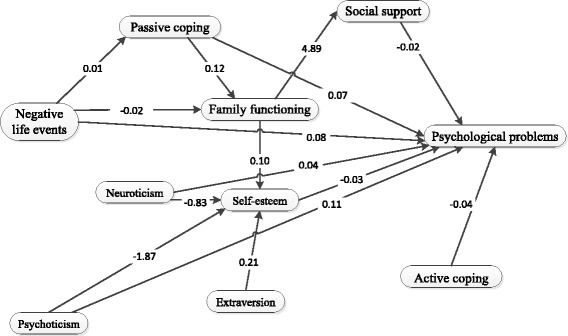
There was a significant difference in score of psychological problems between LBC and non-LBC(F = 18.224, P<0.000). Life event was the major factor(r = .487) that affected psychological problems (path coefficient, PC = 0.08) directly and affect psychological problems indirectly through affecting passive coping (PC = 0.01)and family functioning(PC = 0.02); family functioning impacted psychological problems indirectly through affecting social support (PC = 4.89) and self-esteem (PC = 0.10); social support (PC = -0.02), passive coping (PC =0.07) and active coping PC = -0.04) affected psychological problems directly. Psychoticism (P) (PC = 0.11), Neuroticism (N) influenced psychological problems of LBC both directly (PC = 0.04) and indirectly through affecting self-esteem (PC: P:-1.87; N: -0.83), while Extraversion/Introversion (E) (PC = 0.21) only impact psychological problems indirectly through self-esteem. Altogether, these variables accounted for 50.2% of total variance of psychological problems (F = 130.470, P = 0.000) for LBC.
In this research we proved that LBC have more sever psychological problems than non-LBC. We also identified the direct and indirect influential factors of psychological problems of LBC. The findings had important implications for prevention policies and interventions to promote mental health of LBC.
由于缺乏父母的陪伴,留守儿童相较于与父母生活在一起的儿童,更容易出现心理问题。本研究旨在探讨留守儿童的心理健康状况以及心理问题与相关因素之间的关系。
采用分层随机分组的方法,以地区、县、村(镇)为抽样框架,利用人口统计学数据记录表、青少年生活事件自评量表、APGAR 量表、感知社会支持量表、简易应对方式问卷、艾森克人格问卷、自尊量表和中国中学生心理健康量表对湖南省 1309 名初中留守儿童的心理健康状况进行评估。采用统计描述、结构方程模型对数据进行分析。
留守儿童与非留守儿童在心理问题得分上存在显著差异(F=18.224,P<0.000)。生活事件是影响心理问题的主要因素(r=0.487),直接影响心理问题(路径系数,PC=0.08),间接通过影响被动应对(PC=0.01)和家庭功能(PC=0.02)影响心理问题;家庭功能通过影响社会支持(PC=4.89)和自尊(PC=0.10)间接影响心理问题;社会支持(PC=-0.02)、被动应对(PC=0.07)和积极应对(PC=-0.04)直接影响心理问题。精神质(P)(PC=0.11)、神经质(N)直接(PC=0.04)和间接(通过影响自尊,PC:P=-1.87;N:-0.83)影响留守儿童的心理问题,而外向/内向(E)(PC=0.21)仅通过自尊间接影响心理问题。总的来说,这些变量占留守儿童心理问题总方差的 50.2%(F=130.470,P=0.000)。
本研究证明,留守儿童比非留守儿童有更严重的心理问题。我们还确定了留守儿童心理问题的直接和间接影响因素。这些发现对预防政策和干预措施具有重要意义,可以促进留守儿童的心理健康。