González Rueda Vanessa, López de Celis Carlos, Barra López Martín Eusebio, Carrasco Uribarren Andoni, Castillo Tomás Sara, Hidalgo García Cesar
Rehabilitation Service Baix Llobregat Centre, DAP Costa de Ponent, Catalan Institute of Health, Barcelona, Spain.
Jordi Gol Institute of Research on Primary Health Care, Barcelona, Spain.
BMC Musculoskelet Disord. 2017 Sep 5;18(1):384. doi: 10.1186/s12891-017-1744-5.
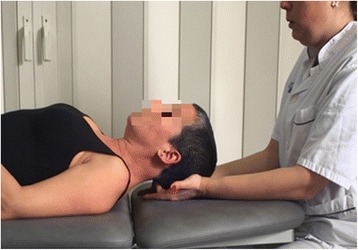
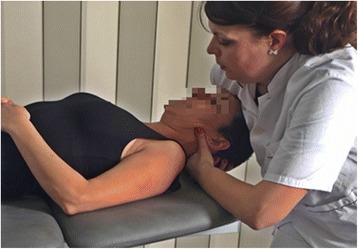
Mechanical neck pain is a highly prevalent problem in primary healthcare settings. Many of these patients have restricted mobility of the cervical spine. Several manual techniques have been recommended for restoring cervical mobility, but their effectiveness in these patients is unknown. The aim of the present study is to compare the effectiveness of two types of specific techniques of the upper neck region: the pressure maintained suboccipital inhibition technique (PMSIT) and the translatory dorsal glide mobilization (TDGM) C0-C1 technique, as adjuncts to a protocolized physiotherapy treatment of the neck region in subjects with chronic mechanical neck pain and rotation deficit in the upper cervical spine.
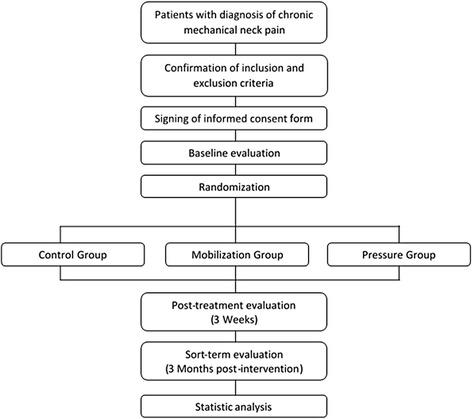
A randomized, prospective, double-blind (patient and evaluator) clinical trial. The participants (n = 78) will be randomly distributed into three groups. The Control Group will receive a protocolized treatment for 3 weeks, the Mobilization Group will receive the same protocolized treatment and 6 sessions (2 per week) of the TDGM C0-C1 technique, and the Pressure Group will receive the same protocolized treatment and 6 sessions (2 per week) of the PMSIT technique. The intensity of pain (VAS), neck disability (NDI), the cervical range of motion (CROM), headache intensity (HIT-6) and the rating of clinical change (GROC scale) will be measured. The measurements will be performed at baseline, post-treatment and 3 months after the end of treatment, by the same physiotherapist blinded to the group assigned to the subject.
We believe that an approach including manual treatment to upper cervical dysfunction will be more effective in these patients. Furthermore, the PMSIT technique acts mostly on the musculature, while the TDGM technique acts on the joint. We expect to clarify which component is more effective in improving the upper cervical mobility.
ClinicalTrials.gov NCT02832232 . Registered on July 13th, 2016.
机械性颈痛是基层医疗环境中极为普遍的问题。这些患者中有许多人的颈椎活动受限。已有多种手法技术被推荐用于恢复颈椎活动度,但它们在这些患者中的有效性尚不清楚。本研究的目的是比较上颈部区域两种特定技术的有效性:持续压力枕下抑制技术(PMSIT)和C0 - C1平移背侧滑动松动术(TDGM),作为慢性机械性颈痛且上颈椎旋转功能障碍患者颈部区域规范化物理治疗方案的辅助手段。
一项随机、前瞻性、双盲(患者和评估者)临床试验。参与者(n = 78)将被随机分为三组。对照组将接受为期3周的规范化治疗,松动术组将接受相同的规范化治疗以及6次(每周2次)TDGM C0 - C1技术治疗,压力组将接受相同的规范化治疗以及6次(每周2次)PMSIT技术治疗。将测量疼痛强度(视觉模拟评分法[VAS])、颈部功能障碍指数(NDI)、颈椎活动范围(CROM)、头痛强度(HIT - 6)以及临床变化评定(GROC量表)。测量将在基线、治疗后以及治疗结束后3个月由对受试者分组不知情的同一名物理治疗师进行。
我们认为,对上颈椎功能障碍采用包括手法治疗在内的方法对这些患者会更有效。此外,PMSIT技术主要作用于肌肉组织,而TDGM技术作用于关节。我们期望阐明哪个组成部分在改善上颈椎活动度方面更有效。
ClinicalTrials.gov NCT02832232。于2016年7月13日注册。