Department of Instructive Biomaterials Engineering, MERLN Institute for Technology-Inspired Regenerative Medicine, Maastricht University, Universiteitssingel 40, Room C3.577, 6229 ER, Maastricht, Netherlands.
Science and Technology Faculty, University of Twente, Drienerlolaan 5, 7522 NB, Enschede, The Netherlands.
Eur J Clin Microbiol Infect Dis. 2018 Feb;37(2):187-208. doi: 10.1007/s10096-017-3089-2. Epub 2017 Sep 4.
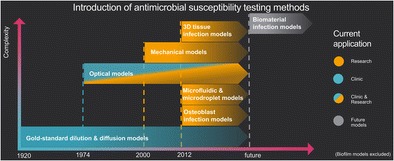
In the field of orthopaedic surgery, bacterial invasion of implants and the resulting periprosthetic infections are a common and unresolved problem. Antimicrobial susceptibility testing methods help to define the optimal treatment and identify antimicrobial resistance. This review discusses proven gold-standard techniques and recently developed models for antimicrobial susceptibility testing, while also providing a future outlook. Conventional, gold-standard methods, such as broth microdilution, are still widely applied in clinical settings. Although recently developed methods based on microfluidics and microdroplets have shown advantages over conventional methods in terms of testing speed, safety and the potential to provide a deeper insight into resistance mechanisms, extensive validation is required to translate this research to clinical practice. Recent optical and mechanical methods are complex and expensive and, therefore, not immediately clinically applicable. Novel osteoblast infection and tissue models best resemble infections in vivo. However, the integration of biomaterials into these models remains challenging and they require a long tissue culture, making their rapid clinical implementation unlikely. A method applicable for both clinical and research environments is difficult to realise. With a continuous increase in antimicrobial resistance, there is an urgent need for methods that analyse recurrent infections to identify the optimal treatment approaches. Graphical abstract Timeline of published and partly applied antimicrobial susceptibility testing methods, listed according to their underlying mechanism, complexity and application in research or clinics.
在骨科手术领域,植入物的细菌入侵和由此导致的假体周围感染是一个常见且未解决的问题。抗菌药物敏感性测试方法有助于确定最佳治疗方法并识别抗菌药物耐药性。本文综述了已证实的金标准技术和最近开发的抗菌药物敏感性测试模型,并对未来进行了展望。传统的金标准方法,如肉汤微量稀释法,仍广泛应用于临床环境中。尽管最近基于微流控和微滴的方法在测试速度、安全性和提供耐药机制深入了解方面显示出优于传统方法的优势,但需要进行广泛的验证才能将这项研究转化为临床实践。最近的光学和机械方法复杂且昂贵,因此不能立即应用于临床。新型成骨细胞感染和组织模型最能模拟体内感染。然而,将生物材料整合到这些模型中仍然具有挑战性,并且需要长时间的组织培养,因此不太可能快速应用于临床。一种适用于临床和研究环境的方法很难实现。随着抗菌药物耐药性的不断增加,迫切需要分析复发性感染的方法来确定最佳治疗方法。图表摘要 按其潜在机制、复杂性和在研究或临床中的应用列出了已发表和部分应用的抗菌药物敏感性测试方法的时间线。