De Ri, Liu Liying, Qian Yuan, Zhu Runan, Deng Jie, Wang Fang, Sun Yu, Dong Huijin, Jia Liping, Zhao Linqing
Laboratory of Virology, Beijing Key Laboratory of Etiology of Viral Diseases in Children, Capital Institute of Pediatrics, Beijing, China.
PLoS One. 2017 Sep 14;12(9):e0184833. doi: 10.1371/journal.pone.0184833. eCollection 2017.
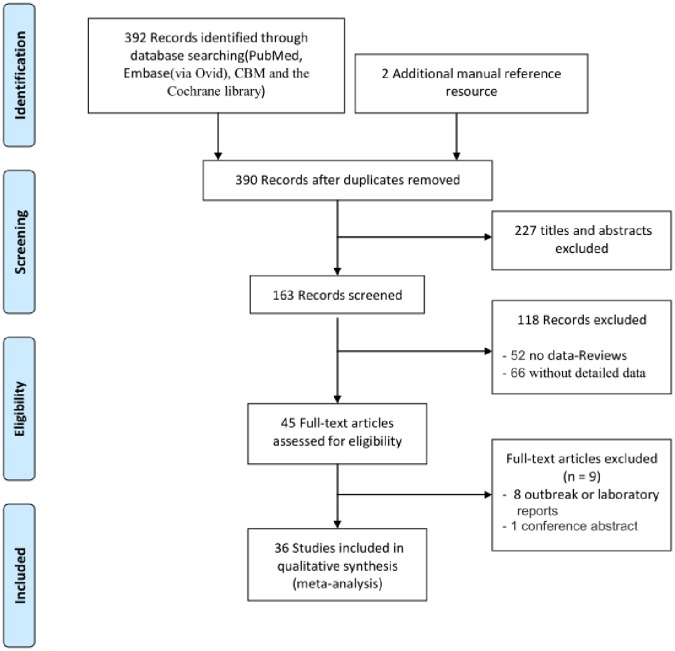
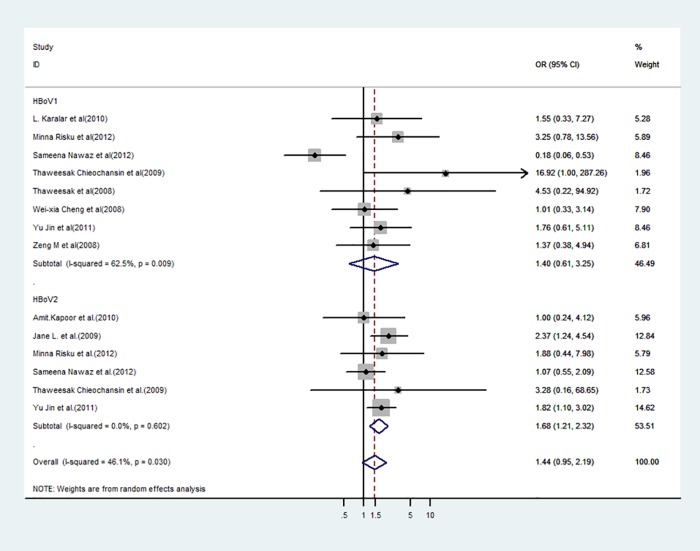
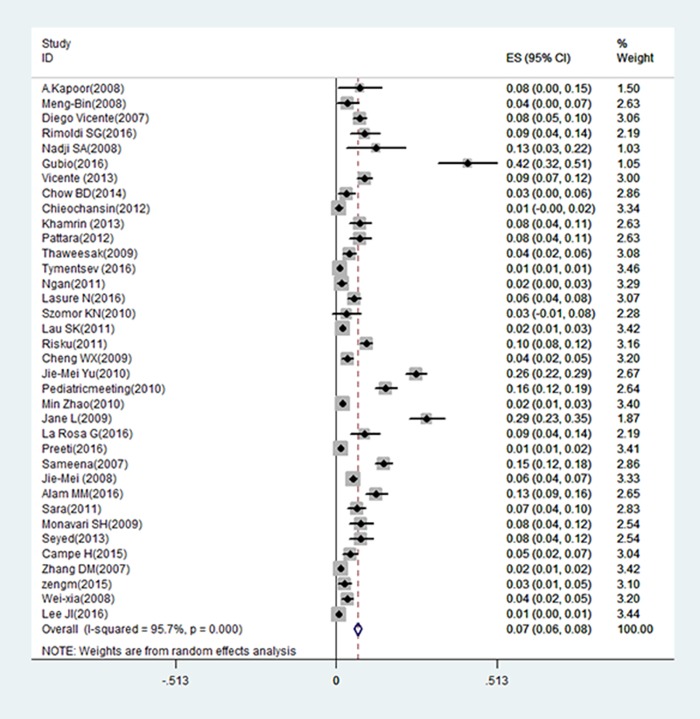
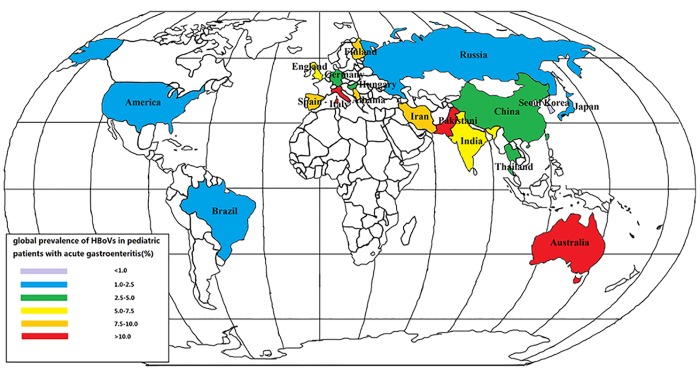
Human bocaviruses (HBoVs), which were first identified in 2005 and are composed of genotypes 1-4, have been increasingly detected worldwide in pediatric patients with acute gastroenteritis. To investigate if HBoV infection is a risk factor of acute gastroenteritis in children younger than 5 years old, we searched PubMed, Embase (via Ovid), the Chinese Biomedical Literature Database (CBM), and the Cochrane Library for studies assessing the prevalence of HBoVs in individuals from Oct 25, 2005 to Oct 31, 2016. We included studies using PCR-based diagnostics for HBoVs from stool specimens of patients with or without acute gastroenteritis that carried out research for over 1 year on pediatric patients aged younger than 5 years old. The primary outcome was the HBoV prevalence among all cases with acute gastroenteritis. Pooled estimates of the HBoV prevalence were then generated by fitting linear mixed effect meta-regression models. Of the 36 studies included, the pooled HBoV prevalence in 20,591 patients with acute gastroenteritis was 6.90% (95% confidence interval (95% CI): 5.80-8.10%). In the ten studies with a control group, HBoVs were detected in 12.40% of the 3,620 cases with acute gastroenteritis and in 12.22% of the 2,030 control children (odds ratio (OR): 1.44; 95% CI: 0.95-2.19, p = 0.09 between case and control groups). HBoV1 and HBoV2 were detected in 3.49% and 8.59% of acute gastroenteritis cases, respectively, and in 2.22% and 5.09% of control children, respectively (OR: 1.40; 95% CI: 0.61-3.25; p = 0.43 and OR: 1.68; 95% CI: 1.21-2.32; p = 0.002, respectively). Current evidence suggests that the overall HBoV prevalence in children younger than 5 years old is not significantly different between groups with or without acute gastroenteritis. However, when HBoV1 was excluded, the HBoV2 prevalence was significantly different between these two groups, which may imply that HBoV2 is a risk factor of acute gastroenteritis in children younger than 5 years old.
人博卡病毒(HBoVs)于2005年首次被发现,由1-4型基因型组成,在全球范围内,越来越多地在患有急性肠胃炎的儿科患者中被检测到。为了调查HBoV感染是否是5岁以下儿童急性肠胃炎的危险因素,我们检索了PubMed、Embase(通过Ovid)、中国生物医学文献数据库(CBM)和考克兰图书馆,以查找评估2005年10月25日至2016年10月31日期间个体中HBoVs患病率的研究。我们纳入了使用基于PCR的诊断方法检测HBoVs的研究,这些研究来自患有或未患有急性肠胃炎患者的粪便标本,对5岁以下儿科患者进行了超过1年的研究。主要结局是所有急性肠胃炎病例中的HBoV患病率。然后通过拟合线性混合效应meta回归模型生成HBoV患病率的合并估计值。在纳入的36项研究中,20591例急性肠胃炎患者中HBoV的合并患病率为6.90%(95%置信区间(95%CI):5.80-8.10%)。在有对照组的10项研究中,3620例急性肠胃炎病例中有12.40%检测到HBoVs,2030例对照儿童中有12.22%检测到HBoVs(优势比(OR):1.44;95%CI:0.95-2.19,病例组与对照组之间p = 0.09)。HBoV1和HBoV2分别在3.49%和8.59%的急性肠胃炎病例中被检测到,分别在2.22%和5.09%的对照儿童中被检测到(OR:1.40;95%CI:0.61-3.25;p = 0.43和OR:1.68;95%CI:1.21-2.32;p = 0.002)。目前的证据表明,5岁以下儿童中,患有或未患有急性肠胃炎的组间HBoV总体患病率无显著差异。然而,当排除HBoV1时,这两组之间的HBoV2患病率存在显著差异,这可能意味着HBoV2是5岁以下儿童急性肠胃炎的危险因素。