Self-Fordham Jezrom Bokcaerin, Naqvi Afsar Raza, Uttamani Juhi Raju, Kulkarni Varun, Nares Salvador
Department of Periodontics, University of Illinois at Chicago, Chicago, IL, United States.
Front Immunol. 2017 Aug 31;8:1062. doi: 10.3389/fimmu.2017.01062. eCollection 2017.
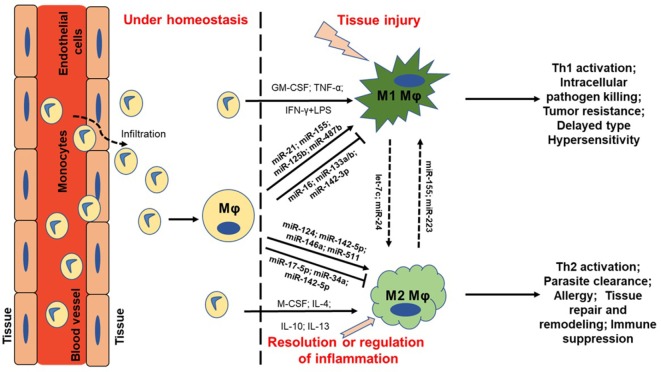
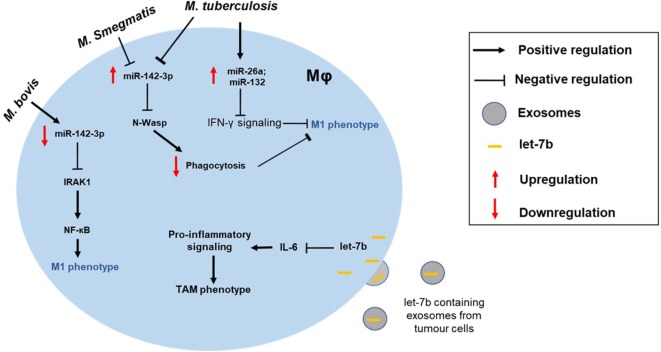
The ability of a healthy immune system to clear the plethora of antigens it encounters incessantly relies on the enormous plasticity displayed by the comprising cell types. Macrophages (MΦs) are crucial member of the mononuclear phagocyte system (MPS) that constantly patrol the peripheral tissues and are actively recruited to the sites of injury and infection. In tissues, infiltrating monocytes replenish MΦ. Under the guidance of the local micro-milieu, MΦ can be activated to acquire specialized functional phenotypes. Similar to T cells, functional polarization of macrophage phenotype viz., inflammatory (M1) and reparative (M2) is proposed. Equipped with diverse toll-like receptors (TLRs), these cells of the innate arm of immunity recognize and phagocytize antigens and secrete cytokines that activate the adaptive arm of the immune system and perform key roles in wound repair. Dysregulation of MΦ plasticity has been associated with various diseases and infection. MicroRNAs (miRNAs) have emerged as critical regulators of transcriptome output. Their importance in maintaining health, and their contribution toward disease, encompasses virtually all aspects of human biology. Our understanding of miRNA-mediated regulation of MΦ plasticity and polarization can be utilized to modulate functional phenotypes to counter their role in the pathogenesis of numerous disease, including cancer, autoimmunity, periodontitis, etc. Here, we provide an overview of current knowledge regarding the role of miRNA in shaping MΦ polarization and plasticity through targeting of various pathways and genes. Identification of miRNA biomarkers of diagnostic/prognostic value and their therapeutic potential by delivery of miRNA mimics or inhibitors to dynamically alter gene expression profiles is highlighted.
健康的免疫系统清除其不断遇到的大量抗原的能力,持续依赖于组成细胞类型所展现出的巨大可塑性。巨噬细胞(MΦs)是单核吞噬细胞系统(MPS)的关键成员,它们持续巡逻外周组织,并被积极招募到损伤和感染部位。在组织中,浸润的单核细胞补充MΦ。在局部微环境的引导下,MΦ可被激活以获得特定的功能表型。与T细胞类似,巨噬细胞表型的功能极化,即炎症性(M1)和修复性(M2)极化被提出。这些免疫先天臂的细胞配备了多种Toll样受体(TLRs),能够识别和吞噬抗原,并分泌激活免疫系统适应性臂的细胞因子,在伤口修复中发挥关键作用。MΦ可塑性的失调与多种疾病和感染相关。微小RNA(miRNAs)已成为转录组输出的关键调节因子。它们在维持健康以及对疾病的影响方面,几乎涵盖了人类生物学各个方面。我们对miRNA介导的MΦ可塑性和极化调节的理解,可用于调节功能表型,以对抗它们在包括癌症、自身免疫、牙周炎等众多疾病发病机制中的作用。在此,我们概述了关于miRNA通过靶向各种途径和基因在塑造MΦ极化和可塑性方面作用的当前知识。重点介绍了诊断/预后价值的miRNA生物标志物的鉴定,以及通过递送miRNA模拟物或抑制剂动态改变基因表达谱来发挥其治疗潜力。