Mashima Izumi, Theodorea Citra F, Thaweboon Boonyanit, Thaweboon Sroisiri, Scannapieco Frank A, Nakazawa Futoshi
Japan Society for the Promotion of Science, Chiyoda-ku, Tokyo, Japan.
Department of Oral Biology, School of Dental Medicine, University at Buffalo, The State University of New York, Buffalo, New York, United States of America.
PLoS One. 2017 Sep 21;12(9):e0185274. doi: 10.1371/journal.pone.0185274. eCollection 2017.
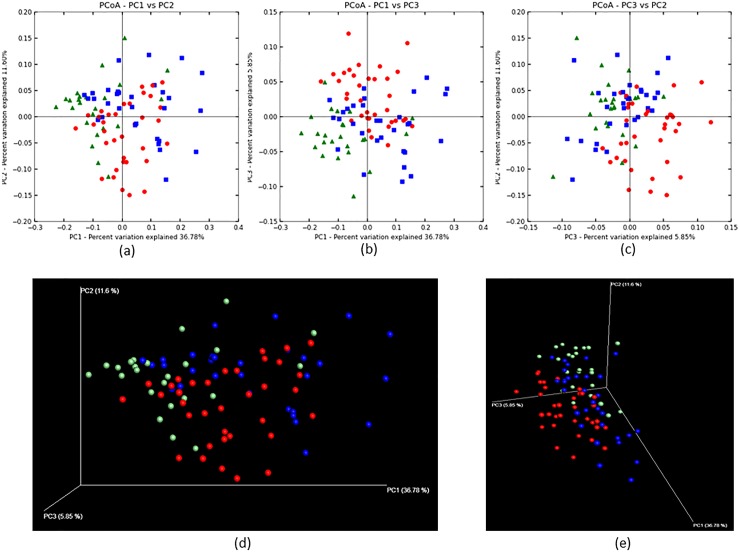
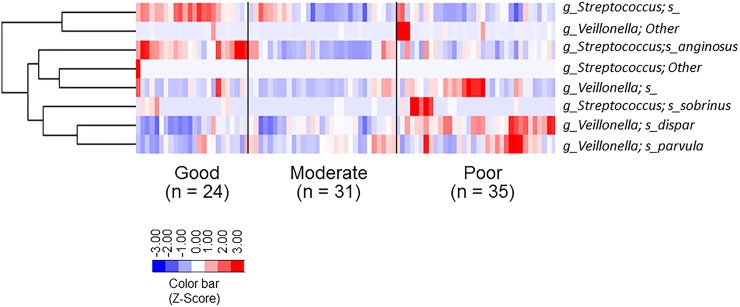
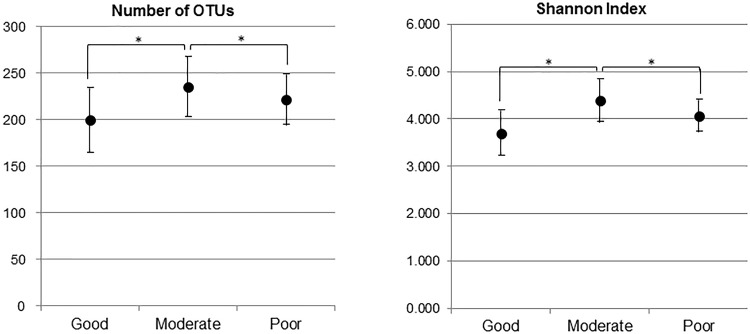
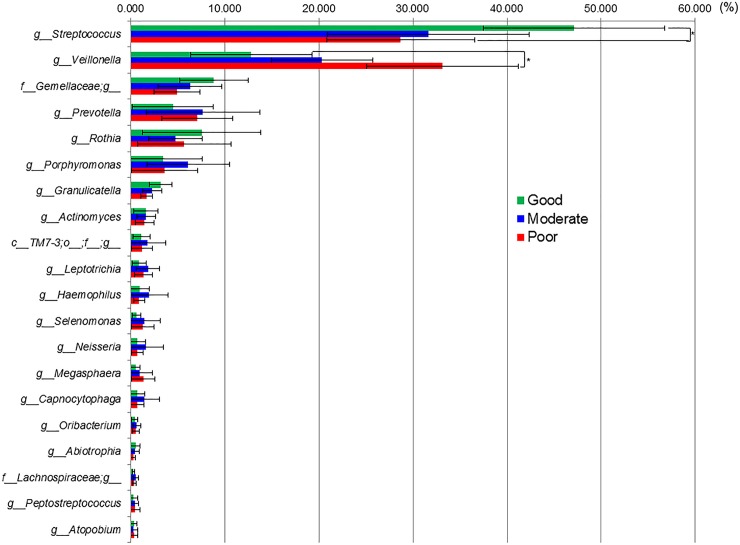
Poor oral hygiene often leads to chronic diseases such as periodontitis and dental caries resulting in substantial economic costs and diminished quality of life in not only adults but also in children. In this study, the salivary microbiome was characterized in a group of children stratified by the Simplified Oral Hygiene Index (OHI-S). Illumina MiSeq high-throughput sequencing based on the 16S rRNA was utilized to analyze 90 salivary samples (24 Good, 31 Moderate and 35 Poor oral hygiene) from a cohort of Thai children. A total of 38,521 OTUs (Operational Taxonomic Units) with a 97% similarity were characterized in all of the salivary samples. Twenty taxonomic groups (Seventeen genera, two families and one class; Streptococcus, Veillonella, Gemellaceae, Prevotella, Rothia, Porphyromonas, Granulicatella, Actinomyces, TM-7-3, Leptotrichia, Haemophilus, Selenomonas, Neisseria, Megasphaera, Capnocytophaga, Oribacterium, Abiotrophia, Lachnospiraceae, Peptostreptococcus, and Atopobium) were found in all subjects and constituted 94.5-96.5% of the microbiome. Of these twenty genera, the proportion of Streptococcus decreased while Veillonella increased with poor oral hygiene status (P < 0.05). Furthermore, an unassigned species of Veillonella, Veillonella dispar and Veillonella parvula tended to be elevated in the Poor oral hygiene group. This is the first study demonstrating an important association between increase of Veillonella and poor oral hygiene status in children. However, further studies are required to identify the majority of Veillonella at species level in salivary microbiome of the Poor oral hygiene group.
口腔卫生状况不佳往往会引发慢性疾病,如牙周炎和龋齿,这不仅会给成年人,也会给儿童带来巨大的经济成本,并降低生活质量。在本研究中,我们对一组根据简化口腔卫生指数(OHI-S)分层的儿童的唾液微生物群进行了特征分析。利用基于16S rRNA的Illumina MiSeq高通量测序技术,对一组泰国儿童的90份唾液样本(24份口腔卫生良好、31份中等和35份不佳)进行了分析。在所有唾液样本中,共鉴定出38,521个具有97%相似性的操作分类单元(OTU)。在所有受试者中均发现了20个分类群(17个属、2个科和1个纲;链球菌属、韦荣球菌属、孪生球菌科、普雷沃菌属、罗氏菌属、卟啉单胞菌属、颗粒链菌属、放线菌属、TM-7-3、纤毛菌属、嗜血杆菌属、栖瘤胃普雷沃菌属、奈瑟菌属、巨球型菌属、二氧化碳嗜纤维菌属、殊异韦荣球菌属、嗜胨菌属、毛螺菌科、消化链球菌属和阿托波菌属),它们构成了微生物群的94.5-96.5%。在这20个属中,随着口腔卫生状况变差,链球菌属的比例下降,而韦荣球菌属的比例上升(P < 0.05)。此外,在口腔卫生不佳组中,一种未分类的韦荣球菌、殊异韦荣球菌和微小韦荣球菌往往会增多。这是第一项证明韦荣球菌增加与儿童口腔卫生状况不佳之间存在重要关联的研究。然而,需要进一步研究以在口腔卫生不佳组的唾液微生物群中在种水平上鉴定出大多数韦荣球菌。