Tercedor Pablo, Villa-González Emilio, Ávila-García Manuel, Díaz-Piedra Carolina, Martínez-Baena Alejandro, Soriano-Maldonado Alberto, Pérez-López Isaac José, García-Rodríguez Inmaculada, Mandic Sandra, Palomares-Cuadros Juan, Segura-Jiménez Víctor, Huertas-Delgado Francisco Javier
PA-HELP "Physical Activity for HEalth Promotion" Research Group, Granada, Spain.
Department of Physical Education and Sport, Faculty of Sport Sciences, University of Granada, Granada, Spain.
BMC Public Health. 2017 Sep 26;17(1):748. doi: 10.1186/s12889-017-4788-4.
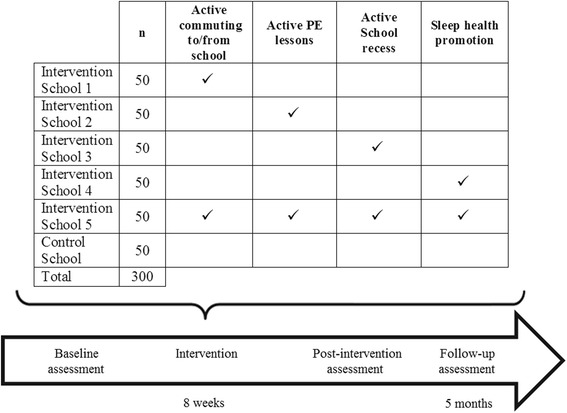
The lack of physical activity and increasing time spent in sedentary behaviours during childhood place importance on developing low cost, easy-toimplement school-based interventions to increase physical activity among children. The PREVIENE Project will evaluate the effectiveness of five innovative, simple, and feasible interventions (active commuting to/from school, active Physical Education lessons, active school recess, sleep health promotion, and an integrated program incorporating all 4 interventions) to improve physical activity, fitness, anthropometry, sleep health, academic achievement, and health-related quality of life in primary school children.
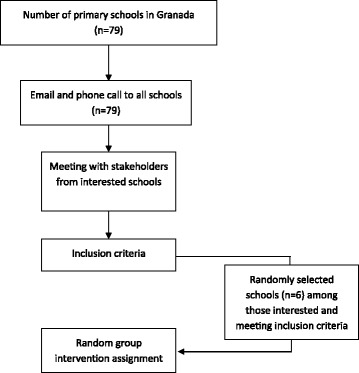
A total of 300 children (grade 3; 8-9 years of age) from six schools in Granada (Spain) will be enrolled in one of the 8-week interventions (one intervention per school; 50 children per school) or a control group (no intervention school; 50 children). Outcomes will include physical activity (measured by accelerometry), physical fitness (assessed using the ALPHA fitness battery), and anthropometry (height, weight and waist circumference). Furthermore, they will include sleep health (measured by accelerometers, a sleep diary, and sleep health questionnaires), academic achievement (grades from the official school's records), and health-related quality of life (child and parental questionnaires). To assess the effectiveness of the different interventions on objectively measured PA and the other outcomes, the generalized linear model will be used.
The PREVIENE Project will provide the information about the effectiveness and implementation of different school-based interventions for physical activity promotion in primary school children.
儿童期缺乏体育活动以及久坐行为时间的增加,凸显了开发低成本、易于实施的校内干预措施以增加儿童体育活动的重要性。PREVIENE项目将评估五种创新、简单且可行的干预措施(往返学校的主动出行、体育活动课、学校课间主动活动、睡眠健康促进以及包含所有四项干预措施的综合项目)对改善小学生体育活动、体能、人体测量指标、睡眠健康、学业成绩以及健康相关生活质量的效果。
来自西班牙格拉纳达六所学校的300名儿童(三年级;8 - 9岁)将被纳入为期8周的干预措施之一(每所学校一种干预措施;每所学校50名儿童)或对照组(无干预措施学校;50名儿童)。结果将包括体育活动(通过加速度计测量)、体能(使用ALPHA体能测试组合进行评估)以及人体测量指标(身高、体重和腰围)。此外,还将包括睡眠健康(通过加速度计、睡眠日记和睡眠健康问卷进行测量)、学业成绩(来自学校官方记录的成绩)以及健康相关生活质量(儿童和家长问卷)。为了评估不同干预措施对客观测量的体育活动及其他结果的有效性,将使用广义线性模型。
PREVIENE项目将提供有关不同校内干预措施对促进小学生体育活动的有效性和实施情况的信息。