IEEE Trans Biomed Eng. 2018 Jun;65(6):1410-1420. doi: 10.1109/TBME.2017.2756018. Epub 2017 Sep 22.
Pulse transit time (PTT) is being widely pursued for ubiquitous blood pressure (BP) monitoring. PTT-based systems may require periodic cuff calibrations but can still be useful for hypertension screening by affording numerous out-of-clinic measurements that can be averaged. The objective was to predict the maximum calibration period that would not compromise accuracy and acceptable error limits in light of measurement averaging for PTT-based systems.
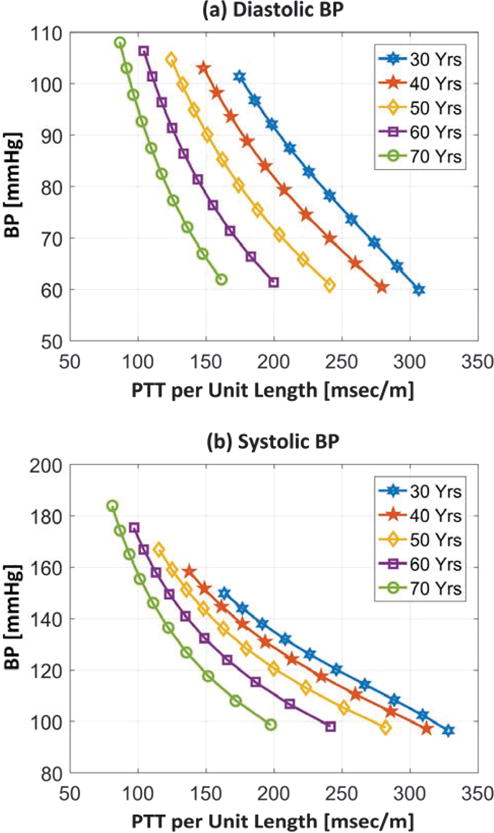
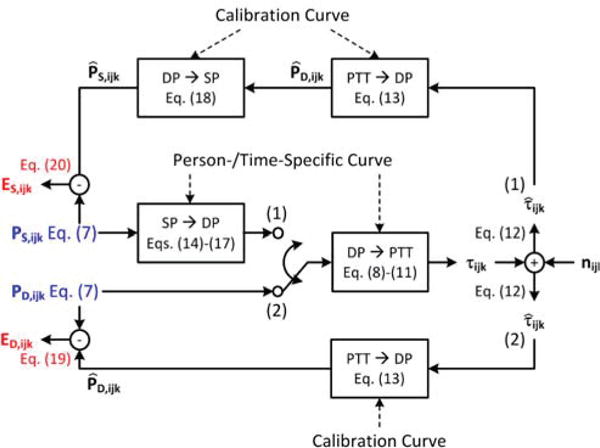
Well-known mathematical models and vast BP data were leveraged. Models relating PTT, age, and gender to BP were employed to determine the maximum time period for the PTT-BP calibration curve to change by <1 mmHg over physiological BP ranges for each age and gender. A model of within-person BP variability was employed to establish the screening accuracy of the conventional cuff-based approach. These models were integrated to investigate the screening accuracy of the average of numerous measurements of a PTT-based system in relation to the accuracy of its individual measurements.
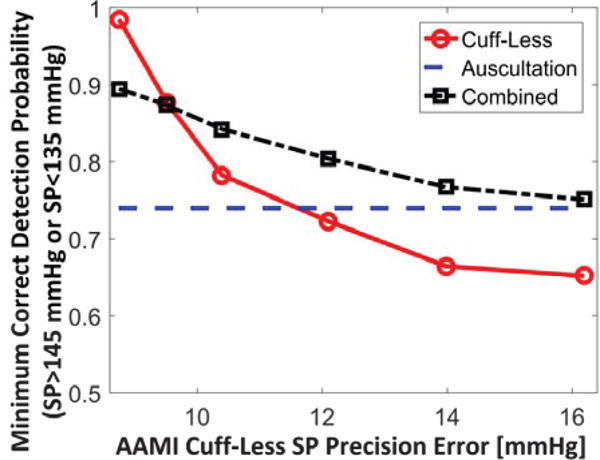
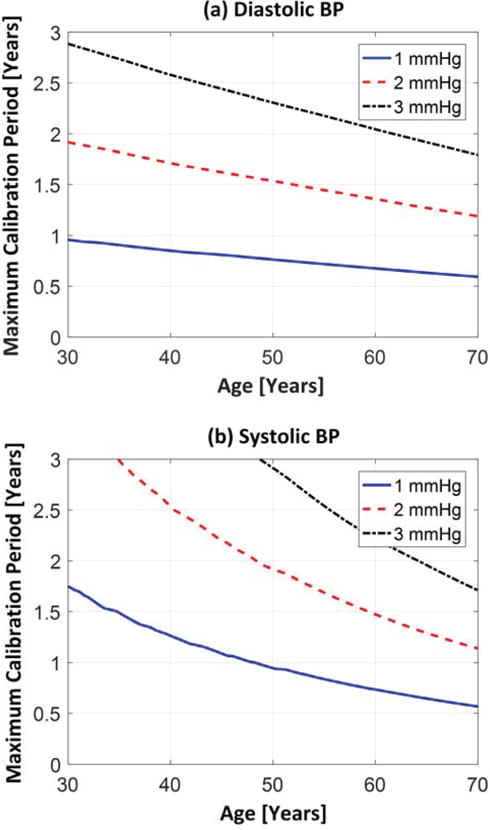
The maximum calibration period was about 1 year for a 30 year old and declined linearly to about 6 months for a 70 year old. A PTT-based system with a precision error of >12 mmHg for systolic BP could achieve the screening accuracy of the cuff-based approach via measurement averaging.
This theoretical study indicates that PTT-based BP monitoring is viable even with periodic calibration and seemingly high measurement errors.
The predictions may help guide the implementation, evaluation, and application of PTT-based BP monitoring systems in practice.
脉搏传输时间(PTT)正被广泛应用于血压(BP)的连续监测。PTT 系统可能需要定期进行袖带校准,但仍可通过提供大量可平均的非诊室测量值,用于高血压筛查,而具有一定的实用价值。本研究旨在预测在 PTT 系统中,为了不影响测量平均值的准确性和可接受的误差限制,最大的校准周期。
利用了著名的数学模型和大量的 BP 数据。采用了将 PTT、年龄和性别与 BP 相关联的模型,以确定 PTT-BP 校准曲线在每个年龄和性别生理 BP 范围内,变化<1mmHg 的最大时间段。采用个体内 BP 变异性模型来确定传统袖带式方法的筛查准确性。将这些模型整合起来,研究了 PTT 系统多次测量平均值的筛查准确性与个别测量值的准确性的关系。
对于 30 岁的人,最大校准周期约为 1 年,对于 70 岁的人,最大校准周期线性下降至约 6 个月。对于收缩压精度误差>12mmHg 的 PTT 系统,通过测量平均值,可达到袖带式方法的筛查准确性。
这项理论研究表明,即使存在周期性校准和看似较高的测量误差,PTT 监测 BP 仍然是可行的。
这些预测结果可能有助于指导 PTT 监测系统在实际中的实施、评估和应用。