Itabashi Masayuki, Nasierowska-Guttmejer Anna, Shimoda Tadakazu, Majewski Przemysław, Rezner Witold, Sikora Katarzyna, Śrutek Ewa, Stęplewska Katarzyna, Swatek Jarosław, Szumilo Justyna, Wierzchniewska-Ławska Agnieszka, Wronecki Lech, Zembala-Nożyńska Ewa, Arai Tomio, Fujita Masahiro, Kawachi Hiroshi, Unakami Masamitsu, Kamoshida Toshiro
Pathology and Cytology Center, LSI Medience Corporation, 4-25-11 Azusawa, Itabashi-ku, Tokyo, 174-0051 Japan.
Department of Pathology, CSK MSW, Warsaw, Poland.
Esophagus. 2017;14(4):333-342. doi: 10.1007/s10388-017-0583-7. Epub 2017 Jun 14.
There are differences in the histological diagnostic criteria for early stage gastrointestinal carcinoma between Western and Japanese pathologists. Western histological criteria of carcinoma are "presence of stromal invasion of neoplastic cells", while Japanese criteria are "the degree of cytological and structural abnormality of neoplastic cells, regardless of stromal invasion". The aim of the present study is to clarify and review the present status of the Western and Japanese histological criteria of early stage esophageal squamous cell carcinoma (SCC) and also to clarify their significance and accuracy.
Twenty-nine Polish, German, and Japanese pathologists participated in this study. A total of 18 histological slides of biopsy, endoscopic submucosal dissection (ESD), and surgical resection of esophageal squamous lesions were diagnosed using a virtual slide system.
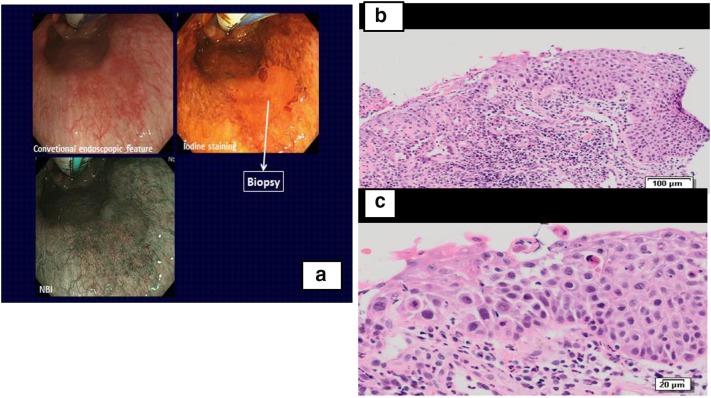
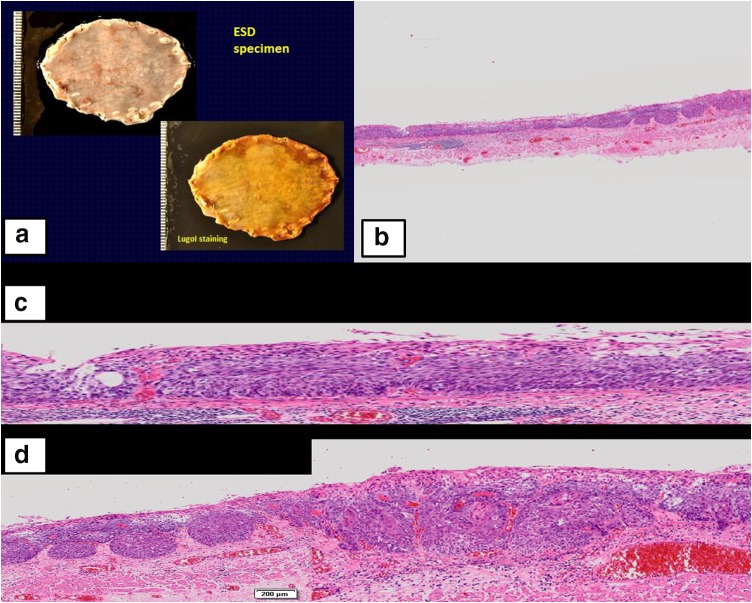
Most of noninvasive (intraepithelial) carcinomas diagnosed by Japanese pathologists were diagnosed as high- or low-grade dysplasia (intraepithelial neoplasia) or reactive atypia by the majority of Polish and German pathologists. Diagnoses of not only high-grade dysplasia but also low-grade dysplasia or reactive lesion by Western criteria were given for many biopsy specimens of cases in which the corresponding ESD or surgical specimens showed definite stromal invasion.
There still exist differences in the histological diagnostic criteria for early stage esophageal carcinoma between Western and Japanese pathologists. The Japanese diagnostic criteria could improve agreement of diagnoses between biopsy and resected specimens of esophageal SCC. Moreover, diagnostic approaches using Western criteria may cause delay in the early diagnosis and treatment of esophageal SCC.
西方和日本病理学家对早期胃肠道癌的组织学诊断标准存在差异。西方癌的组织学标准是“肿瘤细胞存在间质浸润”,而日本的标准是“肿瘤细胞的细胞学和结构异常程度,不论间质浸润情况”。本研究的目的是阐明并回顾西方和日本早期食管鳞状细胞癌(SCC)组织学标准的现状,并阐明其意义和准确性。
29名波兰、德国和日本病理学家参与了本研究。使用虚拟切片系统对18张食管鳞状病变活检、内镜黏膜下剥离术(ESD)及手术切除的组织学切片进行诊断。
日本病理学家诊断的大多数非浸润性(上皮内)癌,大多数波兰和德国病理学家诊断为高级别或低级别异型增生(上皮内瘤变)或反应性异型增生。对于许多活检标本,按照西方标准诊断为低级别异型增生或反应性病变,而相应的ESD或手术标本显示有明确的间质浸润。
西方和日本病理学家对早期食管癌的组织学诊断标准仍存在差异。日本的诊断标准可提高食管SCC活检标本与切除标本诊断的一致性。此外,采用西方标准的诊断方法可能会导致食管SCC早期诊断和治疗的延迟。