Brain Science Institute, RIKEN, Wako, 351-0198, Japan.
Neuroscience Research Center, Shahid Beheshti University of Medical Sciences, Tehran, 19615-1178, Iran.
Sci Rep. 2017 Oct 6;7(1):12764. doi: 10.1038/s41598-017-12958-4.
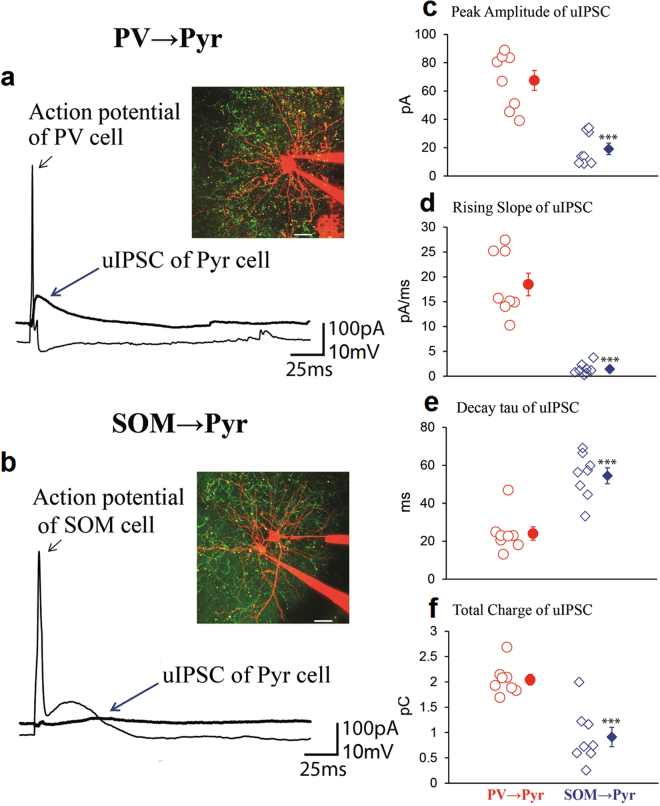
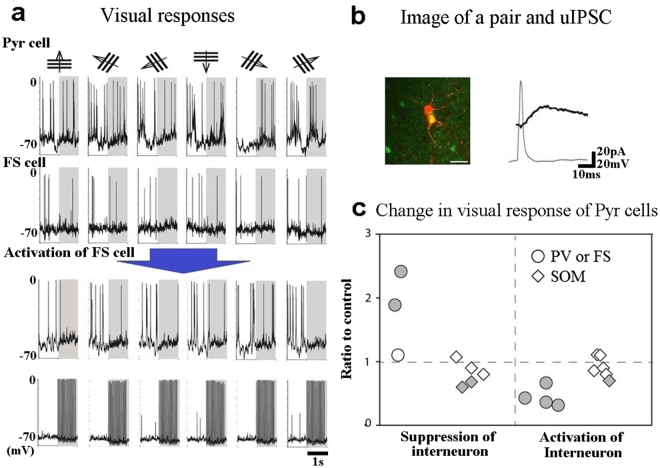
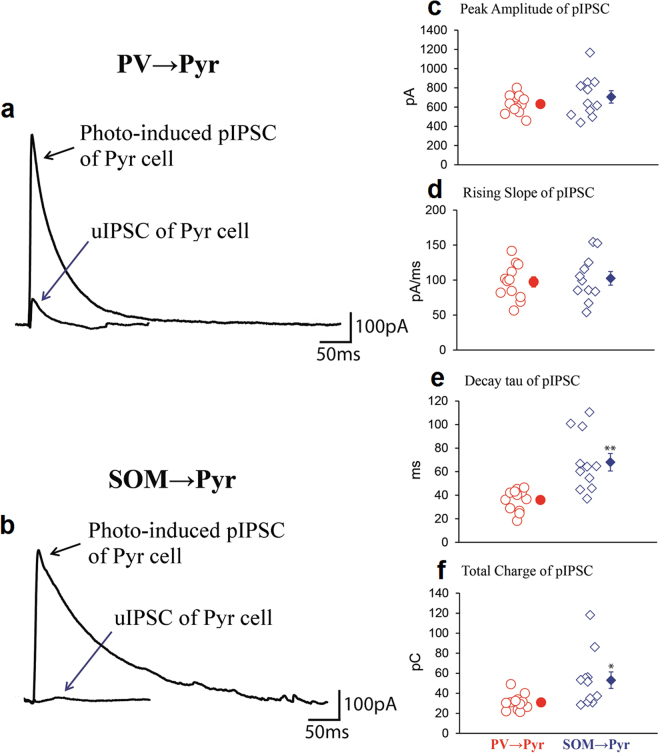
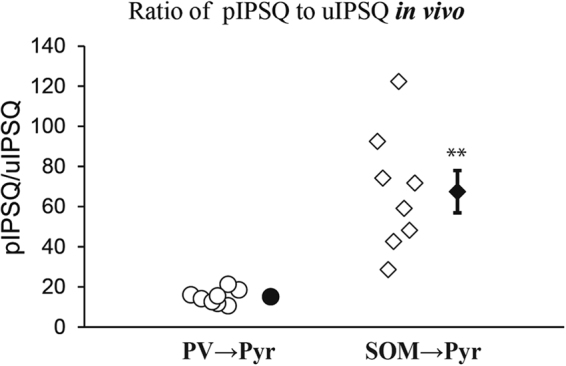
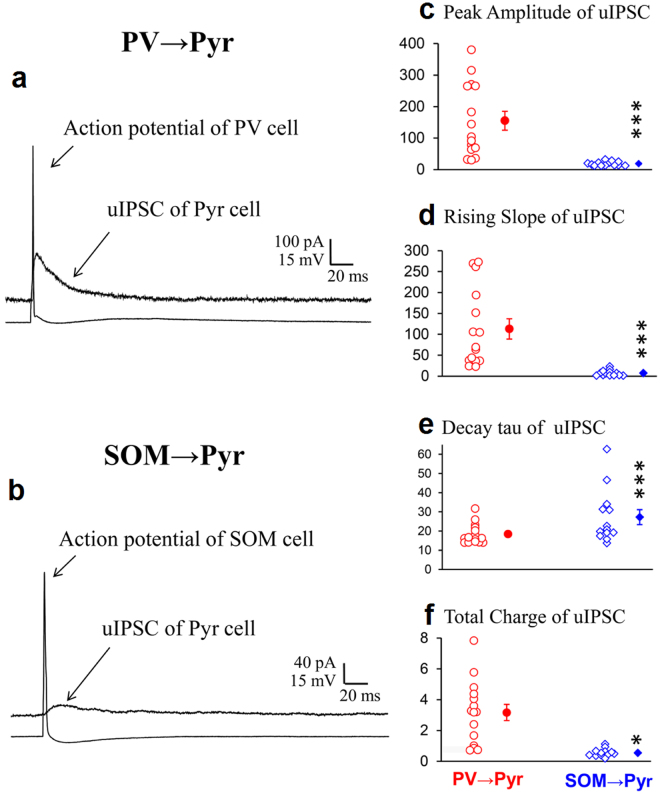
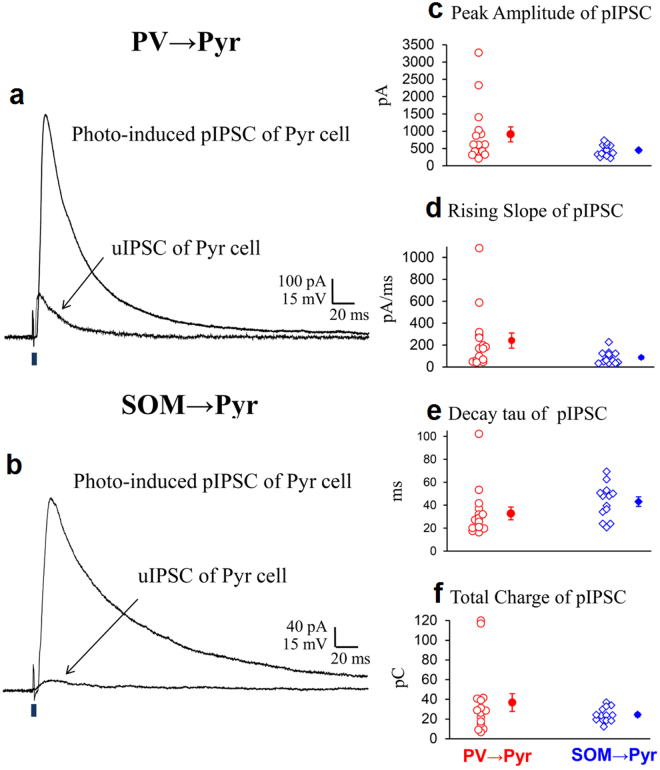
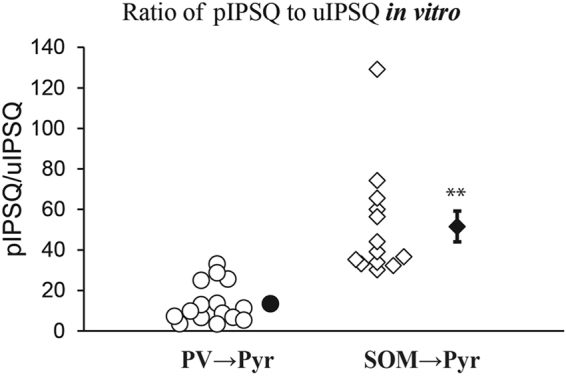
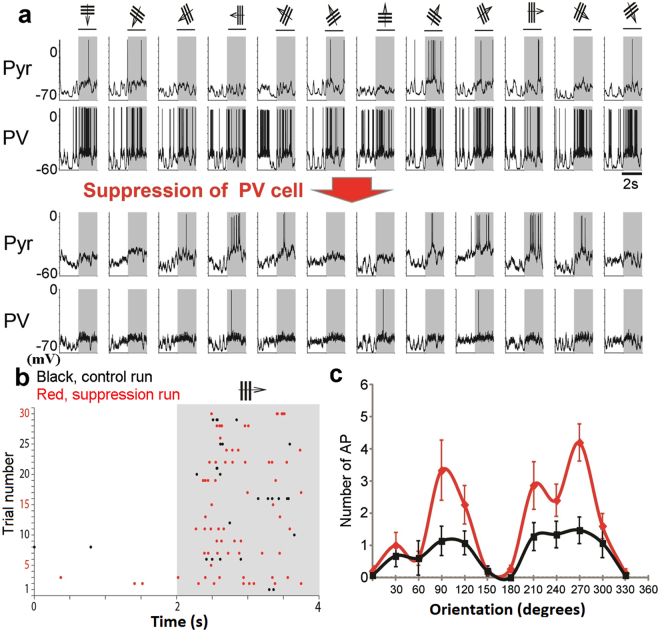
Neural circuits in the cerebral cortex consist primarily of excitatory pyramidal (Pyr) cells and inhibitory interneurons. Interneurons are divided into several subtypes, in which the two major groups are those expressing parvalbumin (PV) or somatostatin (SOM). These subtypes of interneurons are reported to play distinct roles in tuning and/or gain of visual response of pyramidal cells in the visual cortex. It remains unclear whether there is any quantitative and functional difference between the PV → Pyr and SOM → Pyr connections. We compared unitary inhibitory postsynaptic currents (uIPSCs) evoked by electrophysiological activation of single presynaptic interneurons with population IPSCs evoked by photo-activation of a mass of interneurons in vivo and in vitro in transgenic mice in which PV or SOM neurons expressed channelrhodopsin-2, and found that at least about 14 PV neurons made strong connections with a postsynaptic Pyr cell while a much larger number of SOM neurons made weak connections. Activation or suppression of single PV neurons modified visual responses of postsynaptic Pyr cells in 6 of 7 pairs whereas that of single SOM neurons showed no significant modification in 8 of 11 pairs, suggesting that PV neurons can act solo whereas most of SOM neurons may act in chorus on Pyr cells.
大脑皮层中的神经回路主要由兴奋性锥体(Pyr)细胞和抑制性中间神经元组成。中间神经元可分为几个亚型,其中两个主要群体是表达钙蛋白(PV)或生长抑素(SOM)的中间神经元。据报道,这些中间神经元亚型在视觉皮层中锥体细胞的视觉反应调谐和/或增益中发挥着不同的作用。PV→Pyr 和 SOM→Pyr 连接之间是否存在任何数量和功能上的差异仍不清楚。我们比较了通过电生理激活单个中间神经元诱发的单位抑制性突触后电流(uIPSCs)与在体内和体外通过光激活大量中间神经元诱发的群体 IPSCs,在表达通道视紫红质-2的转基因小鼠中,我们发现至少约 14 个 PV 神经元与一个突触后 Pyr 细胞形成强连接,而大量的 SOM 神经元形成弱连接。在 7 对中的 6 对中,激活或抑制单个 PV 神经元可修饰突触后 Pyr 细胞的视觉反应,而在 11 对中的 8 对中,单个 SOM 神经元的激活或抑制对视觉反应没有显著影响,这表明 PV 神经元可以单独作用,而大多数 SOM 神经元可能在 Pyr 细胞上协同作用。