• 文献检索
  • 文档翻译
  • 深度研究
  • 学术资讯
  • Suppr Zotero 插件Zotero 插件
  • 邀请有礼
  • 套餐&价格
  • 历史记录
应用&插件
Suppr Zotero 插件Zotero 插件浏览器插件Mac 客户端Windows 客户端微信小程序
定价
高级版会员购买积分包购买API积分包
服务
文献检索文档翻译深度研究API 文档MCP 服务
关于我们
关于 Suppr公司介绍联系我们用户协议隐私条款
关注我们

Suppr 超能文献

核心技术专利:CN118964589B侵权必究
粤ICP备2023148730 号-1Suppr @ 2026

文献检索

告别复杂PubMed语法,用中文像聊天一样搜索,搜遍4000万医学文献。AI智能推荐,让科研检索更轻松。

立即免费搜索

文件翻译

保留排版,准确专业,支持PDF/Word/PPT等文件格式,支持 12+语言互译。

免费翻译文档

深度研究

AI帮你快速写综述,25分钟生成高质量综述,智能提取关键信息,辅助科研写作。

立即免费体验

当声音成为目标。早期婴儿期的4E认知与远程音乐性。

When the Sound Becomes the Goal. 4E Cognition and Teleomusicality in Early Infancy.

作者信息

Schiavio Andrea, van der Schyff Dylan, Kruse-Weber Silke, Timmers Renee

机构信息

Institute for Music Education, University of Music and Performing ArtsGraz, Austria.

Department of Music, University of SheffieldSheffield, United Kingdom.

出版信息

Front Psychol. 2017 Sep 25;8:1585. doi: 10.3389/fpsyg.2017.01585. eCollection 2017.

DOI:10.3389/fpsyg.2017.01585
PMID:28993745
原文链接:https://pmc.ncbi.nlm.nih.gov/articles/PMC5622185/
Abstract

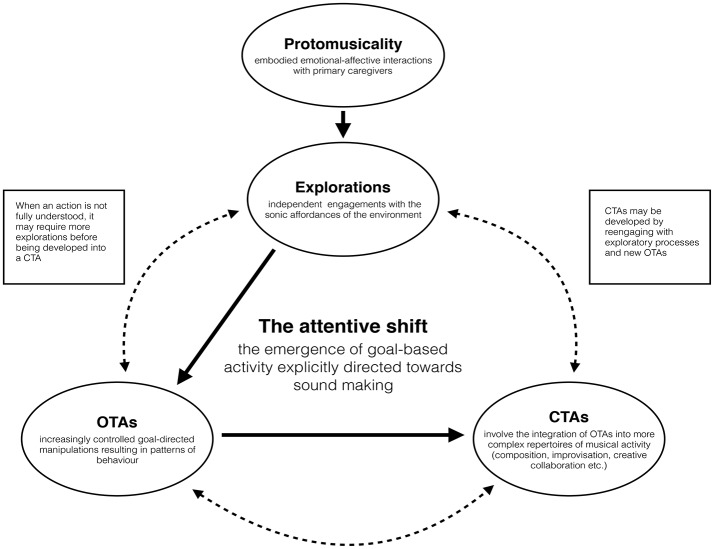
In this paper we explore early musical behaviors through the lenses of the recently emerged "4E" approach to mind, which sees cognitive processes as Embodied, Embedded, Enacted, and Extended. In doing so, we draw from a range of interdisciplinary research, engaging in critical and constructive discussions with both new findings and existing positions. In particular, we refer to observational research by French pedagogue and psychologist François Delalande, who examined infants' first "sound discoveries" and individuated three different musical "conducts" inspired by the "phases of the game" originally postulated by Piaget. Elaborating on such ideas we introduce the notion of "teleomusicality," which describes the goal-directed behaviors infants adopt to explore and play with sounds. This is distinguished from the developmentally earlier "protomusicality," which is based on music-like utterances, movements, and emotionally relevant interactions (e.g., with primary caregivers) that do not entail a primary focus on sound itself. The development from protomusicality to teleomusicality is discussed in terms of an "attentive shift" that occurs between 6 and 10 months of age. This forms the basis of a conceptual framework for early musical development that emphasizes the emergence of exploratory, goal-directed (i.e., sound-oriented), and self-organized musical actions in infancy. In line with this, we provide a preliminary taxonomy of teleomusical processes discussing "Original Teleomusical Acts" (OTAs) and "Constituted Teleomusical Acts" (CTAs). We argue that while OTAs can be easily witnessed in infants' exploratory behaviors, CTAs involve the mastery of more specific and complex goal-directed chains of actions central to musical activity.

摘要

在本文中,我们通过最近出现的“4E”心智方法来探讨早期音乐行为,该方法将认知过程视为具身的、嵌入的、践行的和扩展的。在此过程中,我们借鉴了一系列跨学科研究,就新发现和现有观点展开批判性和建设性的讨论。特别是,我们参考了法国教育家兼心理学家弗朗索瓦·德拉兰德的观察研究,他考察了婴儿最初的“声音发现”,并区分了三种不同的受皮亚杰最初提出的“游戏阶段”启发的音乐“行为”。在阐述这些观点的基础上,我们引入了“目的音乐性”的概念,它描述了婴儿为探索和玩弄声音而采取的目标导向行为。这与发展上更早的“原音乐性”不同,原音乐性基于类似音乐的发声、动作以及与情感相关的互动(例如与主要照顾者的互动),这些互动并不主要关注声音本身。从原音乐性到目的音乐性的发展是根据6至10个月大时发生的“注意力转移”来讨论的。这构成了早期音乐发展概念框架的基础,该框架强调婴儿期探索性、目标导向(即以声音为导向)和自组织音乐行为的出现。与此一致,我们提供了一个目的音乐过程的初步分类,讨论“原始目的音乐行为”(OTAs)和“构成目的音乐行为”(CTAs)。我们认为,虽然在婴儿的探索行为中很容易观察到OTAs,但CTAs涉及对音乐活动核心的更具体、更复杂的目标导向行动链的掌握。
https://cdn.ncbi.nlm.nih.gov/pmc/blobs/0d2d/5622185/79e3519d14f7/fpsyg-08-01585-g0001.jpg

相似文献

1
When the Sound Becomes the Goal. 4E Cognition and Teleomusicality in Early Infancy.当声音成为目标。早期婴儿期的4E认知与远程音乐性。
Front Psychol. 2017 Sep 25;8:1585. doi: 10.3389/fpsyg.2017.01585. eCollection 2017.
2
4E Music Pedagogy and the Principles of Self-Organization.4E音乐教学法与自组织原则
Behav Sci (Basel). 2018 Aug 9;8(8):72. doi: 10.3390/bs8080072.
3
Musical Interaction Reveals Music as Embodied Language.音乐互动揭示音乐为具身语言。
Front Neurosci. 2021 Jul 14;15:667838. doi: 10.3389/fnins.2021.667838. eCollection 2021.
4
Know thy sound: perceiving self and others in musical contexts.了解你的声音:在音乐情境中感知自我与他人。
Acta Psychol (Amst). 2014 Oct;152:67-74. doi: 10.1016/j.actpsy.2014.07.002. Epub 2014 Aug 13.
5
The developmental origins of naïve psychology in infancy.婴儿期朴素心理学的发展起源。
Adv Child Dev Behav. 2009;37:55-104. doi: 10.1016/s0065-2407(09)03702-1.
6
Integration of cognition and emotion in physical and mental actions in musical and other behaviors.身心行为中音乐行为和其他行为的认知和情绪的整合。
Behav Brain Sci. 2015;38:e76. doi: 10.1017/S0140525X14000909.
7
Shall We Play the Same? Pedagogical Perspectives on Infants' and Children's Imitation of Musical Gestures.我们要玩同样的吗?关于婴幼儿对音乐手势模仿的教学视角
Front Psychol. 2020 Jun 3;11:1087. doi: 10.3389/fpsyg.2020.01087. eCollection 2020.
8
Cross-Modal Musical Expectancy in Complex Sound Music: A Grounded Theory.复杂声音音乐中的跨模态音乐期待:一种扎根理论
J Cogn. 2023 Jul 4;6(1):33. doi: 10.5334/joc.281. eCollection 2023.
9
Exploring the Multi-Layered Affordances of Composing and Performing Interactive Music with Responsive Technologies.探索运用响应式技术创作和演奏交互式音乐的多层次功能。
Front Psychol. 2017 Sep 29;8:1701. doi: 10.3389/fpsyg.2017.01701. eCollection 2017.
10
Oral Tradition as Context for Learning Music From 4E Cognition Compared With Literacy Cultures. Case Studies of Flamenco Guitar Apprenticeship.与读写文化相比,作为从具身认知学习音乐背景的口头传统。弗拉门戈吉他学徒制的案例研究。
Front Psychol. 2022 Apr 29;13:733615. doi: 10.3389/fpsyg.2022.733615. eCollection 2022.

引用本文的文献

1
Meaning-making and creativity in musical entrainment.音乐同步中的意义构建与创造力。
Front Psychol. 2024 Jan 3;14:1326773. doi: 10.3389/fpsyg.2023.1326773. eCollection 2023.
2
Oral Tradition as Context for Learning Music From 4E Cognition Compared With Literacy Cultures. Case Studies of Flamenco Guitar Apprenticeship.与读写文化相比,作为从具身认知学习音乐背景的口头传统。弗拉门戈吉他学徒制的案例研究。
Front Psychol. 2022 Apr 29;13:733615. doi: 10.3389/fpsyg.2022.733615. eCollection 2022.
3
The CODA Model: A Review and Skeptical Extension of the Constructionist Model of Emotional Episodes Induced by Music.

本文引用的文献

1
Grounded in the World: Developmental Origins of the Embodied Mind.扎根于世界:具身认知的发展起源
Infancy. 2000 Jan;1(1):3-28. doi: 10.1207/S15327078IN0101_02. Epub 2000 Jan 1.
2
Travel Broadens the Mind.旅行开阔眼界。
Infancy. 2000 Apr;1(2):149-219. doi: 10.1207/S15327078IN0102_1. Epub 2000 Apr 1.
3
Infant Social Development across the Transition from Crawling to Walking.婴儿从爬行到行走过渡阶段的社会发展
CODA模型:对音乐引发的情感片段建构主义模型的回顾与质疑性拓展
Front Psychol. 2022 Apr 13;13:822264. doi: 10.3389/fpsyg.2022.822264. eCollection 2022.
4
Exploratory expertise and the dual intentionality of music-making.探索性专长与音乐创作的双重意向性。
Phenomenol Cogn Sci. 2021;20(5):811-829. doi: 10.1007/s11097-019-09626-5. Epub 2019 Jun 18.
5
Teaching and Learning of Piano Timbre Through Teacher-Student Interactions in Lessons.通过课堂上的师生互动进行钢琴音色的教学与学习。
Front Psychol. 2021 Jun 10;12:576056. doi: 10.3389/fpsyg.2021.576056. eCollection 2021.
6
Theoretical Framework for Facilitating Young Musicians' Learning of Expressive Performance.促进年轻音乐家学习富有表现力的演奏的理论框架。
Front Psychol. 2021 Jan 11;11:584171. doi: 10.3389/fpsyg.2020.584171. eCollection 2020.
7
Dimensions of Musical Creativity.音乐创造力的维度
Front Neurosci. 2020 Nov 30;14:578932. doi: 10.3389/fnins.2020.578932. eCollection 2020.
8
Optimizing Performative Skills in Social Interaction: Insights From Embodied Cognition, Music Education, and Sport Psychology.优化社交互动中的表演技巧:来自具身认知、音乐教育和运动心理学的见解。
Front Psychol. 2019 Jul 16;10:1542. doi: 10.3389/fpsyg.2019.01542. eCollection 2019.
9
Instrumental Technique, Expressivity, and Communication. A Qualitative Study on Learning Music in Individual and Collective Settings.器乐技巧、表现力与交流。关于在个人和集体环境中学习音乐的定性研究。
Front Psychol. 2019 Apr 3;10:737. doi: 10.3389/fpsyg.2019.00737. eCollection 2019.
10
4E Music Pedagogy and the Principles of Self-Organization.4E音乐教学法与自组织原则
Behav Sci (Basel). 2018 Aug 9;8(8):72. doi: 10.3390/bs8080072.
Front Psychol. 2016 Jun 27;7:960. doi: 10.3389/fpsyg.2016.00960. eCollection 2016.
4
Infants' Understanding of Object-Directed Action: An Interdisciplinary Synthesis.婴儿对指向物体动作的理解:跨学科综合研究
Front Psychol. 2016 Feb 9;7:111. doi: 10.3389/fpsyg.2016.00111. eCollection 2016.
5
Assessing human mirror activity with EEG mu rhythm: A meta-analysis.利用脑电图μ节律评估人类镜像活动:一项荟萃分析。
Psychol Bull. 2016 Mar;142(3):291-313. doi: 10.1037/bul0000031. Epub 2015 Dec 21.
6
Exploring Music-Based Rehabilitation for Parkinsonism through Embodied Cognitive Science.通过具身认知科学探索基于音乐的帕金森病康复治疗
Front Neurol. 2015 Oct 19;6:217. doi: 10.3389/fneur.2015.00217. eCollection 2015.
7
Active Drumming Experience Increases Infants' Sensitivity to Audiovisual Synchrony during Observed Drumming Actions.主动击鼓体验可提高婴儿在观察击鼓动作时对视听同步的敏感度。
PLoS One. 2015 Jun 25;10(6):e0130960. doi: 10.1371/journal.pone.0130960. eCollection 2015.
8
Music as a manifestation of life: exploring enactivism and the 'eastern perspective' for music education.音乐作为生命的一种表现形式:探索生成认知论与音乐教育的“东方视角”
Front Psychol. 2015 Mar 27;6:345. doi: 10.3389/fpsyg.2015.00345. eCollection 2015.
9
Relations between infants' emerging reach-grasp competence and event-related desynchronization in EEG.婴儿新兴的伸手抓握能力与脑电图中事件相关去同步化之间的关系。
Dev Sci. 2016 Jan;19(1):50-62. doi: 10.1111/desc.12295. Epub 2015 Mar 5.
10
Short-term Motor Training, but Not Observational Training, Alters Neurocognitive Mechanisms of Action Processing in Infancy.短期运动训练而非观察训练改变婴儿动作加工的神经认知机制。
J Cogn Neurosci. 2015 Jun;27(6):1207-14. doi: 10.1162/jocn_a_00774. Epub 2014 Dec 16.