Fry Kristiann, Power Melinda C
Department of Epidemiology and Biostatistics, The George Washington University, 950 New Hampshire Avenue NW, 5th Floor, Washington DC, 20052, USA.
Environ Health. 2017 Oct 10;16(1):105. doi: 10.1186/s12940-017-0313-6.
Persistent organic pollutants (POPs) are environmentally and biologically persistent chemicals that include polybrominated diphenyl ethers (PBDEs), per- and polyfluoroalkyl substances (PFASs), polychlorinated biphenyls (PCBs), and organochlorine (OC) pesticides. Currently, data on the associations between exposure to POPs and the risk of mortality in the U.S. population is limited. Our objective was to determine if higher exposure to POPs is associated with greater risk of all-cause, cancer, heart/cerebrovascular disease, or other-cause mortality.
Analyses included participants aged 60 years and older from the 1999-2006 National Health and Nutrition Examination Surveys (NHANES). We included 483 participants for analyses of PBDEs, 1043 for PFASs, and 461 for PCBs, and 1428 for OC pesticides. Exposures to POPs were estimated using biomarkers measured in serum. Mortality status through December 31, 2011 was obtained from public-use, linked mortality files. We used Cox proportional hazard models to quantify the associations of interest. Where we observed an association, we explored effect modification by sex, body mass index, smoking status, and albuminuria. We also explored the combined effect of PBDEs and OC pesticides in the subsample of participants with measures of both analytes.
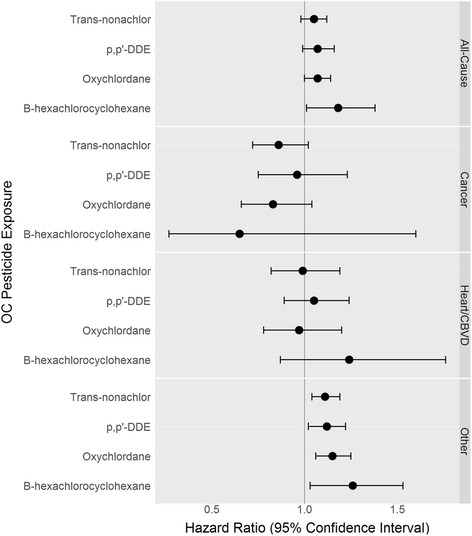
Serum measurements of PBDEs, PFASs, and PCBs were not clearly associated with increased all-cause or cause-specific mortality in older Americans. Beta-hexachlorocyclohexane was associated with an increased risk of all-cause mortality [HR per 1 SD increase =1.18, 95% CI = 1.01, 1.38]. Oxychlordane [HR = 1.15 95% CI 1.06, 1.25], p,p'-DDE [HR = 1.12, 95% CI = 1.02, 1.23], trans-nonachlor [HR = 1.11, 95% CI = 1.04, 1.18], and beta-hexachlorocyclohexane [HR = 1.25, 95% CI = 1.03, 1.52] were associated with increased risk of other-cause mortality. Exploratory analyses suggested associations between OC pesticides and other-cause mortality were modified by sex. Exploratory analyses also suggested that the combination of high PBDE and high OC pesticide exposure had a stronger than expected adverse effect on all-cause mortality.
Higher exposure to beta-hexachlorocyclohexane, an OC pesticide, is associated with increased all-cause mortality and higher exposure to four OC pesticides is associated with increased non-cancer, non-heart/cerebrovascular disease mortality in U.S. adults 60 years or older. These associations may be modified by sex or exposure to other POPs.
持久性有机污染物(POPs)是环境和生物体内持久存在的化学物质,包括多溴二苯醚(PBDEs)、全氟和多氟烷基物质(PFASs)、多氯联苯(PCBs)以及有机氯(OC)农药。目前,关于美国人群接触POPs与死亡风险之间关联的数据有限。我们的目标是确定较高的POPs暴露是否与全因、癌症、心脏/脑血管疾病或其他原因导致的死亡风险增加有关。
分析纳入了1999 - 2006年国家健康和营养检查调查(NHANES)中60岁及以上的参与者。我们纳入了483名参与者进行PBDEs分析,1043名进行PFASs分析,461名进行PCBs分析,1428名进行OC农药分析。使用血清中测量的生物标志物来估计POPs暴露情况。通过2011年12月31日的死亡状态来自公开使用的关联死亡档案。我们使用Cox比例风险模型来量化感兴趣的关联。在观察到关联的情况下,我们探讨了性别、体重指数、吸烟状况和蛋白尿对效应的修饰作用。我们还在同时测量了两种分析物的参与者子样本中探讨了PBDEs和OC农药的联合效应。
在美国老年人中,PBDEs、PFASs和PCBs的血清测量值与全因或特定原因死亡率增加之间没有明显关联。β - 六氯环己烷与全因死亡率增加风险相关[每增加1个标准差的风险比(HR)=1.18,95%置信区间(CI)=1.01,1.38]。氧氯丹[HR = 1.15,95% CI 1.06,1.25]、p,p'-滴滴伊[HR = 1.12,95% CI = 1.02,1.23]、反式九氯[HR = 1.11,95% CI = 1.04,1.18]和β - 六氯环己烷[HR = 1.25,95% CI = 1.03,1.52]与其他原因死亡率增加风险相关。探索性分析表明,OC农药与其他原因死亡率之间的关联存在性别差异。探索性分析还表明,高PBDE和高OC农药暴露的组合对全因死亡率有比预期更强的不利影响。
较高的OC农药β - 六氯环己烷暴露与60岁及以上美国成年人的全因死亡率增加相关,四种OC农药的较高暴露与非癌症、非心脏/脑血管疾病死亡率增加相关。这些关联可能受到性别或其他POPs暴露的影响。