Zapata-Diomedi Belen, Knibbs Luke D, Ware Robert S, Heesch Kristiann C, Tainio Marko, Woodcock James, Veerman J Lennert
The University of Queensland, School of Public Health, Brisbane, Queensland, Australia.
Griffith University, Menzies Health Institute Queensland, Brisbane, Queensland, Australia.
PLoS One. 2017 Oct 11;12(10):e0184799. doi: 10.1371/journal.pone.0184799. eCollection 2017.
An alarmingly high proportion of the Australian adult population does not meet national physical activity guidelines (57%). This is concerning because physical inactivity is a risk factor for several chronic diseases. In recent years, an increasing emphasis has been placed on the potential for transport and urban planning to contribute to increased physical activity via greater uptake of active transport (walking, cycling and public transport). In this study, we aimed to estimate the potential health gains and savings in health care costs of an Australian city achieving its stated travel targets for the use of active transport.
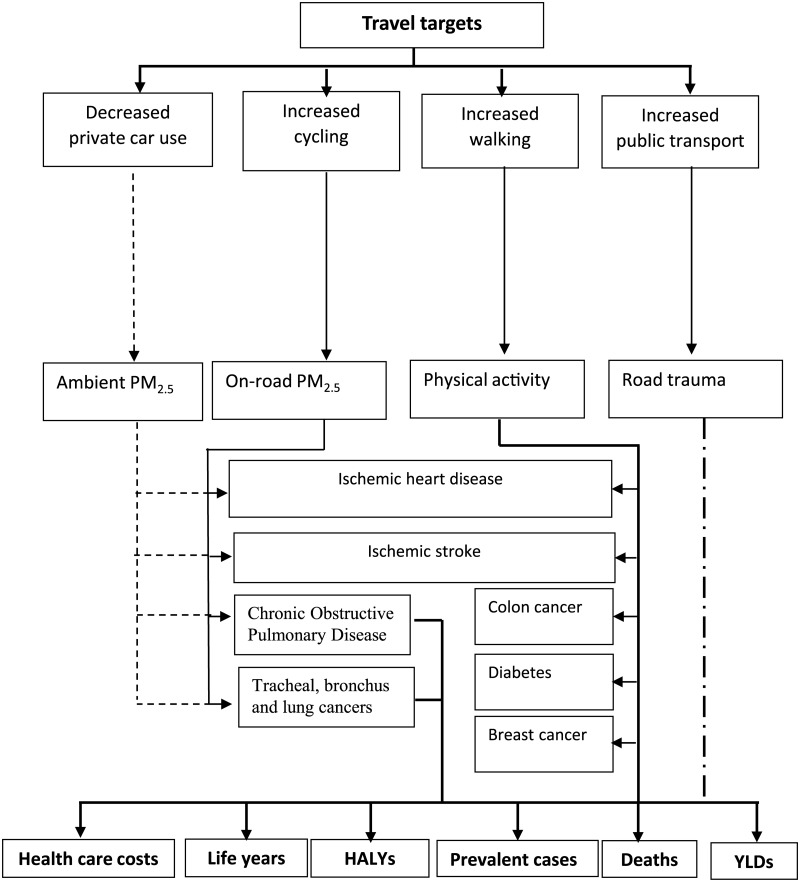
Additional active transport time was estimated for the hypothetical scenario of Brisbane (1.1 million population 2013) in Australia achieving specified travel targets. A multi-state life table model was used to estimate the number of health-adjusted life years, life-years, changes in the burden of diseases and injuries, and the health care costs associated with changes in physical activity, fine particle (<2.5 μm; PM2.5) exposure, and road trauma attributable to a shift from motorised travel to active transport. Sensitivity analyses were conducted to test alternative modelling assumptions.
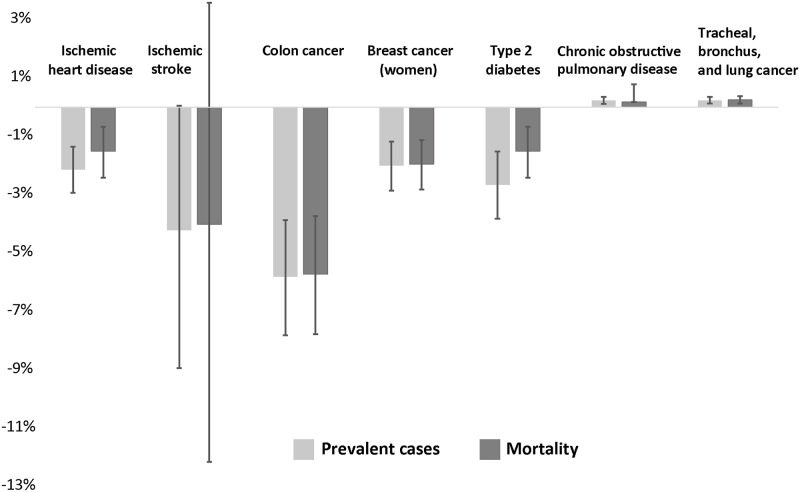
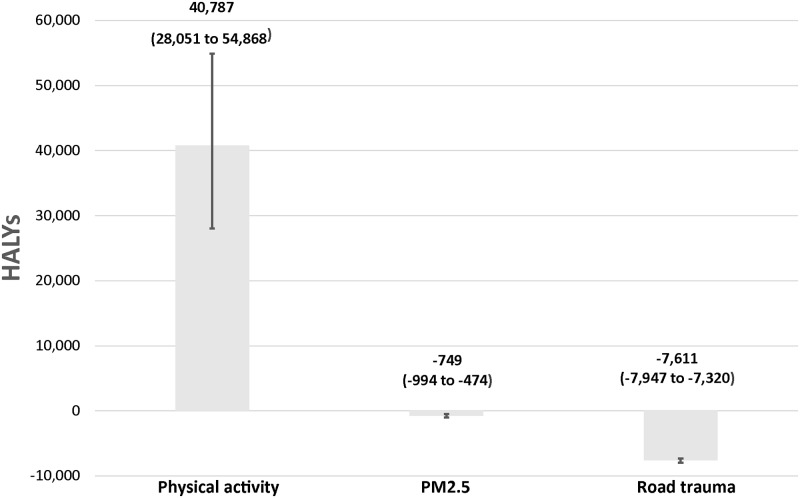
Over the life course of the Brisbane adult population in 2013 (860,000 persons), 33,000 health-adjusted life years could be gained if the travel targets were achieved by 2026. This was mainly due to lower risks of physical inactivity-related diseases, with life course reductions in prevalence and mortality risk in the range of 1.5%-6.0%. Prevalence and mortality of respiratory diseases increased slightly (≥0.27%) due to increased exposure of larger numbers of cyclists and pedestrians to fine particles. The burden of road trauma increased by 30% for mortality and 7% for years lived with disability. We calculated substantial net savings ($AU183 million, 2013 values) in health care costs.
In cities, such as Brisbane, where over 80% of trips are made by private cars, shifts towards walking, cycling and public transport would cause substantial net health benefits and savings in health care costs. However, for such shifts to occur, investments are needed to ensure safe and convenient travel.
澳大利亚成年人口中未达到国家体育活动指南要求的比例高得惊人(57%)。这令人担忧,因为缺乏体育活动是多种慢性疾病的风险因素。近年来,人们越来越强调交通和城市规划通过更多地采用主动交通方式(步行、骑自行车和公共交通)来促进体育活动增加的潜力。在本研究中,我们旨在估计澳大利亚一个城市实现其设定的主动交通出行目标后可能带来的健康益处以及医疗保健成本的节省。
针对澳大利亚布里斯班(2013年人口110万)实现特定出行目标的假设情景,估算了额外的主动交通时间。使用多状态生命表模型来估计健康调整生命年数、生命年数、疾病和伤害负担的变化,以及与体育活动变化、细颗粒物(<2.5微米;PM2.5)暴露和因从机动出行转向主动交通导致的道路创伤相关的医疗保健成本。进行了敏感性分析以检验替代建模假设。
对于2013年布里斯班成年人口(86万人)的整个生命历程,如果到2026年实现出行目标,可获得3.3万个健康调整生命年。这主要是由于缺乏体育活动相关疾病的风险降低,整个生命历程中患病率和死亡风险降低了1.5% - 6.0%。由于更多骑自行车者和行人接触细颗粒物,呼吸道疾病的患病率和死亡率略有上升(≥0.27%)。道路创伤负担在死亡率方面增加了30%,在残疾生存年数方面增加了7%。我们计算出医疗保健成本有大量净节省(1.83亿澳元,2013年价值)。
在像布里斯班这样超过80%的出行由私家车完成的城市,转向步行、骑自行车和公共交通将带来巨大的净健康益处并节省医疗保健成本。然而,要实现这种转变,需要进行投资以确保出行安全和便捷。