RIKILT Wageningen University & Research, P.O. Box 230, 6700 AE Wageningen, The Netherlands.
Food Quality and Design Group, Wageningen University and Research, P.O. Box 8129, 6700 EV Wageningen, The Netherlands.
Gigascience. 2017 Oct 1;6(10):1-18. doi: 10.1093/gigascience/gix080.
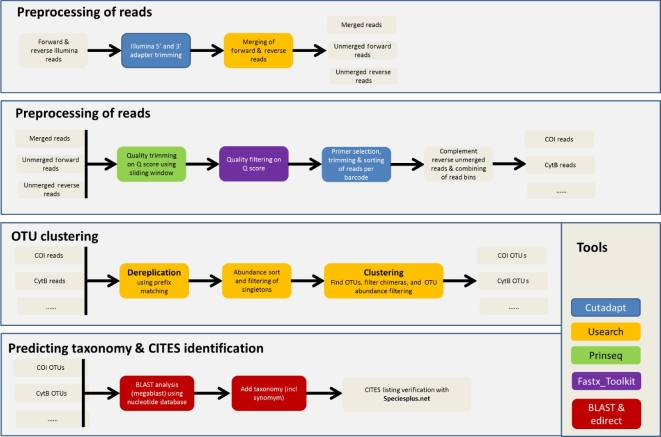
DNA metabarcoding provides great potential for species identification in complex samples such as food supplements and traditional medicines. Such a method would aid Convention on International Trade in Endangered Species of Wild Fauna and Flora (CITES) enforcement officers to combat wildlife crime by preventing illegal trade of endangered plant and animal species. The objective of this research was to develop a multi-locus DNA metabarcoding method for forensic wildlife species identification and to evaluate the applicability and reproducibility of this approach across different laboratories. A DNA metabarcoding method was developed that makes use of 12 DNA barcode markers that have demonstrated universal applicability across a wide range of plant and animal taxa and that facilitate the identification of species in samples containing degraded DNA. The DNA metabarcoding method was developed based on Illumina MiSeq amplicon sequencing of well-defined experimental mixtures, for which a bioinformatics pipeline with user-friendly web-interface was developed. The performance of the DNA metabarcoding method was assessed in an international validation trial by 16 laboratories, in which the method was found to be highly reproducible and sensitive enough to identify species present in a mixture at 1% dry weight content. The advanced multi-locus DNA metabarcoding method assessed in this study provides reliable and detailed data on the composition of complex food products, including information on the presence of CITES-listed species. The method can provide improved resolution for species identification, while verifying species with multiple DNA barcodes contributes to an enhanced quality assurance.
DNA 代谢组学为鉴定食品补充剂和传统药物等复杂样本中的物种提供了巨大的潜力。这种方法将有助于《濒危野生动植物种国际贸易公约》(CITES)执法人员通过防止濒危动植物物种的非法贸易来打击野生动植物犯罪。本研究的目的是开发一种用于法医野生动物物种鉴定的多基因座 DNA 代谢组学方法,并评估该方法在不同实验室中的适用性和可重复性。本研究开发了一种 DNA 代谢组学方法,该方法利用了 12 个 DNA 条码标记物,这些标记物在广泛的动植物分类群中具有普遍适用性,并且有利于鉴定含有降解 DNA 的样本中的物种。该 DNA 代谢组学方法是基于 Illumina MiSeq 扩增子测序的,对于这些实验混合物,开发了一个具有用户友好的网络界面的生物信息学管道。该方法在国际验证试验中由 16 个实验室进行了评估,结果表明该方法具有高度的可重复性,并且足够灵敏,可以识别混合物中以干重 1%存在的物种。本研究评估的先进的多基因座 DNA 代谢组学方法为复杂食品产品的组成提供了可靠和详细的数据,包括 CITES 列出的物种的存在信息。该方法可以提高物种鉴定的分辨率,而使用多个 DNA 条码验证物种则有助于提高质量保证。