Centre for Cancer Prevention, Wolfson Institute of Preventive Medicine, Queen Mary University of London, Charterhouse Square, London, EC1M 6BQ, UK.
Centre for Imaging Science, School of Health Sciences, University of Manchester, Stopford Building, Oxford Road, Manchester, M13 9PT, UK.
Breast Cancer Res. 2017 Oct 18;19(1):114. doi: 10.1186/s13058-017-0906-6.
The percentage of mammographic dense tissue (PD) is an important risk factor for breast cancer, and there is some evidence that texture features may further improve predictive ability. However, relatively little work has assessed or validated textural feature algorithms using raw full field digital mammograms (FFDM).
A case-control study nested within a screening cohort (age 46-73 years) from Manchester UK was used to develop a texture feature risk score (264 cases diagnosed at the same time as mammogram of the contralateral breast, 787 controls) using the least absolute shrinkage and selection operator (LASSO) method for 112 features, and validated in a second case-control study from the same cohort but with cases diagnosed after the index mammogram (317 cases, 931 controls). Predictive ability was assessed using deviance and matched concordance index (mC). The ability to improve risk estimation beyond percent volumetric density (Volpara) was evaluated using conditional logistic regression.
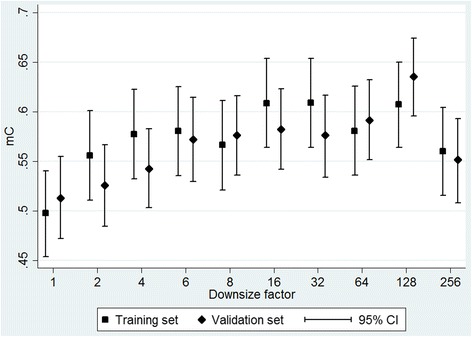
The strongest features identified in the training set were "sum average" based on the grey-level co-occurrence matrix at low image resolutions (original resolution 10.628 pixels per mm; downsized by factors of 16, 32 and 64), which had a better deviance and mC than volumetric PD. In the validation study, the risk score combining the three sum average features achieved a better deviance than volumetric PD (Δχ = 10.55 or 6.95 if logarithm PD) and a similar mC to volumetric PD (0.58 and 0.57, respectively). The risk score added independent information to volumetric PD (Δχ = 14.38, p = 0.0008).
Textural features based on digital mammograms improve risk assessment beyond volumetric percentage density. The features and risk score developed need further investigation in other settings.
乳腺组织的致密程度(PD)百分比是乳腺癌的一个重要危险因素,有证据表明纹理特征可能进一步提高预测能力。然而,相对较少的工作使用原始全视野数字乳腺 X 线摄影(FFDM)评估或验证纹理特征算法。
使用英国曼彻斯特的一项病例对照研究(年龄 46-73 岁),该研究嵌套在筛查队列中,使用最小绝对收缩和选择算子(LASSO)方法为 112 个特征开发了纹理特征风险评分(在对侧乳房进行乳房 X 线摄影的同时诊断出 264 例病例,787 例对照),并在同一队列的第二个病例对照研究中进行了验证,但病例是在指数乳房 X 线摄影后诊断出的(317 例病例,931 例对照)。使用偏差和匹配一致性指数(mC)评估预测能力。使用条件逻辑回归评估了在百分比体积密度(Volpara)之外改善风险估计的能力。
在训练集中确定的最强特征是基于灰度共生矩阵的“总和平均值”,该特征在低图像分辨率下(原始分辨率为 10.628 像素/毫米;缩小因子为 16、32 和 64),其偏差和 mC 均优于体积 PD。在验证研究中,结合三个总和平均值特征的风险评分在偏差方面优于体积 PD(Δχ=10.55 或对数 PD 为 6.95),mC 与体积 PD 相似(分别为 0.58 和 0.57)。风险评分增加了体积 PD 的独立信息(Δχ=14.38,p=0.0008)。
基于数字乳腺 X 线摄影的纹理特征可提高体积百分比密度之外的风险评估。需要进一步在其他环境中研究这些特征和风险评分。