Yang Xue-Li, Chen Ji-Chun, Li Jian-Xin, Cao Jie, Lu Xiang-Feng, Liu Fang-Chao, Hu Dong-Sheng, Liu Xiao-Qing, Shen Chong, Yu Ling, Lu Fang-Hong, Wu Xian-Ping, Zhao Lian-Cheng, Huang Jian-Feng, Li Ying, Wu Xi-Gui, Gu Dong-Feng
Department of Epidemiology, Fuwai Hospital, National Center for Cardiovascular Diseases, Chinese Academy of Medical Sciences and Peking Union Medical College, Beijing 100037, China.
Department of Prevention Medicine, Shenzhen University School of Medicine, Guangdong 518000, China.
Chronic Dis Transl Med. 2016 Oct 21;2(2):102-109. doi: 10.1016/j.cdtm.2016.10.001. eCollection 2016 Jun.
This study aims to determine the distribution of observed atherosclerotic cardiovascular disease (ASCVD) incidence in contemporary cohorts in China, and to identify cut-off points for ASCVD risk classification based on traditional criteria and new equations developed by Prediction for ASCVD Risk in China (China-PAR).
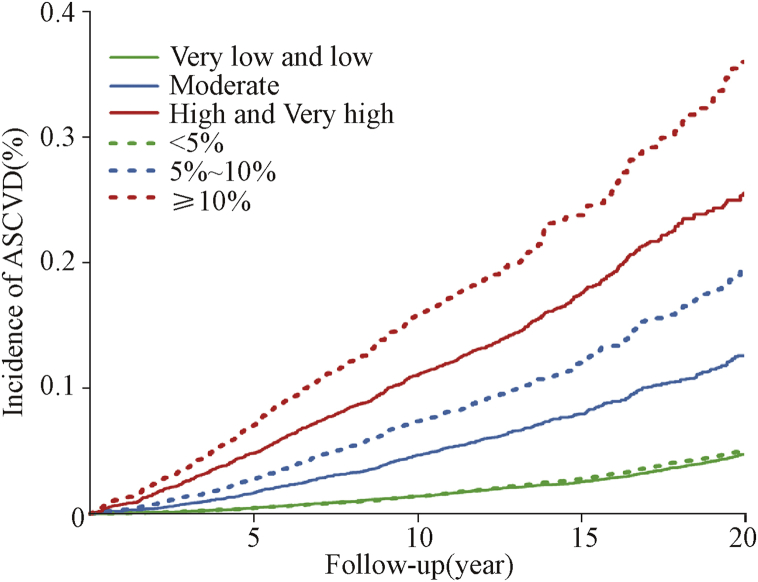
The study populations included cohorts in the China-PAR project, with 34,757 participants eligible for the current analysis. Traditional risk stratification was assessed by using Chinese guidelines on prevention of CVD and hypertension, and 5 risk groups were classified based on these guidelines after slight modification for available risk factors. Kaplan-Meier analysis was conducted to obtain the cumulative incidence of observed ASCVD events for all subjects and sub-groups. The predicted 10-year ASCVD risk was obtained using the China-PAR equations.
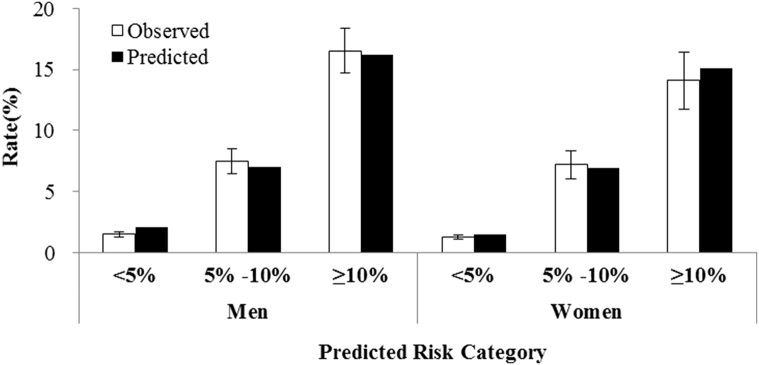
A total of 1922 ASCVD events were identified during an average follow-up of 14.1 years. According to the group classification based on traditional risk stratification, the observed 10-year risks for ASCVD were 4.61% (95% confidence interval []: 4.11-5.10%) in the moderate-risk group and 8.74% (95% : 7.82-9.66%) in the high-risk group. Based on the China-PAR equations for risk assessment of ASCVD, those with predicted risks of <5%, 5-10%, and ≥10% could be classified into categories of low-, moderate-, and high-risk for ASCVD, respectively.
The findings enable development of a simple method for classification of individuals into low-, moderate-, and high-risk groups, based on the China-PAR equations. The method will be useful for self-management and prevention of ASCVD in Chinese adults.
本研究旨在确定中国当代队列中观察到的动脉粥样硬化性心血管疾病(ASCVD)发病率的分布情况,并根据传统标准和中国动脉粥样硬化性心血管疾病风险预测(China-PAR)开发的新方程确定ASCVD风险分类的切点。
研究人群包括China-PAR项目中的队列,共有34757名参与者符合当前分析的条件。采用中国心血管疾病和高血压预防指南评估传统风险分层,并在对可用风险因素进行轻微修改后,根据这些指南将参与者分为5个风险组。采用Kaplan-Meier分析获得所有受试者和亚组观察到的ASCVD事件的累积发病率。使用China-PAR方程获得预测的10年ASCVD风险。
在平均14.1年的随访期间,共确定了1922例ASCVD事件。根据基于传统风险分层的分组分类,中度风险组观察到的10年ASCVD风险为4.61%(95%置信区间[]:4.11-5.10%),高危组为8.74%(95%:7.82-9.66%)。根据China-PAR ASCVD风险评估方程,预测风险<5%、5-10%和≥10%的患者可分别分为ASCVD低、中、高风险类别。
这些发现有助于基于China-PAR方程开发一种将个体分为低、中、高风险组的简单方法。该方法将有助于中国成年人的ASCVD自我管理和预防。