Department of Food Science, Guangxi University, Nanning, Guangxi, 530004, China.
Sci Rep. 2017 Oct 25;7(1):14016. doi: 10.1038/s41598-017-14212-3.
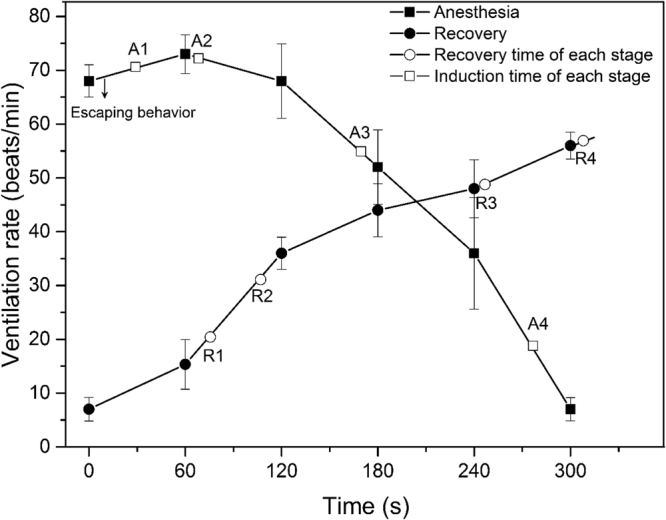
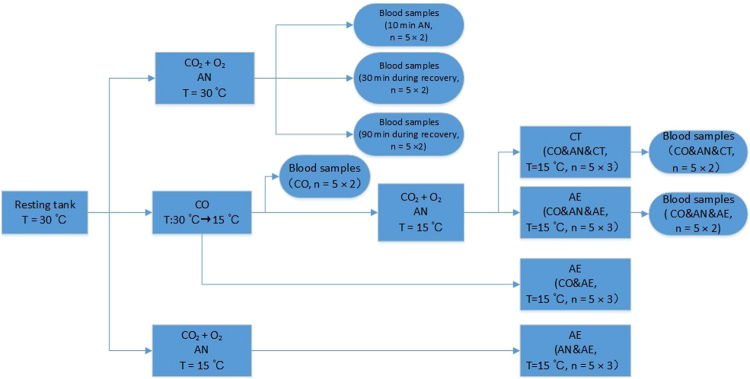
Tilapia were subjected to cooling (CO, a stepwise reduction in temperature from 30 °C to 15 °C), anesthesia (AN, anesthetized by hyperoxic carbon dioxide), air exposure (AE, exposed to air) and cold tolerance (CT, in 15 °C water) treatments, and the physiological responses were determined after the treatments. CO followed by AN treatment for tilapia could meet the criteria of an ideal anesthetic. Fish were deeply sedated within 69 s, completely anesthetized within 276 s and recovered within 308 s without any mortality. The stress responses induced by the CO&AN treatment were mild, whereas they were consistently increased in the AE treatment. Furthermore, the AE treatment caused tissue damage. The AE duration was significantly improved by CO&AN treatment, and the survival time of the CO&AE, AN&AE and CO&AN&AE treatments were 313 min, 351 min and 561 min, respectively, in the laboratory experiments, whereas the survival rate of the CO&AN&AE treatment group after 240-min air exposure was 95.2% in the pilot test. It appeared that cooling followed by hyperoxic CO anesthesia would be suitable for handling tilapia in a short-time air exposure procedure.
罗非鱼分别接受了冷却(CO,逐步将温度从 30°C 降至 15°C)、麻醉(AN,用富氧二氧化碳麻醉)、空气暴露(AE,暴露于空气中)和耐冷(CT,在 15°C 水中)处理,处理后测定生理反应。CO 后接 AN 处理可满足理想麻醉剂的标准。69 秒内鱼会深度镇静,276 秒内完全麻醉,308 秒内恢复,无死亡。CO&AN 处理引起的应激反应温和,而 AE 处理则持续增加。此外,AE 处理会导致组织损伤。CO&AN 处理显著改善了 AE 持续时间,实验室实验中 CO&AE、AN&AE 和 CO&AN&AE 处理的存活时间分别为 313 分钟、351 分钟和 561 分钟,而在 240 分钟空气暴露后的试验中,CO&AN&AE 处理组的存活率为 95.2%。看来,冷却后再接富氧 CO 麻醉,可能适合在短时间空气暴露过程中处理罗非鱼。