Khiyali Zahra, Aliyan Farzaneh, Kashfi Seyyed Hannan, Mansourian Morteza, Khani Jeihooni Ali
Department of Public Health, School of Health, Fasa University of Medical Sciences, Fasa, Iran. Email:
Asian Pac J Cancer Prev. 2017 Oct 26;18(10):2833-2838. doi: 10.22034/APJCP.2017.18.10.2833.
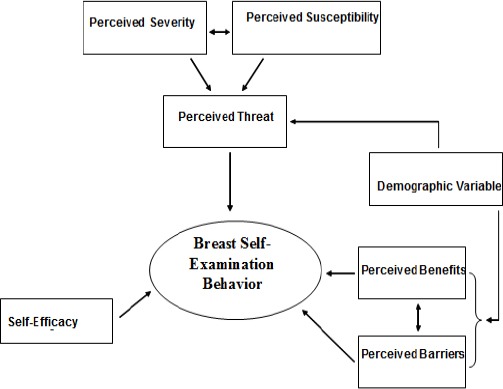
Introduction and aims: Screening can play a major role in reducing deaths associated with cancer. Breast selfexamination (BSE) is a cheap, non-complicated and non-invasive method for breast cancer screening. This study aimed to examine the effects of an educational intervention based on the health belief model (HBM) on BSE behavior in women referred to health centers in Fasa, Iran. Methods: This quasi-experimental study was conducted on 92 women, divided into an experimental and a control group. Data were collected using a validated questionnaire covering demographic characteristics, knowledge, HBM constructs and breast self-examination performance. An educational program was performed in five sessions through group discussion with questions and answers and training videos for participants in the experimental group. Questionnaires were filled before and three months after the intervention in the two groups. Data were analyzed with SPSS-22 software for descriptive and analytical statistics. Results: The results of this study showed that the mean scores for knowledge, HBM constructs and self-examination behavior in the experimental group were elevated compared to the control group after the intervention (P<0.001). Conclusions: Education based on the HBM is effective in promoting breast self-examination behavior. Thus development and implementation of training programs based on the model are proposed for officers involved in education and health promotion in Iran.
筛查在降低癌症相关死亡方面可发挥重要作用。乳房自我检查(BSE)是一种用于乳腺癌筛查的廉价、非复杂且非侵入性的方法。本研究旨在探讨基于健康信念模型(HBM)的教育干预对转诊至伊朗法萨各健康中心的女性乳房自我检查行为的影响。方法:本准实验研究对92名女性进行,分为实验组和对照组。使用一份经过验证的问卷收集数据,内容涵盖人口统计学特征、知识、健康信念模型构成要素以及乳房自我检查表现。通过小组讨论问答以及为实验组参与者播放培训视频的方式,分五节进行了一个教育项目。两组均在干预前及干预后三个月填写问卷。使用SPSS - 22软件对数据进行描述性和分析性统计分析。结果:本研究结果显示,干预后实验组在知识、健康信念模型构成要素及自我检查行为方面的平均得分高于对照组(P<0.001)。结论:基于健康信念模型的教育在促进乳房自我检查行为方面是有效的。因此,建议为伊朗参与教育和健康促进工作的人员制定并实施基于该模型的培训项目。