Lewis-Sigler Institute for Integrative Genomics and Department of Molecular Biology, Princeton University, Princeton, NJ.
Lewis-Sigler Institute for Integrative Genomics and Department of Molecular Biology, Princeton University, Princeton, NJ
J Cell Biol. 2018 Jan 2;217(1):93-106. doi: 10.1083/jcb.201707168. Epub 2017 Oct 26.
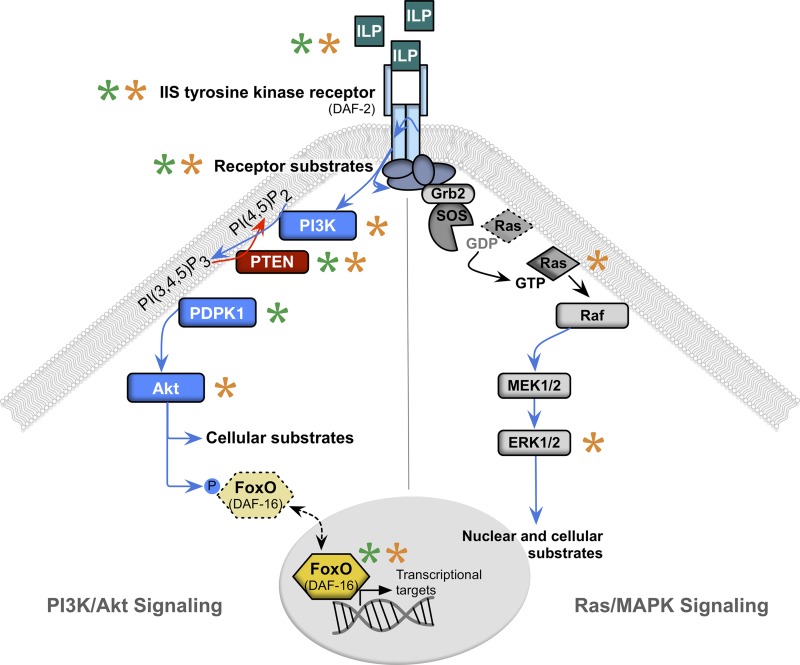
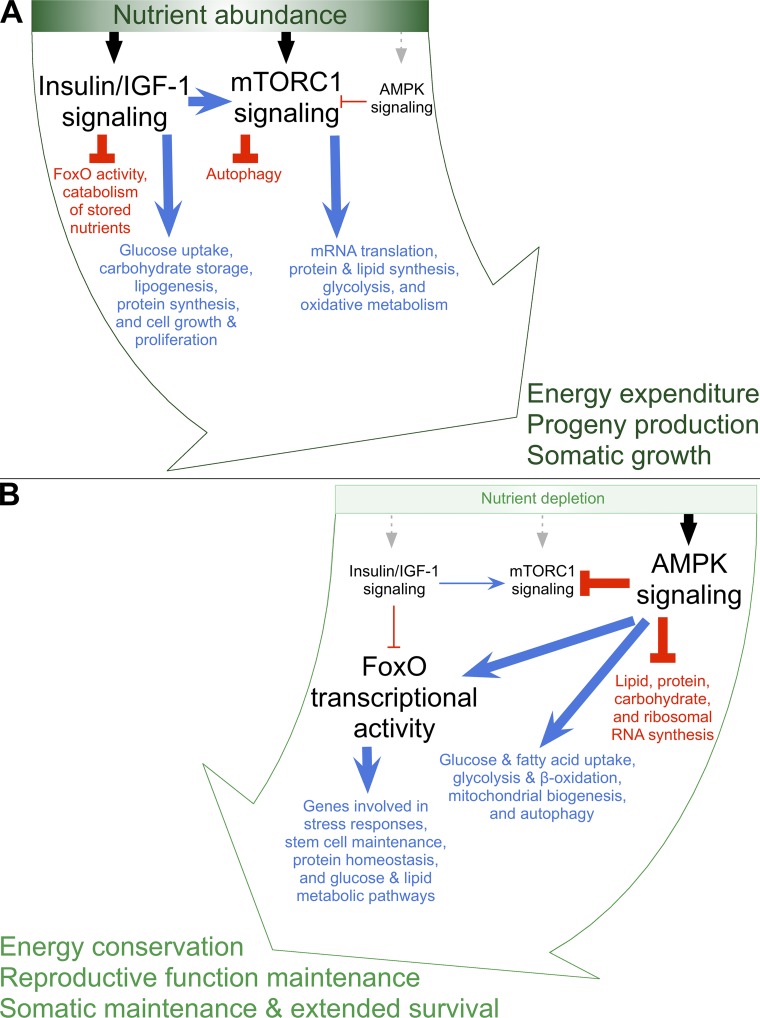
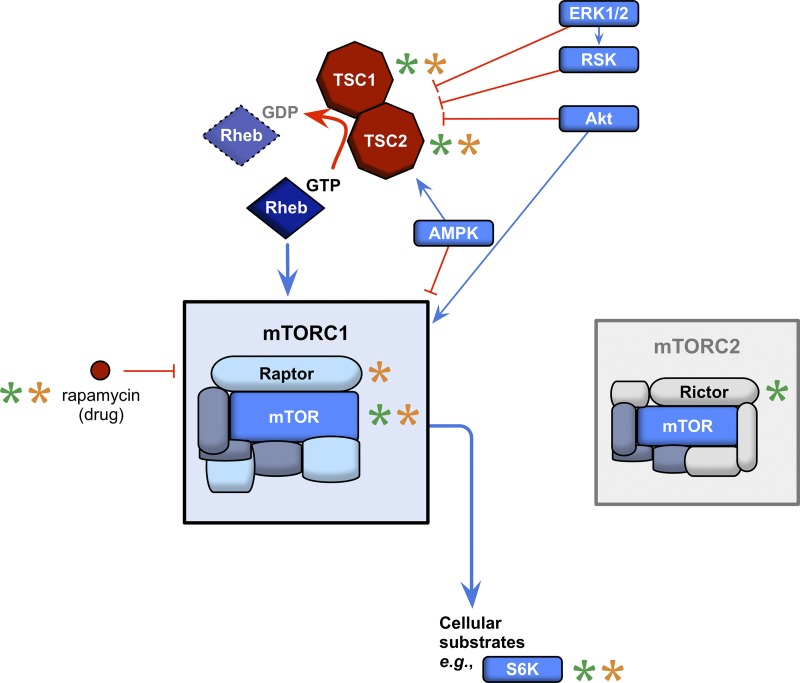
Nutrients are necessary for life, as they are a crucial requirement for biological processes including reproduction, somatic growth, and tissue maintenance. Therefore, signaling systems involved in detecting and interpreting nutrient or energy levels-most notably, the insulin/insulin-like growth factor 1 (IGF-1) signaling pathway, mechanistic target of rapamycin (mTOR), and adenosine monophosphate-activated protein kinase (AMPK)-play important roles in regulating physiological decisions to reproduce, grow, and age. In this review, we discuss the connections between reproductive senescence and somatic aging and give an overview of the involvement of nutrient-sensing pathways in controlling both reproductive function and lifespan. Although the molecular mechanisms that affect these processes can be influenced by distinct tissue-, temporal-, and pathway-specific signaling events, the progression of reproductive aging and somatic aging is systemically coordinated by integrated nutrient-sensing signaling pathways regulating somatic tissue maintenance in conjunction with reproductive capacity.
营养物质是生命所必需的,因为它们是包括繁殖、体细胞生长和组织维持在内的生物过程的关键要求。因此,参与检测和解释营养或能量水平的信号系统——最显著的是胰岛素/胰岛素样生长因子 1 (IGF-1) 信号通路、雷帕霉素机制靶蛋白 (mTOR) 和单磷酸腺苷激活蛋白激酶 (AMPK)——在调节繁殖、生长和衰老的生理决策方面发挥着重要作用。在这篇综述中,我们讨论了生殖衰老和体细胞衰老之间的联系,并概述了营养感应途径在控制生殖功能和寿命方面的参与。尽管影响这些过程的分子机制可能受到不同组织、时间和途径特异性信号事件的影响,但生殖衰老和体细胞衰老的进展是通过整合的营养感应信号途径系统协调的,这些信号途径共同调节生殖能力的体细胞组织维持。