Sichuan Key Laboratory of Conservation Biology for Endangered Wildlife, Chengdu Research Base of Giant Panda Breeding, Chengdu, Sichuan, 610081, China.
Department of Microbiology, School of Medicine, Jiangsu University, Zhenjiang, Jiangsu, 212013, China.
Virol J. 2017 Oct 27;14(1):207. doi: 10.1186/s12985-017-0867-5.
Polyomaviruses infect a wide variety of mammalian and avian hosts with a broad spectrum of outcomes including asymptomatic infection, acute systemic disease, and tumor induction.
Viral metagenomics and general PCR methods were used to detected viral nucleic acid in the samples from a diseased and healthy giant pandas.
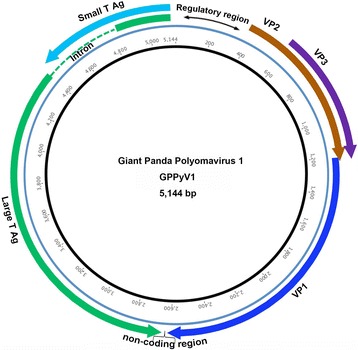
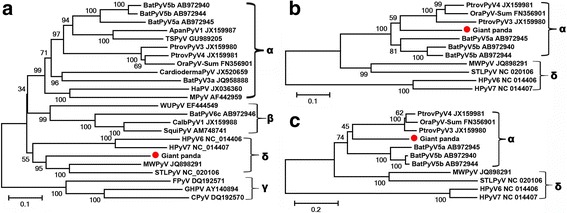
A novel polyomavirus, the giant panda polyomavirus 1 (GPPyV1) from the nasal cavity of a dead giant panda (Ailuropoda melanoleuca) was characterized. The GPPyV1 genome is 5144 bp in size and reveals five putative open-reading frames coding for the classic small and large T antigens in the early region, and the VP1, VP2 and VP3 capsid proteins in the late region. Phylogenetic analyses of the large T antigen of the GPPyV1 indicated GPPyV1 belonged to a putative new species within genus Deltapolyomavirus, clustering with four human polyomavirus species. The GPPyV1 VP1 and VP2 clustered with genus Alphapolyomavirus. Our epidemiologic study indicated that this novel polyomavirus was also detected in nasal swabs and fecal samples collected from captive healthy giant pandas.
A novel polyomavirus was detected in giant pandas and its complete genome was characterized, which may cause latency infection in giant pandas.
多瘤病毒感染范围广泛,宿主包括多种哺乳动物和禽类,其感染结果多样,包括无症状感染、急性全身性疾病和肿瘤诱导。
采用病毒宏基因组学和普通聚合酶链反应(PCR)方法,检测了来自患病和健康大熊猫的样本中的病毒核酸。
从一只死亡大熊猫(Ailuropoda melanoleuca)的鼻腔中分离出一种新型多瘤病毒,即大熊猫多瘤病毒 1(Giant panda polyomavirus 1,GPPyV1)。GPPyV1 的基因组大小为 5144bp,包含 5 个可能的开放阅读框,编码早期区的经典小 T 抗原和大 T 抗原,以及晚期区的 VP1、VP2 和 VP3 衣壳蛋白。GPPyV1 大 T 抗原的系统进化分析表明,GPPyV1 属于 Deltapolyomavirus 属中的一个假定新种,与四种人类多瘤病毒聚为一簇。GPPyV1 的 VP1 和 VP2 与 Alphapolyomavirus 属聚类。我们的流行病学研究表明,这种新型多瘤病毒也存在于圈养健康大熊猫的鼻腔拭子和粪便样本中。
在大熊猫中检测到一种新型多瘤病毒,并对其完整基因组进行了特征描述,该病毒可能导致大熊猫潜伏感染。