Hobbs Cheryl A, Saigo Kazuhiko, Koyanagi Mihoko, Hayashi Shim-Mo
Toxicology Program, Integrated Laboratory Systems, Inc., PO Box 13501, Research Triangle Park, NC 27709, USA.
Drug Safety Research Laboratories, Shin Nippon Biomedical Laboratories, Ltd., 2438 Miyanoura-cho, Kagoshima-City, Kagoshima 891-1394, Japan.
Toxicol Rep. 2017 Oct 16;4:554-559. doi: 10.1016/j.toxrep.2017.10.003. eCollection 2017.
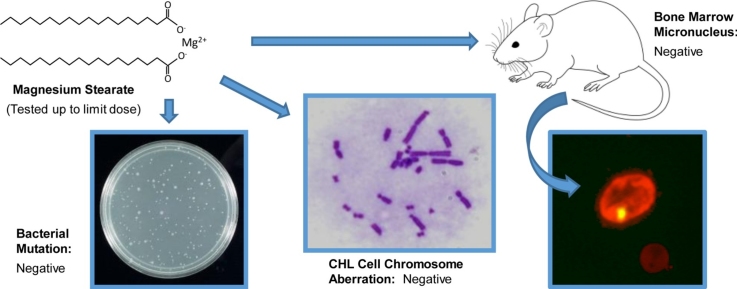
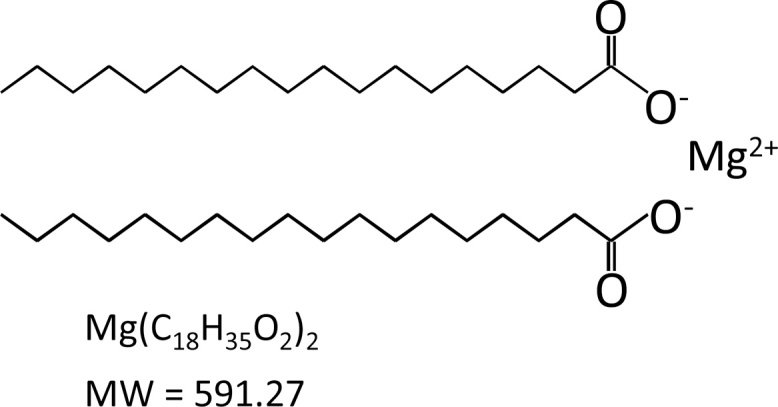
Magnesium stearate is widely used in the production of dietary supplement and pharmaceutical tablets, capsules and powders as well as many food products, including a variety of confectionery, spices and baking ingredients. Although considered to have a safe toxicity profile, there is no available information regarding its potential to induce genetic toxicity. To aid safety assessment efforts, magnesium sulfate was evaluated in a battery of tests including a bacterial reverse mutation assay, an chromosome aberration assay, and an erythrocyte micronucleus assay. Magnesium stearate did not produce a positive response in any of the five bacterial strains tested, in the absence or presence of metabolic activation. Similarly, exposure to magnesium stearate did not lead to chromosomal aberrations in CHL/IU Chinese hamster lung fibroblasts, with or without metabolic activation, or induce micronuclei in the bone marrow of male CD-1 mice. These studies have been used by the Japanese government and the Joint FAO/WHO Expert Committee on Food Additives in their respective safety assessments of magnesium stearate. These data indicate a lack of genotoxic risk posed by magnesium stearate consumed at current estimated dietary exposures. However, health effects of cumulative exposure to magnesium via multiple sources present in food additives may be of concern and warrant further evaluation.
硬脂酸镁广泛应用于膳食补充剂、医药片剂、胶囊和粉剂的生产,以及许多食品中,包括各种糖果、香料和烘焙原料。尽管其毒性被认为是安全的,但尚无关于其潜在遗传毒性的信息。为协助进行安全性评估,对硬脂酸镁进行了一系列测试,包括细菌回复突变试验、染色体畸变试验和红细胞微核试验。在有无代谢活化的情况下,硬脂酸镁在所测试的五种细菌菌株中均未产生阳性反应。同样,无论有无代谢活化,接触硬脂酸镁均未导致中国仓鼠肺成纤维细胞(CHL/IU)出现染色体畸变,也未在雄性CD-1小鼠的骨髓中诱导微核形成。日本政府和粮农组织/世界卫生组织食品添加剂联合专家委员会在各自对硬脂酸镁的安全性评估中采用了这些研究。这些数据表明,在目前估计的膳食暴露水平下,食用硬脂酸镁不存在遗传毒性风险。然而,通过食品添加剂中多种来源累积接触镁对健康的影响可能值得关注,需要进一步评估。