de Vries Bert, Friston Karl J
Department of Electrical Engineering, Eindhoven University of Technology, Eindhoven, Netherlands.
GN Hearing Benelux BV, Eindhoven, Netherlands.
Front Comput Neurosci. 2017 Oct 18;11:95. doi: 10.3389/fncom.2017.00095. eCollection 2017.
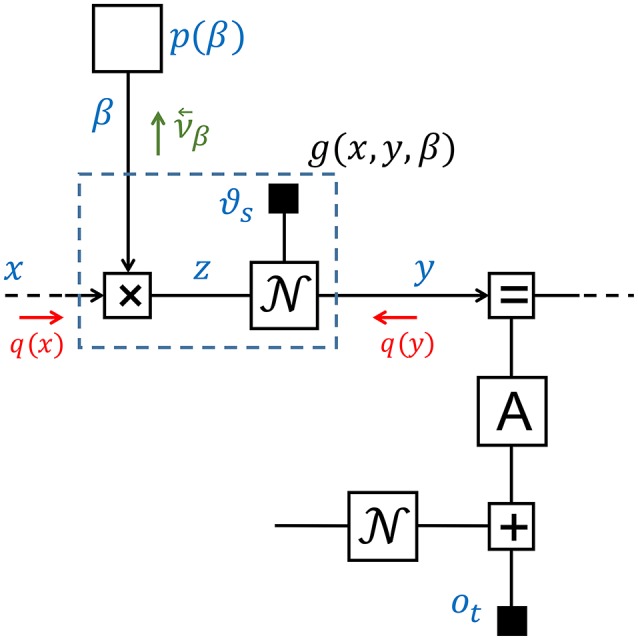
Active inference is a corollary of the Free Energy Principle that prescribes how self-organizing biological agents interact with their environment. The study of active inference processes relies on the definition of a generative probabilistic model and a description of how a free energy functional is minimized by neuronal message passing under that model. This paper presents a tutorial introduction to specifying active inference processes by Forney-style factor graphs (FFG). The FFG framework provides both an insightful representation of the probabilistic model and a biologically plausible inference scheme that, in principle, can be automatically executed in a computer simulation. As an illustrative example, we present an FFG for a deep temporal active inference process. The graph clearly shows how policy selection by expected free energy minimization results from free energy minimization , in an appropriate generative policy model.
主动推理是自由能原理的必然结果,它规定了自组织生物主体如何与环境相互作用。对主动推理过程的研究依赖于生成概率模型的定义以及对在该模型下通过神经元消息传递使自由能泛函最小化的方式的描述。本文提供了一个关于通过福尔尼风格因子图(FFG)来指定主动推理过程的教程式介绍。FFG框架既提供了概率模型的深刻表示,又提供了一种生物学上合理的推理方案,原则上可以在计算机模拟中自动执行。作为一个说明性示例,我们给出了一个用于深度时间主动推理过程的FFG。该图清晰地展示了在适当的生成策略模型中,通过预期自由能最小化进行策略选择是如何由自由能最小化产生的。