Benrimoh David, Parr Thomas, Vincent Peter, Adams Rick A, Friston Karl
Wellcome Trust Centre for Neuroimaging, Institute of Neurology, University College London, London, UK.
Division of Psychiatry, University College London, London, UK.
Comput Psychiatr. 2018 Dec;2:183-204. doi: 10.1162/cpsy_a_00022.
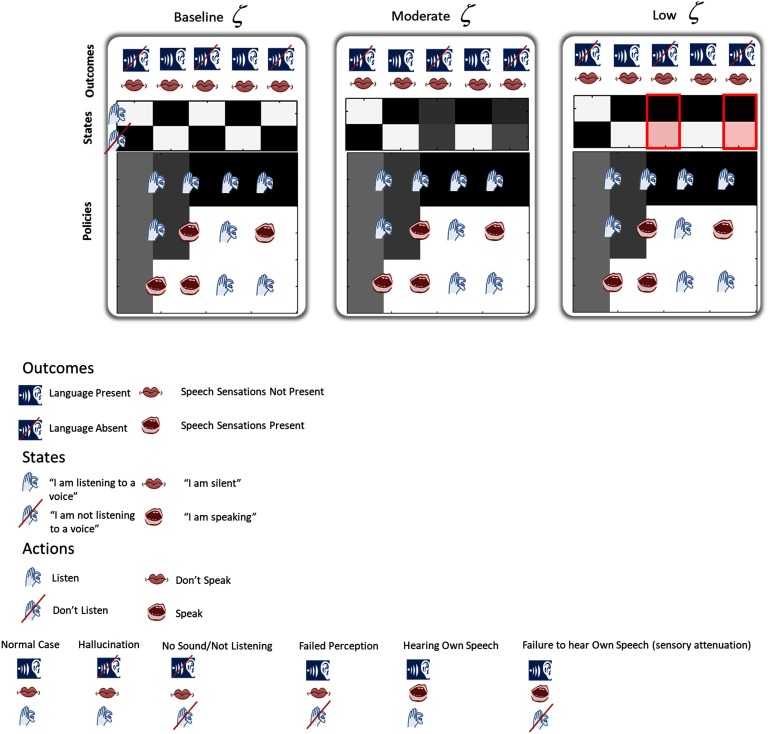
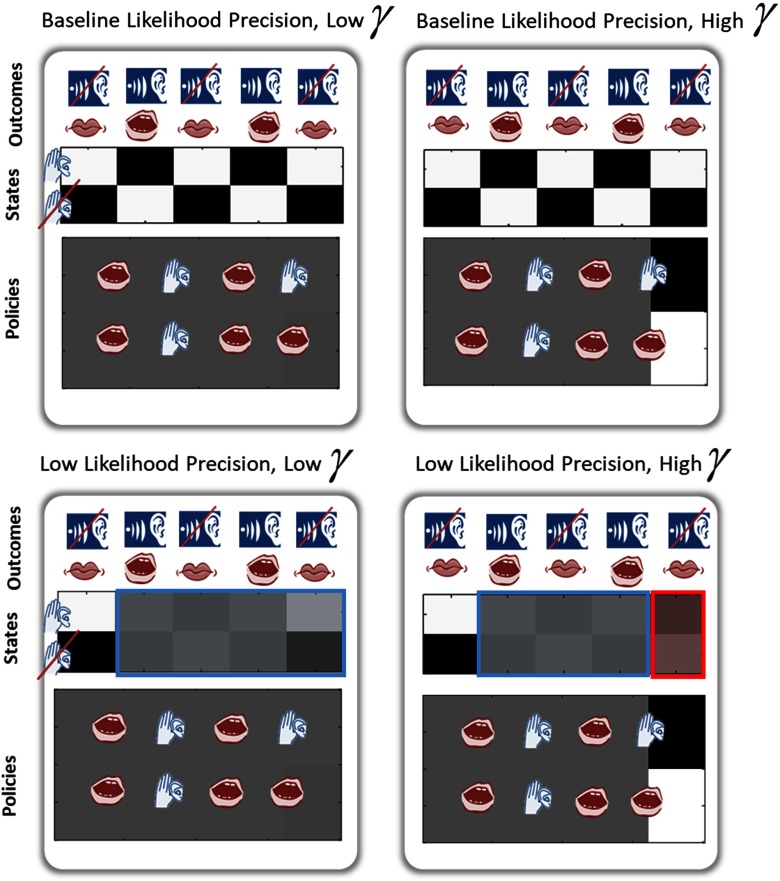
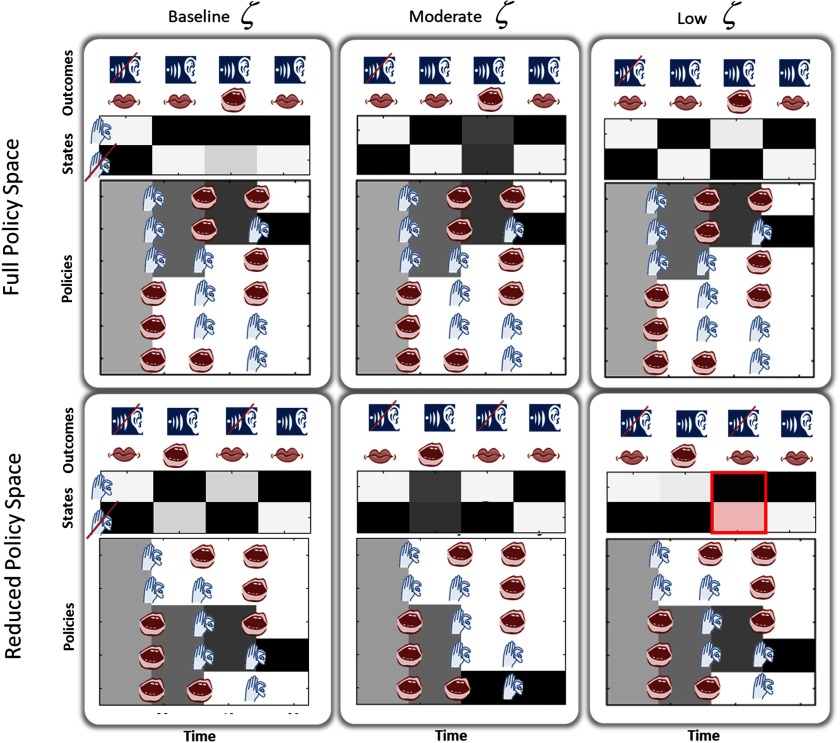
Auditory verbal hallucinations (AVH) are often distressing symptoms of several neuropsychiatric conditions, including schizophrenia. Using a Markov decision process formulation of active inference, we develop a novel model of AVH as false (positive) inference. Active inference treats perception as a process of hypothesis testing, in which sensory data are used to disambiguate between alternative hypotheses about the world. Crucially, this depends upon a delicate balance between prior beliefs about unobserved (hidden) variables and the sensations they cause. A false inference that a voice is present, even in the absence of auditory sensations, suggests that prior beliefs dominate perceptual inference. Here we consider the computational mechanisms that could cause this imbalance in perception. Through simulation, we show that the content of (and confidence in) prior beliefs depends on beliefs about policies (here sequences of listening and talking) and on beliefs about the reliability of sensory data. We demonstrate several ways in which hallucinatory percepts could occur when an agent expects to hear a voice in the presence of imprecise sensory data. This model expresses, in formal terms, alternative computational mechanisms that underwrite AVH and, speculatively, can be mapped onto neurobiological changes associated with schizophrenia. The interaction of action and perception is important in modeling AVH, given that speech is a fundamentally enactive and interactive process-and that hallucinators often actively engage with their voices.
听幻觉(AVH)通常是包括精神分裂症在内的几种神经精神疾病的困扰症状。我们使用主动推理的马尔可夫决策过程公式,开发了一种将AVH作为错误(阳性)推理的新模型。主动推理将感知视为一个假设检验的过程,其中感官数据用于区分关于世界的替代假设。至关重要的是,这取决于关于未观察到的(隐藏)变量及其引起的感觉的先验信念之间的微妙平衡。即使在没有听觉感觉的情况下,关于有声音存在的错误推理表明先验信念主导了感知推理。在这里,我们考虑可能导致这种感知失衡的计算机制。通过模拟,我们表明先验信念的内容(以及对其的信心)取决于关于策略(这里是倾听和交谈的序列)的信念以及关于感官数据可靠性的信念。我们展示了在存在不精确感官数据时,当一个人期望听到声音时幻觉感知可能出现的几种方式。这个模型以形式化的方式表达了支持AVH的替代计算机制,并且推测可以映射到与精神分裂症相关的神经生物学变化上。鉴于言语是一个从根本上具有能动性和交互性的过程,并且幻觉者经常积极地与他们听到的声音互动,行动与感知的相互作用在模拟AVH中很重要。