Bobrovitz Niklas, Lasserson Daniel S, Briggs Adam D M
Nuffield Department of Primary Care Health Sciences, University of Oxford, Radcliffe Primary Care Building, Woodstock Road, Oxford, OX2 6GG, UK.
Ambulatory Care, Institute of Applied Health Research, College of Medical and Dental Sciences, University of Birmingham, Edgbaston, Birmingham, B15 2TT, UK.
BMC Emerg Med. 2017 Nov 2;17(1):32. doi: 10.1186/s12873-017-0145-2.
The four-hour target is a key hospital emergency department performance indicator in England and one that drives the physical and organisational design of the ED. Some studies have identified time of presentation as a key factor affecting waiting times. Few studies have investigated other determinants of breaching the four-hour target. Therefore, our objective was to describe patterns of emergency department breaches of the four-hour wait time target and identify patients at highest risk of breaching.
This was a retrospective cohort study of a large type 1 Emergency department at an NHS teaching hospital in Oxford, England. We analysed anonymised individual level patient data for 378,873 emergency department attendances, representing all attendances between April 2008 and April 2013. We examined patient characteristics and emergency department presentation circumstances associated with the highest likelihood of breaching the four-hour wait time target.
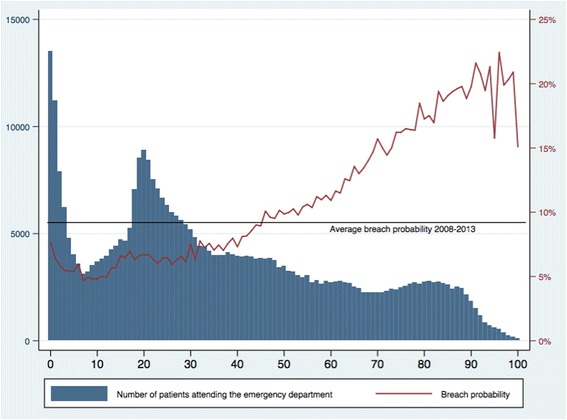
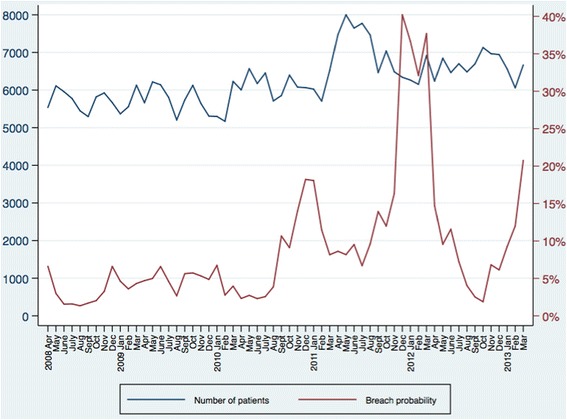
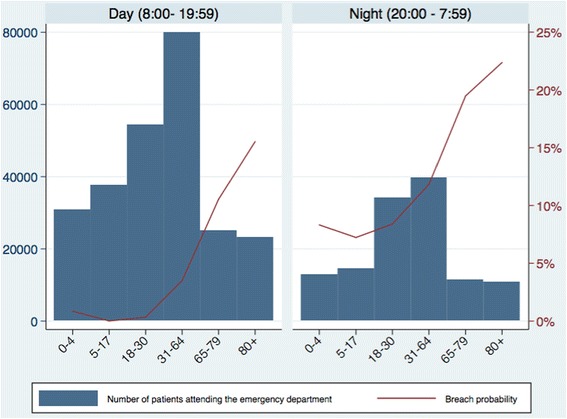
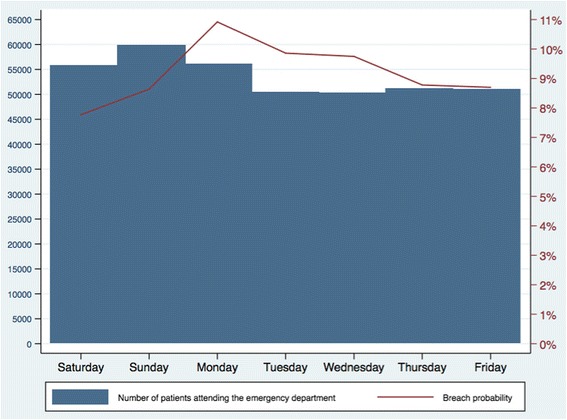
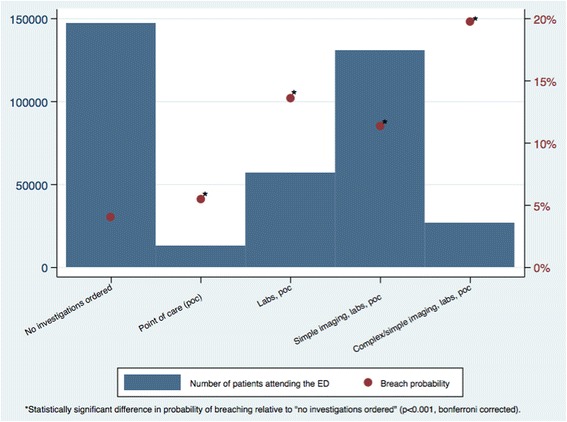
We used 374,459 complete cases for analysis. In total, 8.3% of all patients breached the four-hour wait time target. The main determinants of patients breaching the four-hour wait time target were hour of arrival to the ED, day of the week, patient age, ED referral source, and the types of investigations patients receive (p < 0.01 for all associations). Patients most likely to breach the four-hour target were older, presented at night, presented on Monday, received multiple types of investigation in the emergency department, and were not self-referred (p < 0.01 for all associations). Patients attending from October to February had a higher odds of breaching compared to those attending from March to September (OR 1.63, 95% CI 1.59 to 1.66).
There are a number of independent patient and circumstantial factors associated with the probability of breaching the four-hour ED wait time target including patient age, ED referral source, the types of investigations patients receive, as well as the hour, day, and month of arrival to the ED. Efforts to reduce the number of breaches could explore late-evening/overnight staffing, access to diagnostic tests, rapid discharge facilities, and early assessment and input on diagnostic and management strategies from a senior practitioner.
四小时目标是英国医院急诊科的一项关键绩效指标,也是推动急诊科物理和组织设计的指标。一些研究已将就诊时间确定为影响等待时间的关键因素。很少有研究调查违反四小时目标的其他决定因素。因此,我们的目标是描述急诊科违反四小时等待时间目标的模式,并确定违反该目标风险最高的患者。
这是一项对英国牛津一家国民保健服务教学医院大型1类急诊科的回顾性队列研究。我们分析了378,873例急诊科就诊患者的匿名个体层面数据,这些数据代表了2008年4月至2013年4月期间的所有就诊情况。我们研究了与违反四小时等待时间目标可能性最高相关的患者特征和急诊科就诊情况。
我们使用374,459例完整病例进行分析。所有患者中,总计8.3%违反了四小时等待时间目标。违反四小时等待时间目标的患者的主要决定因素是到达急诊科的时间、星期几、患者年龄、急诊科转诊来源以及患者接受的检查类型(所有关联的p<0.01)。最有可能违反四小时目标的患者年龄较大,在夜间就诊,在周一就诊,在急诊科接受多种类型的检查,且不是自行转诊(所有关联的p<0.01)。与3月至9月就诊的患者相比,10月至2月就诊的患者违反目标的几率更高(比值比1.63,95%置信区间1.59至1.66)。
有许多独立的患者和情况因素与违反急诊科四小时等待时间目标的可能性相关,包括患者年龄、急诊科转诊来源、患者接受的检查类型,以及到达急诊科 的时间、日期和月份。减少违规次数的努力可以探索傍晚/夜间人员配备、诊断检查的可及性、快速出院设施,以及资深从业者对诊断和管理策略的早期评估和投入。