Hagmann Stefan H F, Rao Sowmya R, LaRocque Regina C, Erskine Stefanie, Jentes Emily S, Walker Allison T, Barnett Elizabeth D, Chen Lin H, Hamer Davidson H, Ryan Edward T
Division of Pediatric Infectious Diseases, Bronx Lebanon Hospital Center, Bronx, New York; the Department of Pediatrics, Icahn School of Medicine at Mount Sinai, New York, New York; the Department of Surgery, Boston University Medical Center, Boston, Massachusetts; MGH Biostatistics Center and the Division of Infectious Diseases, Massachusetts General Hospital, Boston, Massachusetts; the Department of Medicine, Harvard Medical School, Boston, Massachusetts; the Division of Global Migration and Quarantine, Centers for Disease Control and Prevention, Atlanta, Georgia; the Department of Pediatrics and the Section of Infectious Diseases, Department of Medicine, Boston University School of Medicine, Boston, Massachusetts; the International Clinic, Boston Medical Center, Boston, Massachusetts; the Division of Infectious Diseases and Travel Medicine, Mount Auburn Hospital, Cambridge, Massachusetts; and the Department of Global Health, Boston University School of Public Health, Boston, Massachusetts.
Obstet Gynecol. 2017 Dec;130(6):1357-1365. doi: 10.1097/AOG.0000000000002360.
To study characteristics and preventive interventions of adult pregnant and breastfeeding travelers seeking pretravel health care in the United States.
This cross-sectional study analyzed data (2009-2014) of pregnant and breastfeeding travelers seen at U.S. travel clinics participating in Global TravEpiNet. Nonpregnant, nonbreastfeeding adult female travelers of childbearing age were used for comparison. We evaluated the prescription of malaria chemoprophylaxis and antibiotics for this population as well as the administration of three travel-related vaccines: hepatitis A, typhoid, and yellow fever. We also evaluated use of tetanus toxoid, reduced diphtheria toxoid, and acellular pertussis and influenza vaccines, because these are widely recommended in pregnancy.
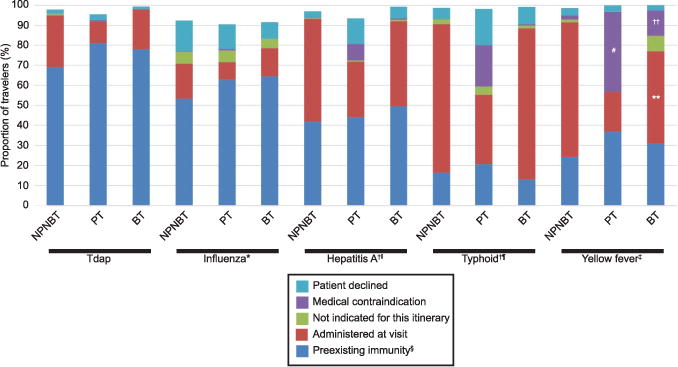
Of 21,138 female travelers of childbearing age in Global TravEpiNet, 170 (0.8%) were pregnant and 139 (0.7%) were breastfeeding. Many traveled to destinations endemic for mosquito-borne illnesses, including malaria (pregnant: 95%; breastfeeding: 94%), dengue (pregnant: 87%; breastfeeding: 81%), or yellow fever (pregnant: 35%; breastfeeding: 50%). Compared with nonpregnant, nonbreastfeeding adult female travelers, eligible pregnant travelers were less likely to be vaccinated against hepatitis A (28% compared with 51%, P<.001) and typhoid (35% compared with 74%, P<.001). More than 20% of eligible pregnant travelers did not receive influenza vaccination. Yellow fever vaccine was occasionally provided to pregnant and breastfeeding travelers traveling to countries entirely endemic for yellow fever (6 [20%] of 30 pregnant travelers and 18 [46%] of 39 breastfeeding travelers). Half of pregnant travelers and two thirds of breastfeeding travelers preparing to travel to malaria-holoendemic countries received a prescription for malaria prophylaxis.
Most pregnant and breastfeeding travelers seen for pretravel health consultations traveled to destinations with high risk for vector-borne or other travel-related diseases. Destination-specific preventive interventions were frequently underused.
研究在美国寻求旅行前医疗保健的成年孕妇和哺乳期旅行者的特征及预防干预措施。
这项横断面研究分析了参与全球旅行流行病学网络的美国旅行诊所中孕妇和哺乳期旅行者(2009 - 2014年)的数据。将育龄期非孕妇、非哺乳期成年女性旅行者作为对照。我们评估了该人群疟疾化学预防和抗生素的处方情况,以及三种与旅行相关疫苗(甲型肝炎、伤寒和黄热病疫苗)的接种情况。我们还评估了破伤风类毒素、白喉类毒素减少量和无细胞百日咳及流感疫苗的使用情况,因为这些疫苗在孕期被广泛推荐。
在全球旅行流行病学网络的21,138名育龄期女性旅行者中,170名(0.8%)为孕妇,139名(0.7%)为哺乳期妇女。许多人前往蚊媒疾病流行的目的地,包括疟疾(孕妇:95%;哺乳期妇女:94%)、登革热(孕妇:憨87%;哺乳期妇女:81%)或黄热病(孕妇:35%;哺乳期妇女:50%)。与非孕妇、非哺乳期成年女性旅行者相比,符合条件的孕妇接种甲型肝炎疫苗(28%对比51%,P<0.001)和伤寒疫苗(35%对比74%,P<0.001)的可能性较小。超过20%符合条件的孕妇未接种流感疫苗。对于前往黄热病完全流行国家的孕妇和哺乳期旅行者,偶尔会提供黄热病疫苗(30名孕妇中的6名[20%]和39名哺乳期妇女中的18名[46%])。准备前往疟疾高度流行国家的旅行者中,一半的孕妇和三分之二的哺乳期妇女接受了疟疾预防处方。
大多数因旅行前健康咨询前来就诊的孕妇和哺乳期旅行者前往的目的地存在虫媒传播或其他与旅行相关疾病的高风险。针对特定目的地的预防干预措施经常未得到充分利用。